

Turkey revives one-week repo auctions
9 minutes ago
The share of Russians who say the political situation in their country is tense or critical has climbed to 70% - the highest in a quarter of a century, according to a recent poll by independent pollster, the Levada Centre.
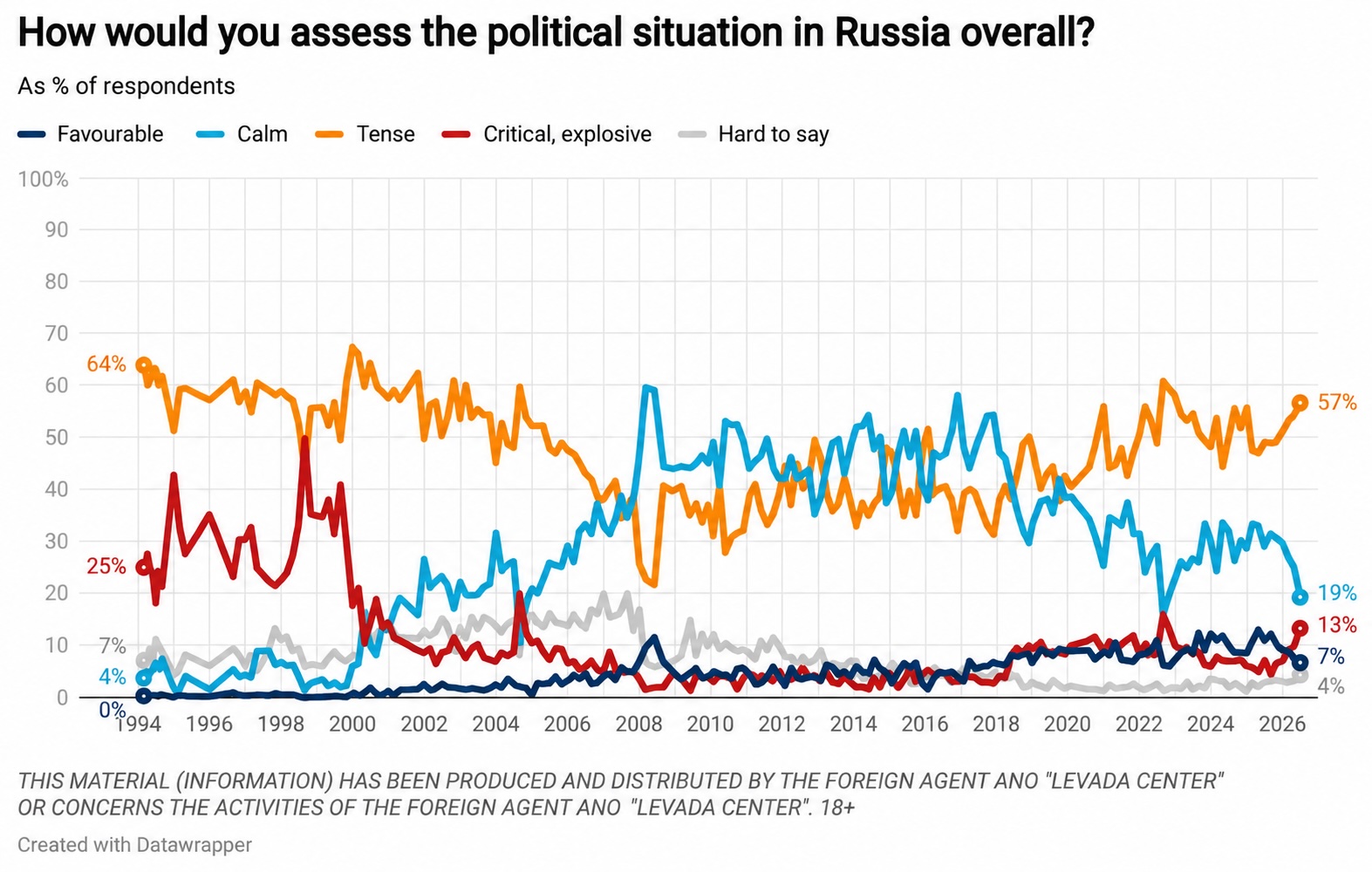
"How would you assess the political situation in Russia overall?", % of respondents. Source: Levada Center.
Levada's latest reading puts 57% of respondents in the "tense" column and a further 13% at "critical, explosive", against 19% who call the situation calm and 7% who describe it as favourable. The tense share is the highest since 2000; the calm share is within a couple of points of the series low.
"The share of Russians who say the political situation is calm or positive is decreasing lately, the share of Russians who say it's tense or even critical is rising," noted Janis Kluge, a German researcher who tracks the Russian economy, flagging the update on August 22.
Levada has asked the same question since 1994, which makes it one of the few instruments capable of showing anything through Russia's wartime information controls. What it shows is a public mood that has been deteriorating steadily since the middle of 2024 and that has now given back the entire improvement of the post-2008 years.
Through the 1990s "tense" ran between 50% and 68% and "critical" spiked above 40% during the 1998 default; the two collapsed together as oil money arrived, and by the mid-2010s "calm" was the majority answer. The February 2022 invasion knocked "calm" down to around 17% before it partially recovered. This year it has fallen back again, without an invasion to explain it.
Timing gives the numbers weight they would not otherwise have. Russia votes for a new State Duma in September, and while the outcome is not in question, the campaign is being run against a background of stalled growth, a fuel crisis, drone strikes on shopping warehouses and a budget deficit the government has already had to accommodate. IntelliNews reported in May that the sands are shifting under United Russia's feet even as the party's win stays certain, citing the same Levada series.
None of this is a measure of support for the war or the president, and Levada does not present it as one. It is a measure of how people describe the weather. What it says is that after four and a half years in which Russians were told the war was distant and the economy was fine, a growing majority have stopped describing their own country as a calm place - with Putin himself putting growth at about 1% this year.
The IntelliNews PRO service includes access to reports, exclusive market data, and more news that decision-makers care about. Stay ahead of the market with IntelliNews PRO.
Sign Up Now


_1787576584.jpg)
