


Russians describing their politics as tense hits 57%, the highest reading since 2000
1 hour ago
The global fertility rate has fallen below the replacement rate for the first time as a Demographic Crisis gathers momentum that will see the world’s popoulation shrink in size from here.
A new paper called "Terra Incognita: The Economics of a Shrinking World" by Jesus Fernandez-Villaverde of the University of Pennsylvania and Patrick Norrick of Northwestern University, prepared for the Annual Review of Economics and circulated this month, concluded: "As of 2026, humanity is likely below replacement fertility. That has never happened before, not in wars or pandemics."
The replacement rate is usually quoted as 2.1 births per woman, which is the figure for a rich country with low child mortality; globally, the authors put it nearer 2.20 to take into account the higher mortality rates in poor countries - and the world's own fertility rate is now at roughly that level. The UN's central projection still has the crossing two decades away.
If Fernandez-Villaverde and Norrick are right, world population peaks at about 9bn around 2056 and then falls, "first slowly, then fast". The UN's medium variant has it rising to about 10.3bn into the mid-2080s. That is not a rounding difference; it is thirty years and 1.3bn people, and it is the difference between a problem for someone else's career and a problem for this one.
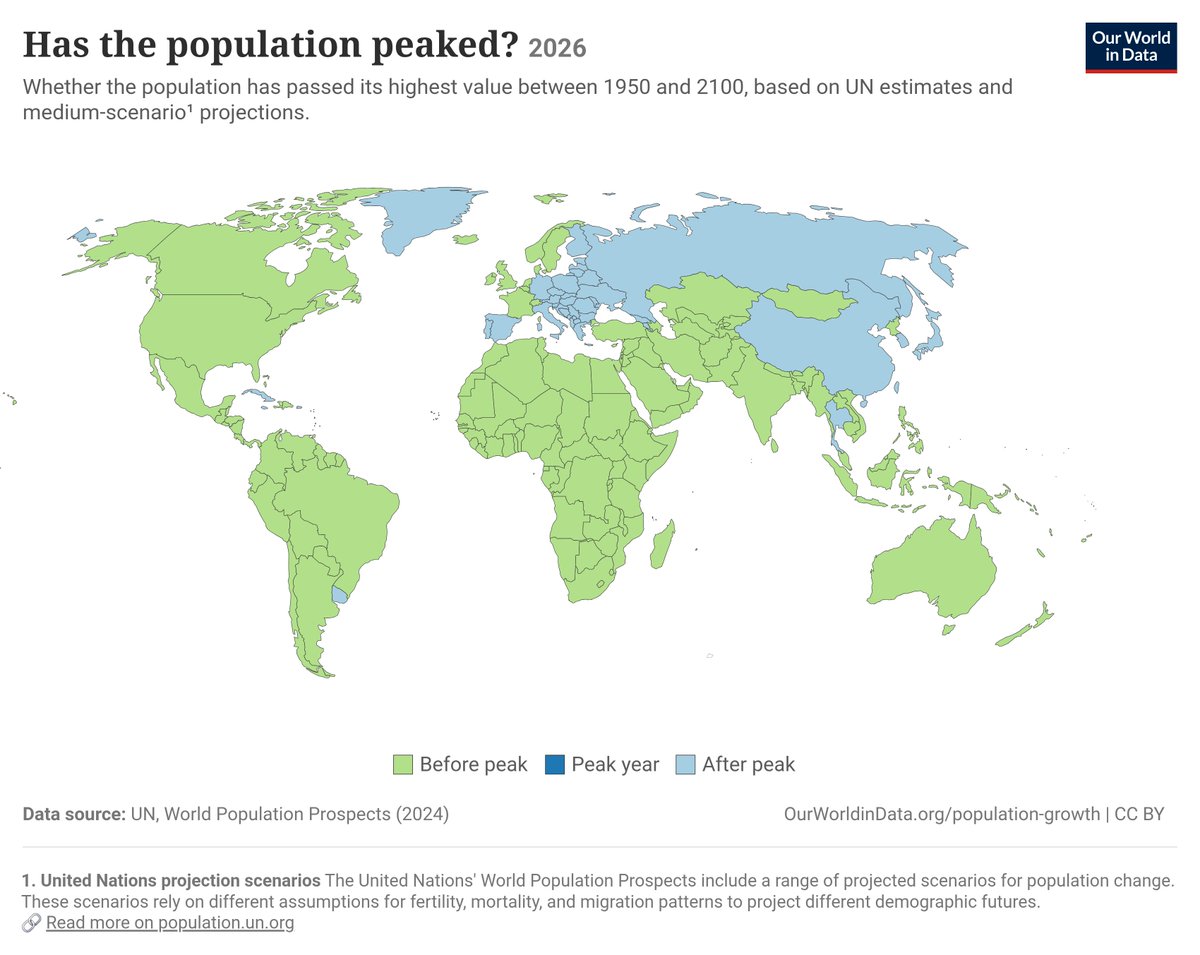
Countries shaded blue have already passed their population peak. Source: Our World in Data, from UN World Population Prospects (2024).
Their evidence is that the decline has stopped being a rich-world story. Fitting a single-factor model to 236 countries since 1950, the authors find the common component peaked in 1978; what is driving fertility down now is country-specific, and of those country trends 219 are negative and not one has levelled off. The steepest falls are in low- and middle-income countries and among poorer, less-educated women - the groups every projection assumed would keep the average up. In recent data, 37 countries recorded about 1.65mn fewer births than the UN had projected, a shortfall of 9.3%.
No standard explanation fits. The authors run through several candidates - income, housing costs, childcare, women's education, urbanisation - and conclude none accounts for the pattern, offering instead a conjecture: modernity itself, which makes a third child expensive and childlessness cheap. IntelliNews has tracked the same phenomenon through the baby bust that crept up on everyone and the demographic point of no return as the number of women of child-bearing age is now in decline.
Singapore, where money did not help
Singapore is the control group for every theory that says people would have more children if they could afford them. One of the most prosperous countries in Asia, its total fertility rate has crashed: it fell to 0.87 in 2025, a record low, from 0.97 in 2024 and 1.24 a decade ago.
"This is a significant drop," Deputy Prime Minister Gan Kim Yong told parliament, warning that the citizen population is projected to start shrinking by the early 2040s without new measures. "Over time, it will be practically impossible to reverse the trend." The government has committed close to S$7bn ($5.5bn) to marriage and parenthood incentives in the 2026 financial year but live births have already dropped below 30,000 for the first time.
Marriages fell 6.2% in 2025 to 24,687. Citizen population growth has slowed from 0.9% a year between 2015 and 2020 to 0.7% last year, even with immigration. Singapore becomes a super-aged society this year, with 21% of its people over 65.
The rest of the region is on the same path. Asia's fertility rate fell to 1.9 in 2024, below replacement, with Seoul, Shanghai and Hong Kong at record lows; Japan reported a tenth consecutive annual fall in births; South Korea's rate rose for a second year and is still around 0.8, among the world's lowest.
Ukraine’s demography in collapse
Ukraine is at the other end of the scale. Not only is it at war with Russia, even before the conflict started it was facing a mounting demographic crisis driven partly by the lack of prosperity: Ukraine has long been the poorest or second poorest nation in Europe.
The war has made everything worse. Average male life expectancy in Ukraine has collapsed to a catastrophic 57.3 years, according to Andriy Druzenko, co-founder of the country's first volunteer mobile hospital, in a figure circulated by former presidential press secretary Iuliia Mendel. "Mobilisation with us is up to 60," Mendel noted. "That is, a man dies - and he still had 2.5 years left to serve."
If the figure is right, it puts Ukrainian men roughly where Russian men were at the worst moment of the post-Soviet collapse. Russian male life expectancy fell from 64.2 years in 1989 to 57.6 in 1994, driven by alcohol, cardiovascular disease and violent death among men aged 20-59, and it took the country the better part of two decades to climb back. The demographic hole that opened then is the one Russia is still trying to fill with cash incentives and patriotic messaging.
That is Ukraine's future problem, arriving early. A cohort of men who are not there in twenty years is a cohort that does not work, does not pay tax and does not father children, and the rebuilding Ukraine is counting on assumes people to do it. The country's population has already collapsed as the war wipes out generations, and it entered the war with among the worst demographics in the world.
Russia, Ukraine, China, Japan, South Korea and most of Europe are already past their peak, as the map above shows. On Fernandez-Villaverde and Norrick's numbers, the world joins them in thirty years - which, as IntelliNews has argued, is also a reason to expect more wars rather than fewer.
The IntelliNews PRO service includes access to reports, exclusive market data, and more news that decision-makers care about. Stay ahead of the market with IntelliNews PRO.
Sign Up Now

_1787576584.jpg)

