


South Korea VS China in the race for a commercial Arctic trade route
5 hours ago
The United States’ ambassador to Turkey and Syria envoy has said that Israel’s strike on a Syrian airbase may have been an election ploy by Prime Minister Benjamin Netanyahu as he continues to face a chorus of opposition after years of war with several countries.
Recent election polls indicate a dramatic shift in support for Netanyahu and his closest hard-right coalition partners; Barrack’s latest uncensored remarks could potentially be a sign of a growing distance between the Trump administration and the Israeli premiership after the quagmire of the ongoing Iran war which continues to this day with Tehran not budging on its closure of the Strait of Hormuz.
Tom Barrack, who is the US special envoy for Syria in addition to his ambassadorship in Turkey, in a rare public rebuke criticised the Israeli raid on the Abu al-Duhur military air base in north-west Syria on August 18.
"We are deeply concerned that the confirmed Israeli airstrikes on Abu al-Duhur Airbase constitute an unnecessary escalation that does not advance regional stability," Barrack wrote on social media platform X (previously Twitter).
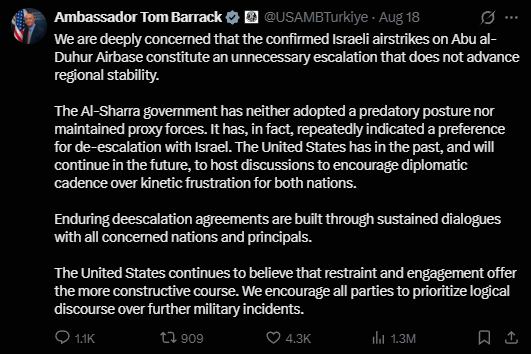
Barrack has stepped up open criticism of Benjamin Netanyahu in recent days, indicating Donald Trump agrees with his positions.
New Israeli-Turkish spat
That strike was close to the Turkish border and the operations centre of the Turkish military in Syria, who have taken an increasing security presence since the new regime backed by Ankara came into power.
The Israeli Prime Minister's Office claimed in a press statement that the base was targeted because Turkish troops were being allowed to deploy there, thereby threatening Israel’s security, yet Barrack asserted that this was an unfounded claim.
“Israel repeatedly warned Syria that such a deployment would pose a threat to Israel's security. Syria chose to ignore these warnings,” the statement from the Prime Minister’s Office read. “Israel will not tolerate threats to its security, and would welcome a return to the status quo,” it added.
In addition, Israeli newspaper Haaretz reported that Israeli security sources told the US that Turkey was preparing to place a radar at the Abu al-Duhur air base. In addition, Kurdish officials (aligned with Israel on intelligence and generally opposed to Turkey and sceptical of their new Syrian endeavour) claimed that Turkey has been "occupying areas in northern Syria" and was further planning to seize control of areas in the east near the Iraqi border, according to a report from Kurdish sources.
In an interview on X with Mario Nawfal, Barrack said that Israel’s claims about the Turkish military presence at Abu al-Duhur were unfounded, also claiming that Netanyahu may have been “baiting the Turks” in a “very aggressive but well-received pre-election concept”. He also claimed that the alternative reason for the attack may have been “miscommunication” between Netanyahu, the IDF, and Mossad.
Israeli Defence Minister Israel Katz hit back at Barrack, claiming in a post on X that “the IDF recommended several times to carry out the strike at the Abu al-Duhur airfield in Syria, based on the clear intelligence received regarding Turkey's intentions to conduct operations there that would endanger the security of the State of Israel.”
Katz also asserted that Israel contacted the United States before the strike was carried out.
“In parallel, the intelligence information was transmitted to the authorised parties in the United States,” Katz wrote. “After the outreach went unanswered, the Prime Minister and I authorised the IDF to carry out the strike, and it was executed successfully.”
“Erdogan was caught red-handed and was forced to back down.”
Upcoming Israeli elections
While Barrack and the Israeli government appear to be at an impasse regarding the Turkish military presence at the air base, Netanyahu’s election campaign remains a crucial topic that proves difficult to ignore.
On October 27, Israelis head to the polls to select their next national government. While Netanyahu’s Likud party had long been the frontrunner in election polls by Israel’s major polling companies, Gadi Eisenkot and his Yashar party have rapidly caught up to Likud in recent weeks.
According to a poll of polls compiled by state broadcaster Kan 11, if one tracks election polling from the start of 2026 to August 23, Likud is the most popular party with 26 mandates, while Yashar comes in second with 17.4 mandates. The Israeli parliament has 120 seats. When looking at the last three months ending August 23, the gap closes significantly, with Likud at 24.6 mandates and Yashar at 21.4.
Over the last month, Yashar has come close to surpassing Likud, with Eisenkot’s party averaging 23.2 mandates while Netanyahu’s Likud led narrowly with an average of 24.2. During the week ending August 23, however, all this changed. Eisenkot leapfrogged Netanyahu for the first time, with Yashar averaging 24.2 mandates while Likud stood at 24.
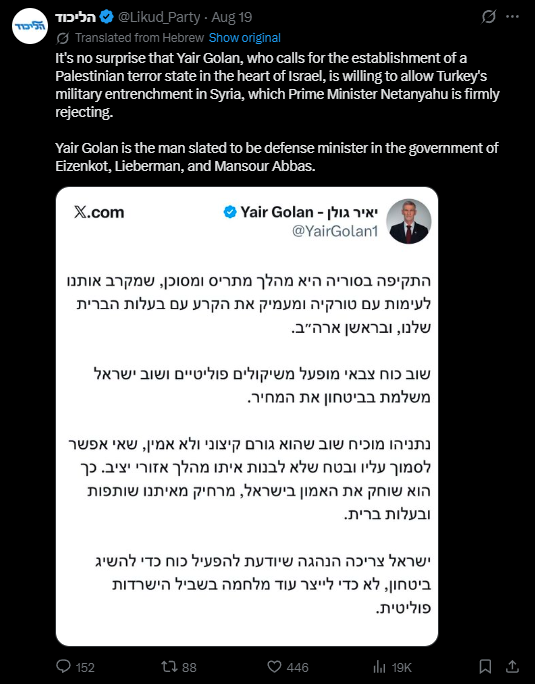
Social media posts from the Linkud Party in recent days have stepped up efforts to fend off critics inside Israel.
With questions still being asked in Israeli society about the security failures behind the Hamas attacks on October 7, 2023, Netanyahu has since sought to reestablish his image as the expert on Israeli security, especially when compared to other candidates who do not have the same governing experience.
While Israel’s subsequent military campaigns against Hamas in Gaza and Hezbollah in Lebanon have been largely viewed as effective in Israeli society, the Iran war has dragged on and infuriated the US leadership and electorate, with many Trump supporters firmly placing the blame on Netanyahu's call to strike and kill Supreme Leader Ali Khamenei, assuming the Islamic Republic system would collapse. That duff intelligence, which led to the ongoing war, has deeply damaged Netanyahu's brand across the US political spectrum and could become his undoing as support for others grows.
The Israeli prime minister is also feeling the effects of his coalition both domestically and internationally, particularly when it comes to the outspokenness of National Security Minister Itamar Ben-Gvir and the ultra-Orthodox parties which continue to seek military draft exemptions for the ultra-Orthodox population.’
As for arch-rival Eisenkot, his broadly centre-right appeal and security track record as the former IDF Chief of Staff give him a broad appeal among potential Likud voters and those in the opposition bloc who find themselves on both the centre-left and centre-right of the political spectrum.
Furthermore, unlike Netanyahu, Eisenkot maintains warm relations with other major candidates, including the right-wing Naftali Bennett and Avigdor Lieberman, as well as the left-wing Yair Golan, all of whom are staunch members of the anti-Netanyahu bloc.
Eisenkot has also not ruled out working with members of the Netanyahu coalition, including the ultra-Orthodox parties, meaning his pathways to forming a governing coalition of at least 61 mandates appear broader than Netanyahu's.
While Barrack’s claims against Israel regarding Turkey’s military presence in Syria remain unfounded, it is not outside the realm of possibility that Netanyahu could be looking to establish Ankara as a new enemy, thereby distracting Israeli voters from other potential issues that may see his election campaign fall by the wayside.


