


Russia's economic plan is hitting its targets, but growth is still only 1%
1 hour ago
Nepal has completed its first IMF-supported programme in almost two decades, ending it with inflation down to 1.7%, more than a year's worth of import cover in reserve and a fiscal deficit it can defend.
Inflation averaged 7.7% in fiscal 2022-23, when the reform effort began. In the first half of fiscal 2025-26 it ran at 1.7%. Gross foreign exchange reserves rose from about nine months of prospective imports to more than twelve, the primary fiscal deficit narrowed sharply, and public debt was kept at low risk of distress.
"Nepal's economy is much more stable today than it was when the reform effort began in 2022," said Sarwat Jahan, the IMF's mission chief for Nepal, in an interview published on August 19 in the Fund's own Country Focus series.
The interesting thing about this programme is not that it worked but that it survived. Nepal went through repeated changes of government, a major earthquake, catastrophic floods and a wave of social unrest while it was running, and any one of those has been enough to derail an IMF arrangement elsewhere. What held it together, on Jahan's account, was that the policy anchor did not move even when the cabinet did.
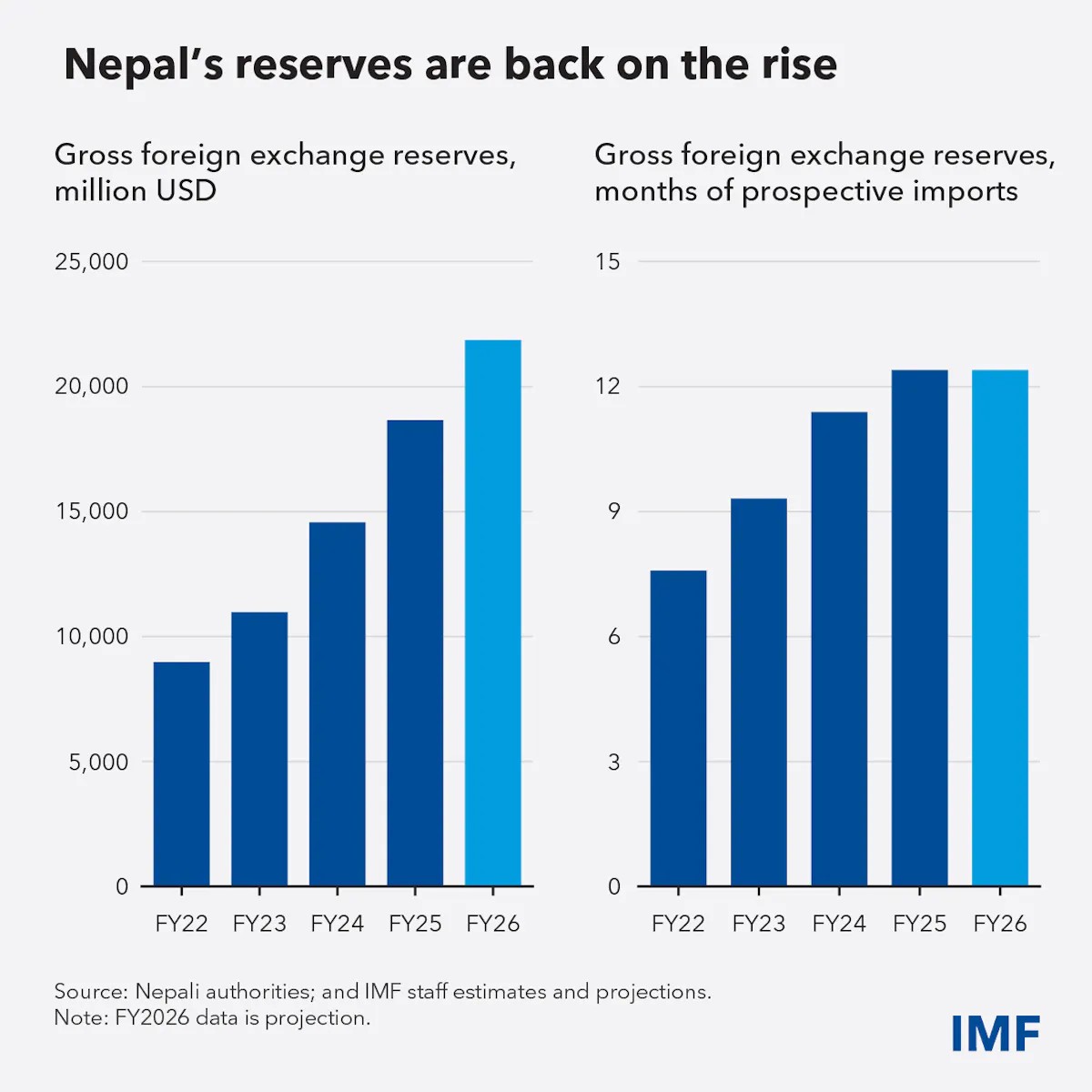
Gross foreign exchange reserves roughly doubled over the life of the programme, to more than 12 months of prospective imports. Source: Nepali authorities and IMF staff estimates and projections; FY2026 is a projection.
Shock after shock
Nepal came into the programme still recovering from the pandemic. A major earthquake struck in 2023, severe floods followed in 2024, and social unrest hit in 2025. More recently, higher energy prices driven by the war in the Middle East added another layer of pressure on an economy that imports almost all its fuel.
"Each shock interrupted the recovery, and together they weighed heavily on job creation," said Jahan. "The experience underlined a hard lesson: resilience must be built in advance. Countries that strengthen institutions and rebuild buffers before a crisis are far better placed to absorb the next one."
The growth series tells that story more plainly than the reform list does. Real GDP growth ran at 5.6% in fiscal 2022, collapsed to 2.0% in fiscal 2023, recovered to 3.7% and then 4.6%, and is projected at 3.0% for fiscal 2026 - each dip lining up with a disaster.
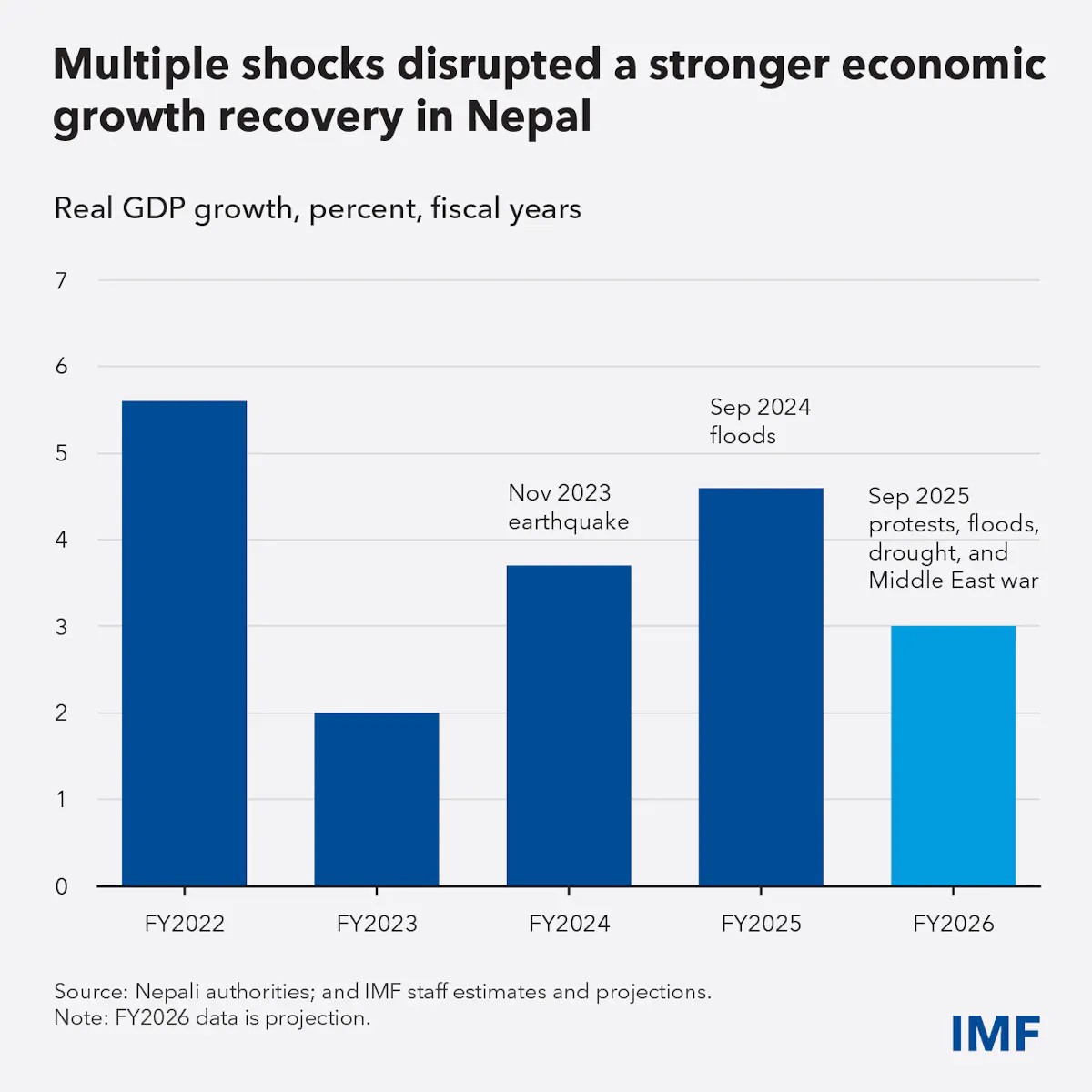
Real GDP growth, percent, fiscal years. Each interruption to Nepal's recovery lines up with a shock: the November 2023 earthquake, the September 2024 floods, and the protests, floods, drought and Middle East war of September 2025. Source: Nepali authorities and IMF staff estimates and projections; FY2026 is a projection.
The reforms nobody sees
The changes Jahan rates most highly are institutional rather than headline-grabbing. Nepal modernised the way its central bank conducts monetary policy and tightened financial-sector oversight, including stronger bank supervision and a review of loan quality.
On the fiscal side it began publishing the financial statements of state-owned enterprises, drew up a revenue mobilisation strategy, and strengthened how public investment is planned and managed. It also upgraded its anti-money-laundering law and moved to reinforce the central bank's governing law and its accountability.
"These reforms improve the quality of economic policy making, and ensure that macroeconomic policies are more effective over time," said Jahan.
Publishing SOE accounts is the one worth dwelling on. In a country where state enterprises have long been a fiscal black box, putting their numbers on paper is the reform that makes every other fiscal reform auditable - and it is the sort of thing that survives a change of government precisely because it is dull.
What is still broken
Jahan's list of unfinished business is longer than the list of achievements. Nepal still needs to raise private investment and generate jobs; parts of the financial system remain vulnerable, particularly the savings and credit cooperatives that serve large numbers of ordinary Nepalis; and the deeper institutional reforms are still in train.
Governance is now the live front. The authorities have started an IMF Governance and Corruption Diagnostic, the Fund's most intrusive assessment of how public money actually moves through a state - a notable thing for a government to invite in a year after social unrest.
"Stability, in other words, is the foundation for growth, not the finish line," said Jahan.
The jobs problem the numbers miss
Low inflation and heavy reserves are, in Nepal's case, partly a symptom of the thing the programme has not fixed. The reserves are so comfortable in large part because remittances from Nepalis working abroad keep arriving, and because a weak domestic economy imports less than a strong one would.
That is the trap the next phase has to break. Jahan's own priorities - private investment, job creation, social protection, financial-sector repair - are all versions of the same problem: an economy stabilised by the money its young people send home from the Gulf and Malaysia rather than by what they could earn at home.
"If reforms continue, Nepal will be well placed to raise living standards, create job opportunities, and withstand future shocks," said Jahan, adding that the IMF would remain a partner as it does so.
The IntelliNews PRO service includes access to reports, exclusive market data, and more news that decision-makers care about. Stay ahead of the market with IntelliNews PRO.
Sign Up Now
_1787239286.jpg)


