

Russians describing their politics as tense hits 57%, the highest reading since 2000
1 hour ago
Russia has sold gold out of its reserves in every month of 2026, and the price it is getting has started to climb again. Central bank holdings fell to 73.2mn troy ounces at the end of July, the lowest level since 2019, after seven consecutive months of drawdowns totalling 1.6mn ounces - 49.72 tonnes, the largest annual disposal in the World Gold Council's records, with four months of the year still to run. As IntelliNews reported, sales are at record levels in July.
What the tonnage figures do not show is what happened to the price while Moscow was selling. On the Bank of Russia's own monthly series, the dollar value of its monetary gold peaked at $402.7bn at the end of January and had fallen to $292.9bn by the end of July - down 27% in six months. Gold set a record above $5,600 an ounce on January 28 and then gave most of it back.
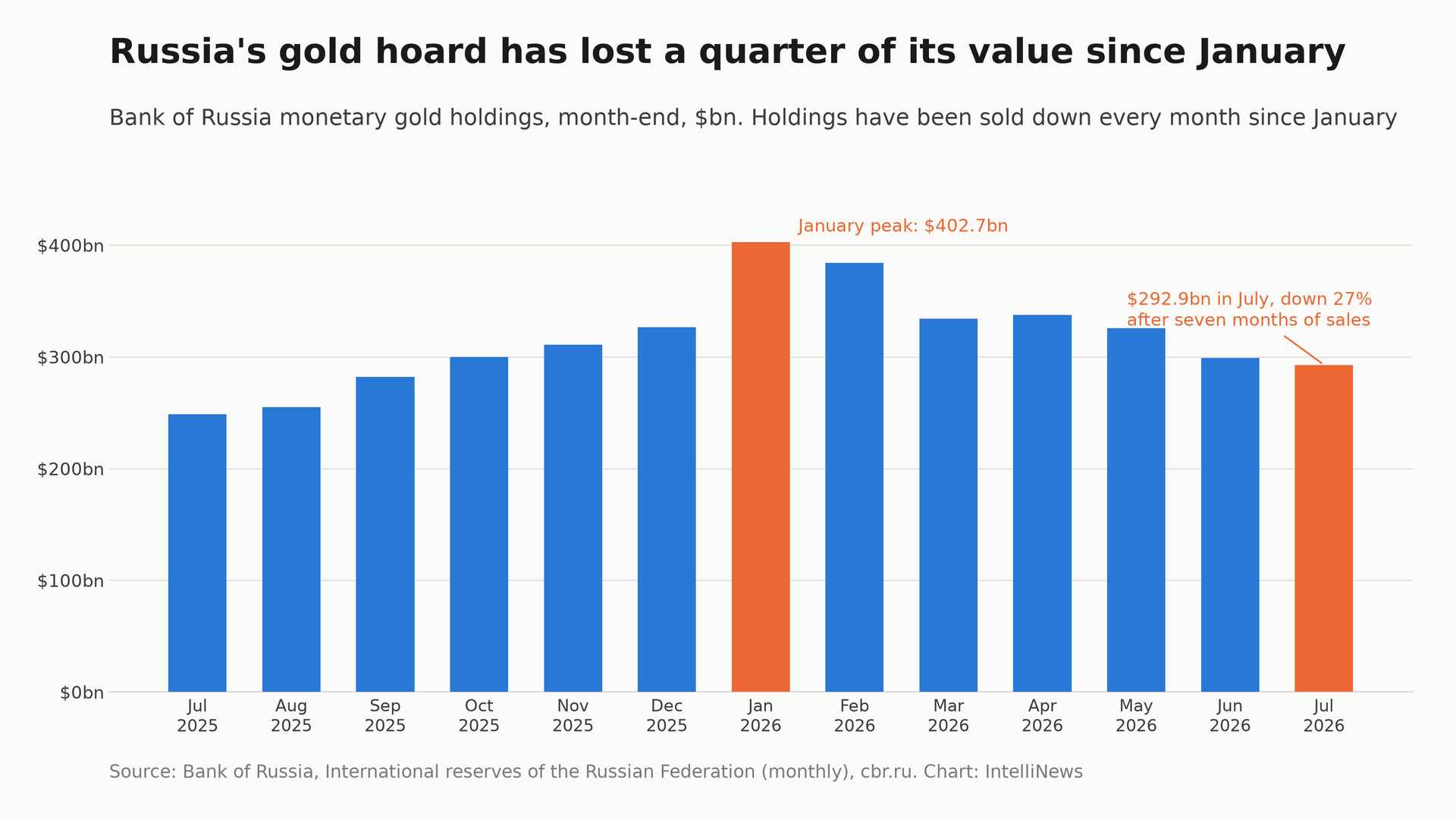
Russia's monetary gold holdings, month-end, $bn. Source: Bank of Russia, International reserves of the Russian Federation (monthly).
Almost all of that $110bn fall is price rather than sales. At January's valuation the 1.3mn ounces sold between February and July were worth about $7bn; the remaining $103bn is simply what happened to gold. A reserve stack that is 40.7% bullion is a bet on one asset, and this year that bet went the wrong way at exactly the moment the budget needed it.
Now it is going the other way. Gold pushed back above $4,700 an ounce in the early hours of August 24, its first time at that level since mid-May, TASS reported, quoting a price of $4,713.8 at 02:30 GMT. Whatever Moscow sells from here fetches materially more than what it sold in July.
Gold was supposed to be the part of Russia's reserves that the West could not reach. Roughly half the central bank's assets were frozen in 2022; the bullion in Moscow vaults was the sanctions-proof remainder, accumulated over a decade precisely so that it would never have to be spent. Total reserves stood at $720.35bn at the start of August, little changed from the $722.4bn recorded in June, but the composition has shifted underneath the headline.
Analysts are split on what the selling means. Elina Ribakova of the Peterson Institute for International Economics has argued that "the very fact that they are selling gold means that they are running out of other, more liquid assets - money". Chris Weafer of Macro-Advisory takes the opposite view, pointing out that gold is among the National Wealth Fund's most liquid assets and that Russia, as one of the world's largest producers, can restock from domestic miners whenever it wants.
The budget pressure is not in dispute either way. Defence spending has more than quadrupled since 2021, Putin has put growth at about 1% for the year, and the government has already lifted its own spending ceiling as the deficit ran past plan. The central bank stopped buying gold in early 2020, when it was the world's largest state buyer. Six years on it is the seller, and the only thing that has improved is the exit price.
The IntelliNews PRO service includes access to reports, exclusive market data, and more news that decision-makers care about. Stay ahead of the market with IntelliNews PRO.
Sign Up Now

_1787576584.jpg)

