


South Korea's top banks post record KRW11.3 trillion profit as household-loan curbs bite
5 hours ago
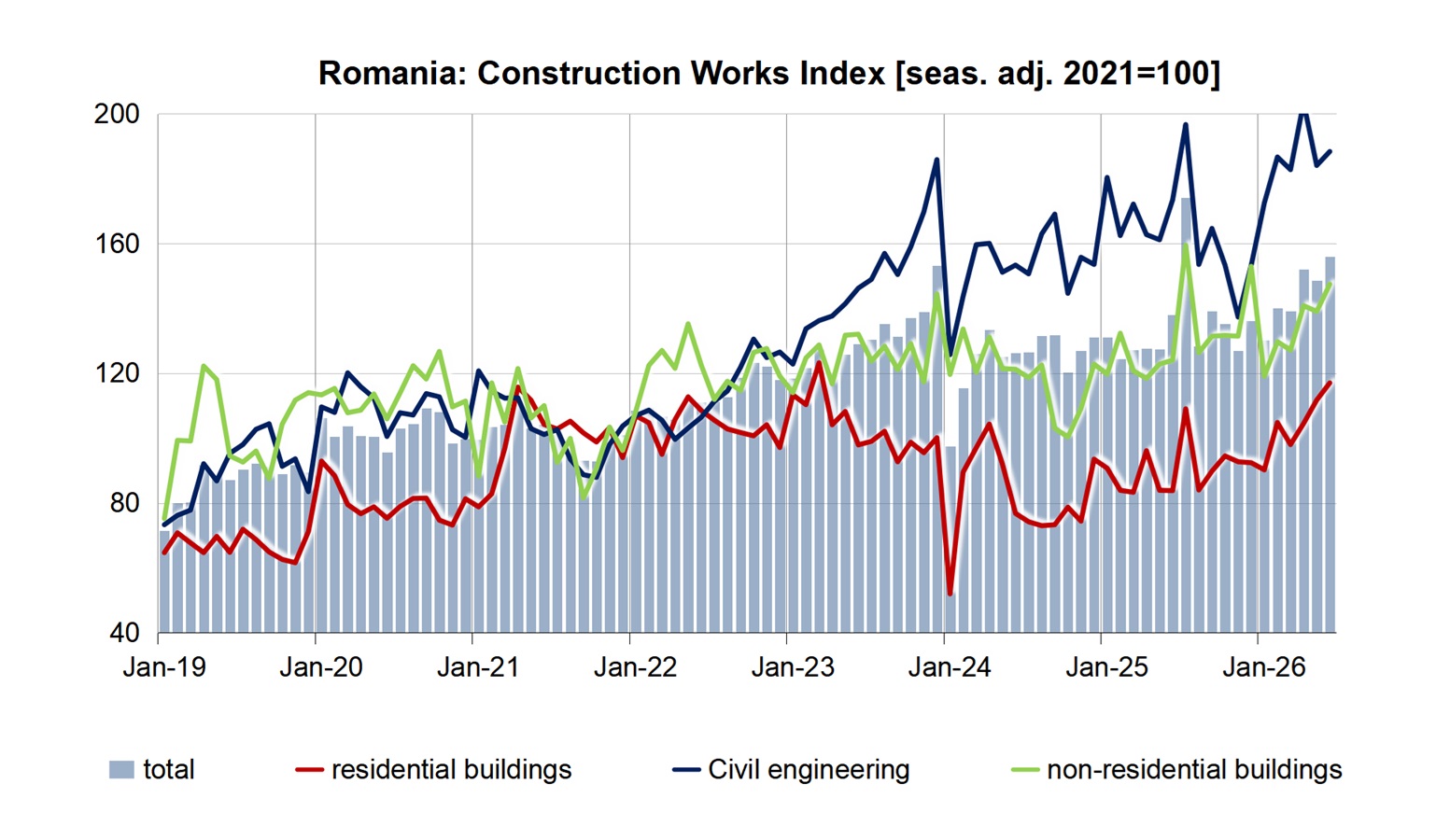
Romania's construction work volume (chart) increased by 18.3% y/y in the second quarter of 2026, accelerating from 7.7% growth in Q1, with new construction projects leading the expansion, according to data published by the National Institute of Statistics (INS).
Work on new projects increased by 21.7% y/y in Q2, ahead of the overall market and signalling stronger activity among developers. New construction also outperformed other segments (current and capital repairs) in Q1, growing 9.1% y/y.
In another breakdown of the market, residential construction was the strongest segment in Q2, with work up 25.9% y/y. Non-residential construction advanced by 15.6%, while civil engineering works increased by 16.9%, all recording double-digit growth.
On a seasonally adjusted basis, construction activity in Romania increased by 11.6% q/q in Q2, driven by a 13.9% q/q rise in new construction.
For the first half of 2026, construction work volume increased by 13.9% y/y, making the sector one of the main positive contributors to economic activity amid a contraction in Romanian GDP. GDP declined by 0.8% y/y, or 1.6% depending on the methodology used, in H1, while Q2 GDP fell by 0.4% y/y, or 2.0% under the two alternative methodologies, following a contraction in Q1.
Construction activity reached new records in Q2, particularly in civil engineering, where projects financed through the EU-funded Recovery and Resilience Facility (RRF) and cohesion programmes have supported activity. The pattern is expected to remain the same in H2.
Residential construction has been recovering for around two and a half years after weakening in 2023 and the first half of 2024 amid higher interest rates and weaker consumer confidence. The recovery strengthened in the first half of 2026, although residential construction remained close to the levels recorded in 2021-2023, standing 7.9% above the 2021 average.
The segment's strong recovery in the first half of this year, besides the above-average performance of the non-food sales, indicates better sentiment among affluent households amid visible budget constraints and bleaker sentiment among households on average.
Non-residential construction was 34.4% above its 2021 average in Q2, while civil engineering activity was 78.8% higher, reflecting the stronger expansion of infrastructure investment.
The IntelliNews PRO service includes access to reports, exclusive market data, and more news that decision-makers care about. Stay ahead of the market with IntelliNews PRO.
Sign Up Now_1_1787285104.jpg)


