


Azerbaijan raises 2026 inflation forecast to 5.7%, trims non-oil growth outlook
7 hours ago
Six years after its first barrel, Guyana has the fastest-growing income per head in the world - and has overtaken the United States on the measure.
The country's GDP per capita has gone from below the global average before oil to more than three times it, Our World in Data said on August 18, drawing on World Bank estimates. The figures are adjusted for inflation and for differences in living costs, so this is not a price effect.
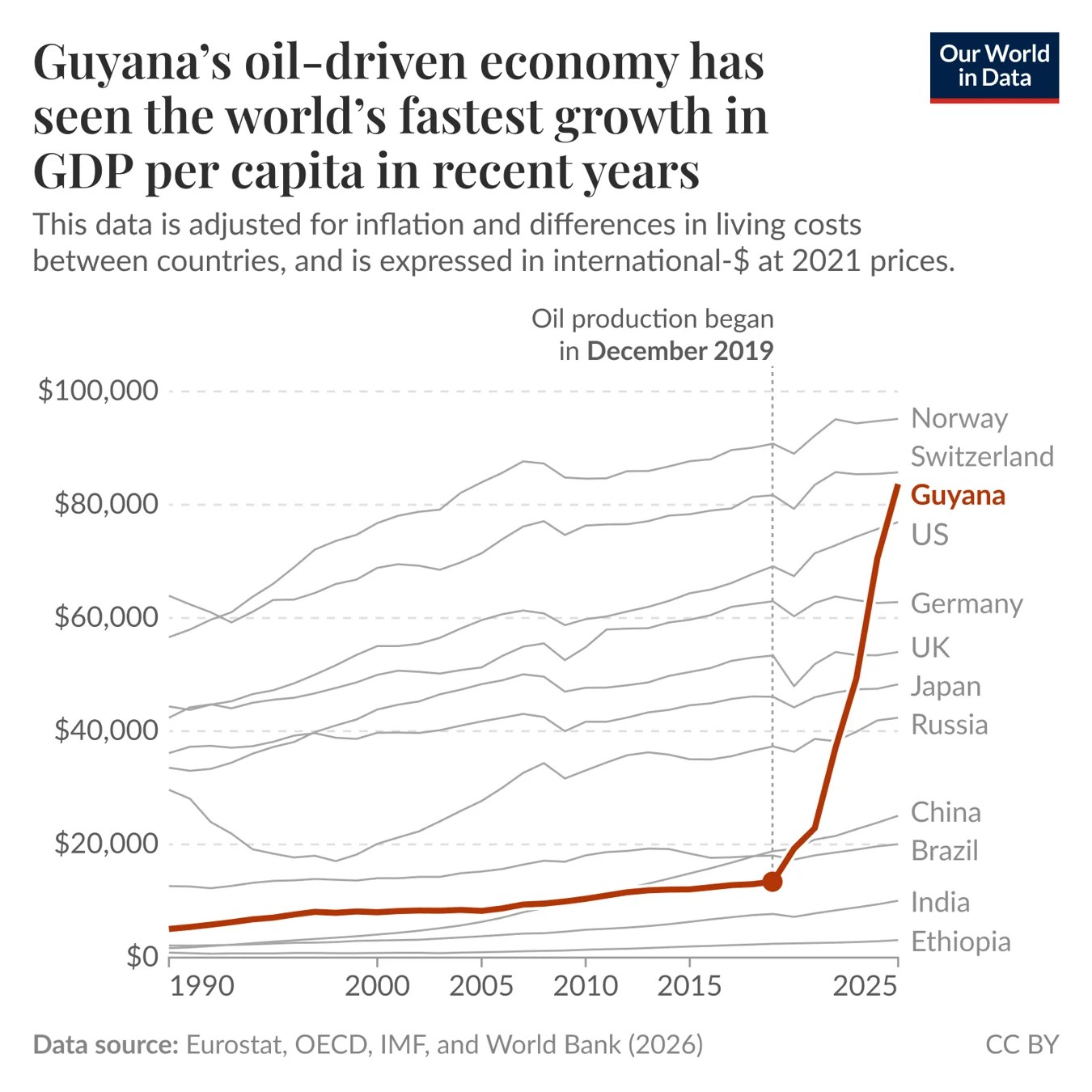
Guyana's GDP per capita against selected countries, international dollars at 2021 prices. Source: Our World in Data, from Eurostat, OECD, IMF and World Bank (2026).
The line on the chart is almost vertical. Guyana tracked flat and low for three decades, sat around $13,000 a head in 2019, and now sits above $80,000 - past the US, past Germany, past the UK, behind only Switzerland and Norway. Oil production began in December 2019 and grew 860% between 2020 and 2025.
This is the fastest transformation of a national income figure anyone has recorded, and it is happening to a country of about 800,000 people. That ratio is the whole story: a Stabroek block that would be a solid regional play in Brazil or Nigeria is, divided by Guyana's population, a per-head number that puts it among the richest countries on earth on paper.
Whether it has reached anyone is a different question. Official poverty estimates have not been published since production started, which makes the honest answer unavailable rather than negative. What can be seen is where the government has put some of the money: cash grants to every adult, free tuition at public universities and higher health spending.
The production runway is long. Guyana was at 645,000 barrels a day in early 2024, all from Stabroek, and the US Energy Information Administration puts combined partner capacity at around 1.3mn b/d by the end of 2027 if the Yellowtail, Uaru and Whiptail projects run to schedule. That would make Guyana the second-largest crude producer in South America after Brazil, from more than 11bn barrels of oil-equivalent recoverable reserves.
The hazards are the familiar ones, and the country has had four years to build institutions that normally take decades. A sovereign wealth fund, a fiscal rule and a non-oil economy that can absorb the spending are the things that separate Norway, at the top of that chart, from the several producers that are not on it at all.
The IntelliNews PRO service includes access to reports, exclusive market data, and more news that decision-makers care about. Stay ahead of the market with IntelliNews PRO.
Sign Up Now


