


MP calls for halt to intelligence reports to Slovenian president over suspected Russia links
1 hour ago
Ukraine has been using UK-made jet drones for deep strikes inside Russia for the past six months, The Sunday Times reported on August 16, citing Ukrainian military sources. The use of UK-made weapons to hit targets deep inside Russia has lead to fears that Russia will retaliate by targetting those British factors as legitimate military targets and strike back.
Ukraine’s using the drones targets have included oil refineries near Moscow and at Volgograd and Yaroslavl, the Kamensky solid rocket-fuel plant in Rostov oblast, and the border city of Belgorod. The main system named is the Nyan, a jet-powered one-way attack drone made by Callen-Lenz, part of BAE Systems' FalconWorks division. A second British type is in use but has not been identified for operational security reasons.
So far Ukraine’s Western allies can argue that they are helping a friendly nation protect itself. But with the use of British weapons against Russia means the Kremlin can now argue that the UK is attacking Russia directly, via its proxy Ukraine and take the drone strikes as an act of war.
Two days later the Russian embassy in London said the use of British drones for strikes deep into Russian territory demonstrates Britain's direct involvement in the conflict, and accused the UK of "deliberately choosing to escalate the Ukrainian crisis while hypocritically claiming that it seeks peace".
Its warning was not subtle: "London's actions will inevitably carry consequences for which it will have to answer. The deeper its involvement in the conflict and the greater its support for Kyiv's terrorist machine, the higher the price it will pay for this," it said, Ukrainska Pravda reported on August 18.
The key question is whether a country whose factories build the weapon that destroys a Russian refinery is still just a supplier, or has become a participant. Britain has been on the outer edge of that distinction since 2022. It is now, by Moscow's own account, over it.
A rounding error in volume
However, the number of drones in use remains small. Britain is not arming Ukraine's drone war in any quantitative sense. President Volodymyr Zelenskiy says Ukraine will produce around 10mn drones this year and could double that with partners; the National Security and Defence Council puts FPV capacity alone above 8mn a year.
Britain's headline contribution, the £752mn package ($1.02bn) announced by Defence Secretary Dan Jarvis on June 18, covers a mere 150,000 drones - and the government's own release is explicit that these are Ukrainian-produced units, bought with the proceeds of immobilised Russian sovereign assets through Britain's £2.26bn ($3.06bn) Extraordinary Revenue Acceleration loan.
So, the widely repeated framing of London supplying 150,000 British drones in a year is wrong twice over: they are not British-made, and 150,000 is about five days of Ukrainian output.
That is what makes the Nyan interesting. Britain's real contribution is not volume, which Ukraine has in abundance, but a specific capability class Ukraine has been buying at ruinous cost - a jet-powered long-range strike weapon that a Nato member has designed, tested and certified.
Cheaper than a missile
The use of the drone falls back to the basic cost-to-kill ratio that is the basis of fighting an asymmetrical war. Have a lot of very cheap drones to overwhelm your opponent’s defences with.
The UK-made Storm Shadow cruise missile that London has supplied Kyiv with in the past, costs somewhere around £1mn ($1.36mn); the Nyan is put at £50,000-£100,000 ($68,000-$136,000). Twenty of them for the price of one missile.
Cheap means numerous, and numerous means swarms - launched in enough volume to saturate Russian air defence rather than evade it one aircraft at a time. On the night of August 17 Ukraine fired over 800 drones at Russia, according to the Russian authorities. That is a different theory of penetration from a cruise missile, and it scales in a way cruise missiles cannot.
Kyiv's defence ministry now measures its strike campaign as a cost ratio, claiming almost $5 of Russian losses for every $1 spent in June. A weapon at a twentieth of the price of the missile it replaces moves that ratio the right way.
Britain's other long-range contribution shows why it needed replacing. Storm Shadow has been delivered in successive batches, but the missile is out of production and the stockpile is finite. Every one fired is gone. The Nyan is a production line.
The range does not add up
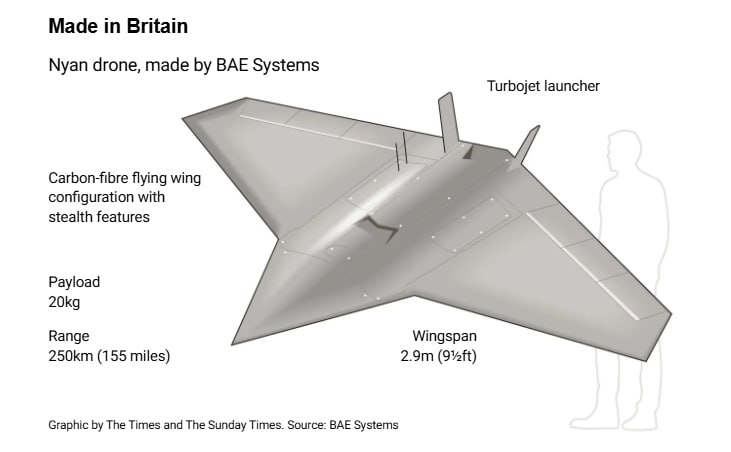
BAE Systems' own published specification for the Nyan, as set out in a Times graphic: a 2.9-metre carbon-fibre flying wing, 20 kg payload, 250 km range. Source: The Times and The Sunday Times, from BAE Systems data.
BAE Systems' own published figures give the Nyan a range of 250 km and a 20 kg payload. Ukrainian military sources briefing The Sunday Times describe British long-range drones flying close to 1,000 km, and the targets named - refineries at Volgograd and Yaroslavl - sit several hundred kilometres beyond a 250 km radius from Ukrainian-held territory.
Experts say, the published 250 km may be a conservative or export-baseline figure, as manufacturer specifications for strike systems often are. The long-range strikes may have used the second British drone type the sources declined to identify. Or the launches happened from somewhere closer than the border - Ukraine has been launching from inside Russia for over a year.
The payload is an issue too. A 20 kg payload is not a refinery-destroying warhead; the Geran-5 that Russia fires the other way carries 90 kg. The Nyan is a precision system that works by hitting the right and irreplaceable valve, not by removing the building. Ukraine’s drones are now increasingly targeting the most sensitive and difficult to repair or replace parts of refineries, a distillation column or a pumping station.
The drone has a carbon-fibre flying wing with stealth features, launched by pneumatic catapult off a rail, powered by a turbojet. It has been trialled on land and at sea, including at Exercise Spring Storm in Estonia and launched from the Royal Navy's experimental vessel XV Patrick Blackett.
What makes the drone good, as opposed to merely cheap, is mostly classified. What such a weapon must defeat is not. Russian electronic warfare jams GPS across most of the country's western approaches and spoofs it where jamming is not enough, so a strike drone needs inertial navigation good enough to hold course without a satellite fix, terrain or scene-matching to correct the drift, and increasingly onboard machine vision to identify the target in the final stretch. That navigation-and-counter-EW stack, developed and certified against a peer threat, is what a Western defence prime supplies that a Ukrainian workshop cannot yet match at scale. Stealth shaping on a flying wing suggests the design also assumes it will be shot at by something better than a machine gun.
The factory problem
The problem is using British drones to strike Russian territory could give Moscow grounds to treat the British factories that make them as legitimate targets.
That is a claim about law and about intent, and it does not require an air raid on Wiltshire to matter. Russia has a demonstrated, cheaper method for reaching British and European industry, and it has been using it for years.
Historian Mark Galeotti's argument, in circulation since the strikes were reported, is that the likelier Russian response is an expansion of the sabotage campaign against Britain and other European countries - attacks on factories, warehouses and logistics infrastructure rather than anything that would trigger Article 5. He also argues the Kremlin does not currently want serious escalation, partly because of Russia's own coming elections, and that the calculation could change after the winter.
The precedent is already established in a British courtroom. Three men were convicted of burning down a London warehouse holding supplies bound for Ukraine, in an arson prosecutors said was directed by Russian intelligence - one of more than 70 Russia-linked incidents across Europe since 2022. MI5 director general Ken McCallum has described Russian services as pursuing "sustained mayhem on British and European streets", and a cross-border investigation has documented how recruits for it are hired online across the Baltics and Poland.
A drone factory in southern England is a softer target than a Nato airbase and carries none of the same consequences.
The bases are already built
Russia's own long-range drone infrastructure has grown to the point where the reciprocal threat is no longer hypothetical either. Ten new bases with 59 launch rails have gone up along the Ukrainian and Belarusian borders, built for Geran-4 and Geran-5 jet drones with a range close to 1,000 km - enough, on one analysis of the satellite imagery, to reach Poland, Turkey, Estonia, Lithuania, Latvia and Romania. And the Oreshnik powerful intermediate-range ballistic missile show cased in January by the Kremlin can hit pretty much any city in Europe from Moscow.
The first Russian missiles are already reaching EU territory – purportedly “by mistake.” A Russian Shahed-type drone hit a residential building in Romania in May; another crossed into Moldova in July; an explosive-laden drone was found near a Ukrainian cargo plane at Leipzig airport this month. German army chief Christian Freuding has said it is Nato-agreed intelligence that Russia could be ready to move against a member state as early as 2029.
Nato's planners, meanwhile, admit they have not seriously studied the scenario that worries them most - a coordinated Russian move in Europe alongside a Chinese move on Taiwan. Florence Gaub of the Nato Défense College: "Let's just say this is the scenario we're currently not ready for."
Britain has been here longer than most
None of this is a departure for London. Britain signed a naval deal with Kyiv before the full-scale invasion, in 2021, financing Ukrainian missile-boat production and port work at a point when most European capitals were still weighing whether to sell Ukraine anything lethal at all. Months earlier HMS Defender sailed through waters off Crimea that Russia claims as its own and was buzzed and, by Russian account, fired near - the sharpest direct Anglo-Russian military confrontation of the period.
Since 2022 Britain has been consistently first: first with main battle tanks, first with long-range cruise missiles, and now first with a Nato-built deep-strike drone. It has also signed a military assistance treaty with Poland, tying itself further into the eastern flank.
The Nyan is the logical end of that trajectory rather than a break in it. What has changed is that the weapon is cheap enough to use often, which means the British name will now be attached to Russian industrial damage on a weekly basis rather than a quarterly one - and that is the variable Moscow's threats are actually responding to.
The IntelliNews PRO service includes access to reports, exclusive market data, and more news that decision-makers care about. Stay ahead of the market with IntelliNews PRO.
Sign Up Now


