

Turkey revives one-week repo auctions
5 hours ago
Russia's federal budget deficit reached RUB6.45 trillion ($78bn, or 2.8% of GDP) in the first seven months of 2026, already more than the RUB5.63 trillion shortfall recorded across the whole of 2025, according to Finance Ministry data.
The July figure widened the year-to-date gap by around RUB0.7 trillion. The narrowing recorded in June, when the cumulative deficit briefly fell back, proved to be a blip rather than the start of a new trend — the sort of month-to-month wobble that the cumulative series produces routinely and that should not be read as a turn.
By the end of July 2025 the deficit stood at RUB4.62 trillion. It is now 39.7% wider. And because December is always the heaviest spending month in the Russian budget calendar — the December step has added between RUB1.6 trillion and RUB4.0 trillion to the annual deficit in each of the last four years — the full-year outturn will land far above where the year-to-date figure now sits.
The oil problem
The deficit is not primarily a spending story, though spending is rising. Total expenditure over January-July came to RUB28.57 trillion, up 14.5% year on year. That alone would be manageable. The difficulty is on the revenue side, and specifically in the oil and gas column.
Oil and gas revenues over the same seven months were RUB4.59 trillion, down 16.8% on 2025 and down 32% on the RUB6.78 trillion collected in the first seven months of 2024. Two years of erosion have removed roughly a third of the single most important revenue line in the Russian budget.
What has kept the headline revenue number from falling is everything else. Non-oil-and-gas revenues rose 18.3% to RUB17.52 trillion, enough to lift total revenues 8.8% to RUB22.11 trillion despite the hydrocarbon decline. The budget is being carried by domestic taxation — and by an economy running hot on state spending, which is itself part of what the deficit is financing.
Stripping the hydrocarbon revenue out entirely gives the clearest measure of the underlying position. The non-oil-and-gas balance stood at minus RUB11.05 trillion by July, against minus RUB10.14 trillion a year earlier.
Expenditure has already reached 66.6% of the 2025 full-year total in 58% of the year. If spending holds to that pace and the oil and gas line does not recover, the 2026 deficit will comfortably exceed anything recorded since the pandemic year of 2020.
One caveat on the monthly numbers: the Finance Ministry revises. Contemporary reporting put July's widening at RUB724bn, while the current published series implies RUB706bn — the difference is a revision to the June figure made after the July release. Month-on-month moves in this series should be treated as provisional until the following month confirms them.
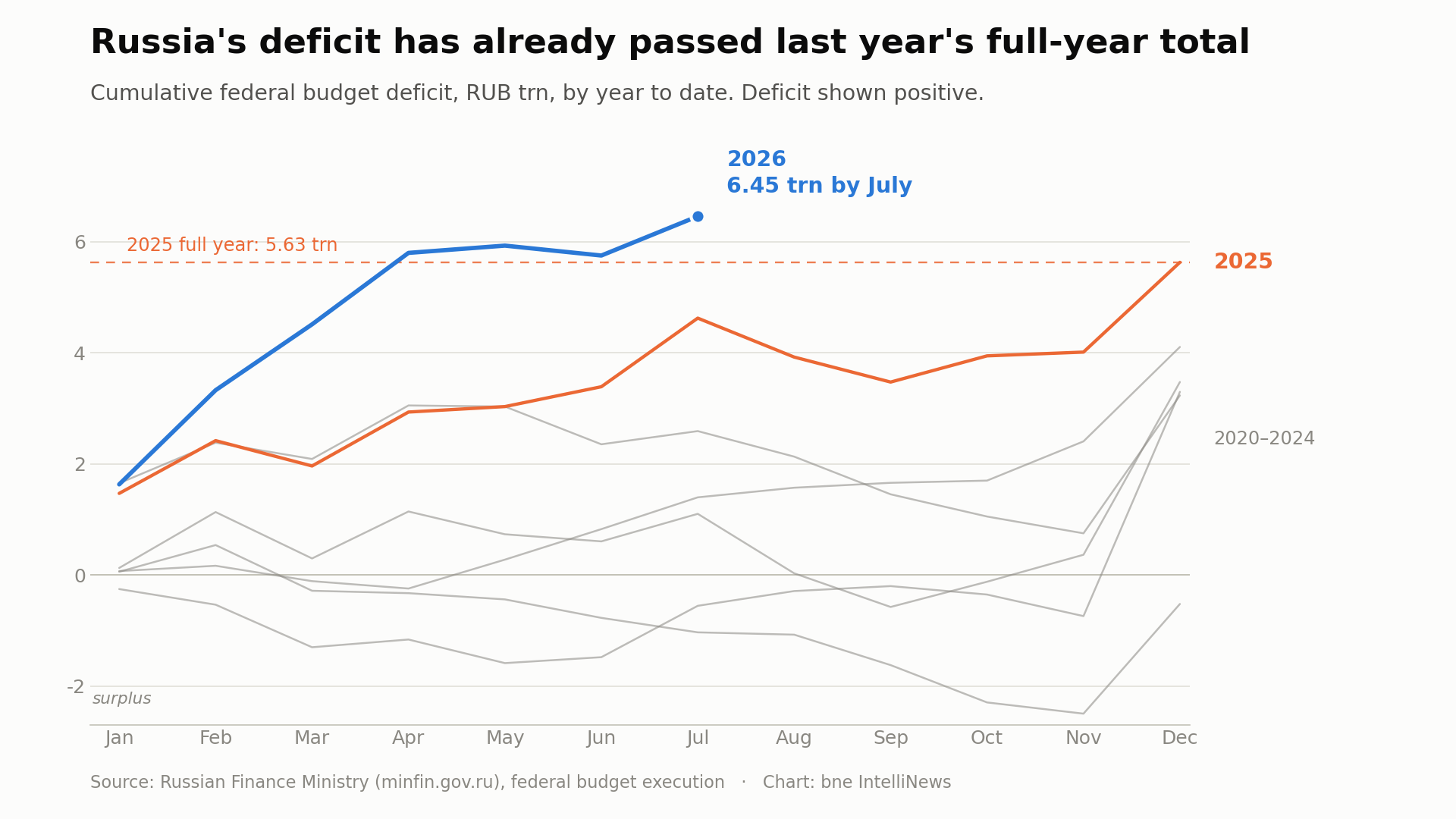
Cumulative federal budget deficit by year to date, RUB trn. Source: Russian Finance Ministry.
Federal budget, January-July, RUB trn
| 2024 | 2025 | 2026 | Change y/y | |
| Total revenues | 19.75 | 20.33 | 22.11 | +8.8% |
| of which oil and gas | 6.78 | 5.52 | 4.59 | -16.8% |
| of which non-oil and gas | 12.98 | 14.81 | 17.52 | +18.3% |
| Total expenditure | 20.85 | 24.95 | 28.57 | +14.5% |
| Budget balance | -1.10 | -4.62 | -6.45 | -39.7% |
| Non-oil-and-gas balance | -7.88 | -10.14 | -11.05 | -8.9% |
Source: Russian Finance Ministry, federal budget execution, cumulative January-July. Figures held in the bne statistics database (stats.db, source Minfin_budget, monthly from 2011) and cross-checked against the bne MinFin tracking sheet, which agree exactly on every month.
The IntelliNews PRO service includes access to reports, exclusive market data, and more news that decision-makers care about. Stay ahead of the market with IntelliNews PRO.
Sign Up Now


_1787576584.jpg)