 Kyiv Blog
A fresh corruption scandal broke out in Ukraine – this time, it was racketeering by relative junior members of the Zelenskiy administration. Corruption is not a problem of the system in Ukraine; corruption is the system.
Ukrainian President Volodymyr Zelenskiy’s deputy head of staff, Iryna Mudra, has been arrested and found to have assets of just over $6mn and together with a dozen other high officials, connected to Bankova, to have been running mafia-like racketeering schemes. Before I go on, I should point out that the fact they have been caught, arrested and charged is something of a revolution in Ukraine, but nevertheless, it also highlights how fundamentally corrupt the government of Ukraine is.
Russia is famously corrupt, but I don’t think people realise just how much worse it is in Ukraine. When the war started, the foreign ministries called their embassies for advice and were warned by those that actually lived and worked in Kyiv to be very careful. There is a reason why Ukraine, which has significant resources – agricultural, metals, manufacturing, excellent human capital, etc, and is one of the biggest retail markets in Europe – has been the poorest or second poorest (after Moldova), country in Europe for all of the last three decades. Any money available gets stolen.
Superficially it looks much better than Russia as, unlike Russia, it has a vibrant civil society thanks to two coloured revolutions. And the elections are more or less real. But on the economic front Ukraine is still in the stone ages and even the heroes of Orange Revolution were rotten to the core (with the big exception of Viktor Yushchenko, who they tried to kill).
The way it works is Ukraine’s the lack of progress in setting up institutions and the dysfunctional courts drives corruption. Leaders give deputies lucrative posts that control cashflows and they are expected to help themselves. The hold of the leader becomes his ability to take that job away, which ensures loyalty. The weakness of the legal system and the irrelevance of elections allows deputies to steal with impunity and they are not accountable to public opinion.
Ex-Orange Prime Minister Yulia Tymoshenko was an early media star with her trademark hair braid and seen as a “firebrand” democratic leader. In Ukraine she is more widely known as the “gas princess” as she is believed to have stolen some $350mn while she was minister of gas. After the Euromaidan Revolution of Dignity was over and she was let out to jail, where President Viktor Yanukovych put her, the crowds were happy to see her released but had no interest in seeing her back in power. To highlight the point she has also recently been fingered by NABU in its latest vote buying investigations. She was caught on camera with huge bundles of dollars that she uses to get votes through the Rada.
Yanukovych is even more old school and stripped-mined the country while he was president. He is accused of nicking a third of the country’s hard currency reserves – some $35bn – that has never been recovered. His Mezhyhirya Residence is famously a palace where amongst the many trappings of wealth was a loaf of bread made out of solid gold – and even that has been stolen in the meantime; no one knows where it is.
I had personal experience of this. While in Odesa, Yanukovych had dinner at a very famous restaurant there and liked it so much he decided to take the restaurant over. The owner was a friend of a friend in Kyiv who told me he came to lobby Bankova to back off. He was offered half the value of the restaurant and took it. “Getting half of its value was a pretty good deal under Yanukovych as usually he just takes what he wants and pays nothing.”
Ukraine became a true mafia state under Yanukovych – a label usually reserved for Russia.
He was ousted and replaced by former President Petro Poroshenko who was a bit better, but even Poroshenko remains an oligarch, having earned billions from his Roshen chocolate empire. He was supposed to put all his assets into trust after taking office and never did it – maintain business and sales in Russia even after the 2014 annexation of the Crimea and eventually ended up in the Panama Papers leak.
He wasn’t as bad as Yanukovych – I’d say the only leader worse than Yanukovych in the Former Soviet Union (FSU) in the last 30 years was probably Turkmenbashi, the late leader of Turkmenistan – but while he did make some reforms, the old system was alive and well.
One of the good things he did was appoint Lithuanian born ex-investment banker Aivaras Abromavičius, who worked for Sweden’s East Capital and married a local and was appointed Economics Minister. Abromavičius, who I know personally, was the real McCoy and one of the few high ups with real international investment banking experience and could actually spell “corporate governance.”
Abromavičius made a real stab at cleaning things up and, for example, closed down a scheme where uber-oligarch Ihor Kolomoisky, and Zelenskiy’s business partner and election sponsor, had injected a “trading company” between the state oil company Ukrnafta and state procurement that was charging 15% for any deal, but did nothing else. That deal was worth tens of millions of dollars a year.
However, eventually Abromavičius gave up and quit in spectacular fashion with a public press conference on February 3, 2016 where he accused the Poroshenko regime of endemic corruption.
"My team and I have no wish to be a cover for open corruption or puppets under the control of those who want to establish control over state money in the style of the old authorities," he said at the presser. "I don't want to be part of this free-for-all… but we have to wake up from lethargic sleep. I don't think things will change quickly.”
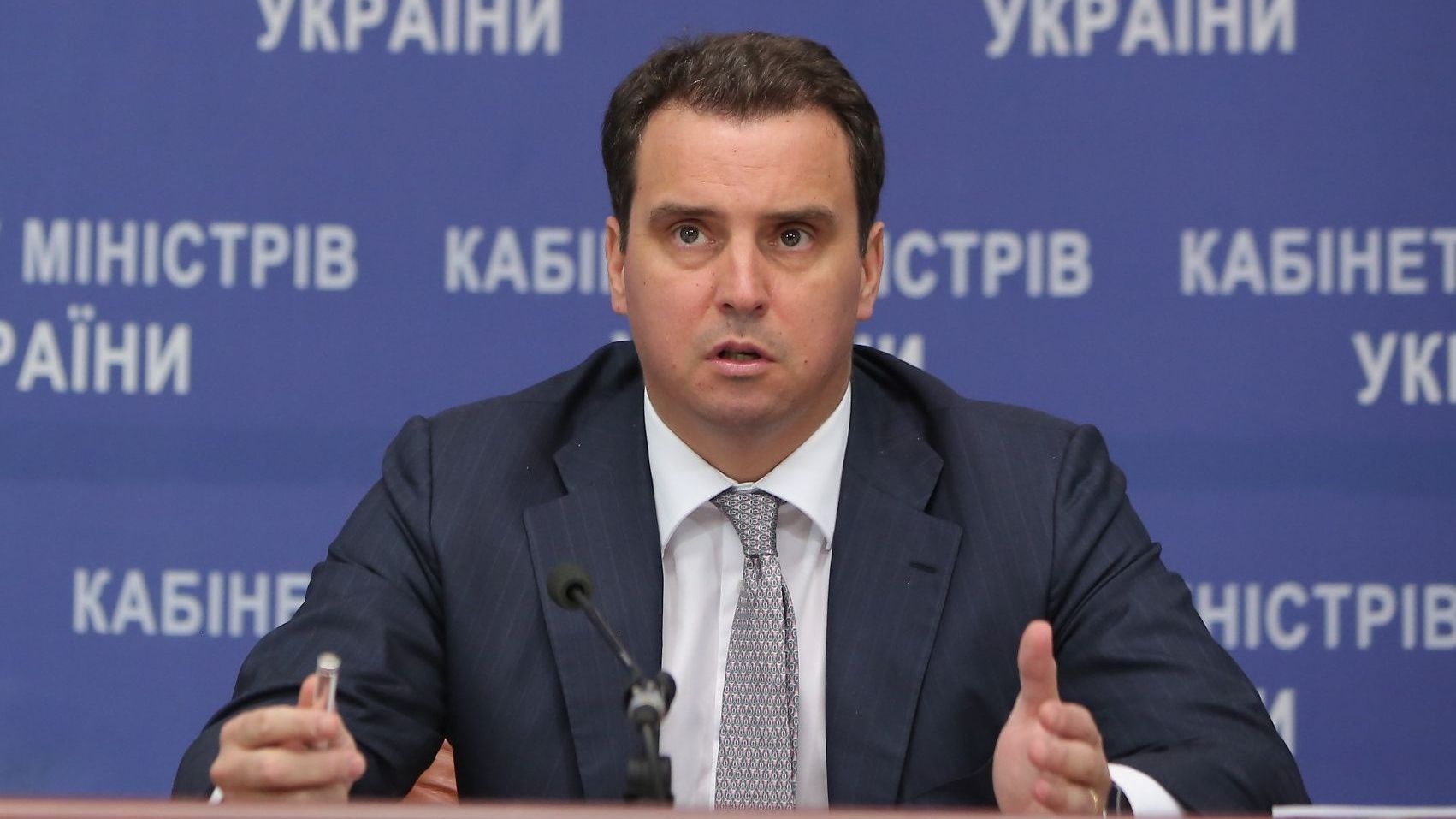
Investment banker Aivaras Abromavičius was appointed Economics Minister until he quit in 2016 with a press conference complaining about endemic corruption in the Poroshenko administration.
The problem he explained to me was Poroshenko tried to appoint a deputy to the head of a ministry department making procurements and control its cashflow; as minister, Abromavičius was supposed to be in charge of all appointments in his own ministry and was trying to oust these placemen as a key part of his anti-corruption efforts. His press conference caused a major political crisis as it completely undermined Poroshenko’s efforts to get the EU and US on board in his escalating war with Russia, which was in the process of splitting the Donbas off from the government’s control.
Some progress
Still, despite all this, some real progress has been made in selected directions. First of all, to note that the creation of the triumvirate of the National Anti-Corruption Bureau of Ukraine (NABU), the Specialized Anti-Corruption Prosecutor’s Office (SAPO) and the Anti-Corruption Court (ACC) – forced on Ukraine by its western partners – is a revolution. Nothing like this exists in any of the other FSU states.
Tellingly, Poroshenko couldn’t stop the creations of NABU and SAPO, but successfully blocked the creation of the ACC for years. And NABU has itself been stymied by the powers that be for years; when it arrested its first big fish, Poroshenko's right-hand man Roman Nasirov in 2017, and charged him with embezzling millions of dollars he spent a weekend in jail. However, before the judge arrived to arraign him on Monday morning, a delegation of Rada deputies showed up along with Nasirov’s wife who brought a bag containing a million dollars to pay his bail – scenes that have been repeated in the last month with high officials close to Zelenskiy coming up with millions of dollars for bail in the Energoatom corruption scandal. Not only did NABU never get Nasirov in front of the bench, he went on to run against Zelenskiy in the 2019 elections.
But the triumvirate is real and has real powers. In what is now widely taken as a sign that Zelenskiy administration is little different from all the others, he tried to close them down last year with Law 21414 in an obvious authoritarian style: the Rada deputies were ordered back from summer holiday at the weekend and the three votes were rammed through in one sitting that would have put the two agencies under direct presidential control. It was a move worthy of Putin, but thanks to Ukraine’s vibrant civil society, demonstrations immediately broke out and Zelenskiy was forced to back down and cancel the law. NABU is now on a roll and actually arresting people from the very top of the tree.
Maybe the most significant change is Kolomoisky has been arrested and is in jail. One of IntelliNews claims to fame is our cover story “Privat Investigations” that uncovered the rampant stealing at Ukraine’s largest commercial bank, caused it to be nationalised in December 2016.
The banking sector has been comprehensively cleaned up by former NBU governor Valeria Gontareva, but she decided to leave the country after Kolomoisky threatened her life and had a coffin with her effigy delivered to the doors of the NBU. She was later hospitalised in London after being hit by a car in what UK police have called “suspicious circumstances.”
Oh, and her house in Kyiv was burnt to the ground by “unknown” arsonists.
But maybe the biggest success has been the reforms at Naftogaz, the state-owned gas company. Corruption in the gas business in the 1990s was insane. Ukraine was transiting huge amounts of gas from Russia to Europe and earning $3bn a year in transit fees, not counting the money that could be made from stealing Russian gas from the pipes. Everyone had a hand in this – Russian government officials, Ukrainian government officials, the board members of Gazprom and Naftogaz. It was the major gravy train at time, organised via another set of “trading” companies that did nothing.
And it was so blatant. I once sent our Romanian correspondent to the “office” of Eural Trans Gas, one of the main traders doing several billion dollars of business a year. The office turned out to be an empty apartment in a rundown block in Transylvania where neighbours said no one lives. I also interviewed the CEO of Itera, Igor Makarov, the Russian gas trading company in this partnership, who plays gold in his office with a solid gold putter, which he showed me. One of the reasons Ukraine is so poor is that this gas business, which should have funded investment, was bled dry by Ukraine’s own elite and the Russian executives.
That has stopped now. Naftogaz is a well-run business and where it used to be a black hole supported by massive budget grants, it is now the biggest taxpayer in the country. The fact that Zelenskiy appointed Serhii Koretskyi the new Prime Minister is really good news. He is not a politician, but an oil and gas man and comes to his new job from running Naftogaz. He is as close as you can get in Ukraine to a clean and professional pair of hands in charge of one of the country’s biggest sources of cash.
So, there is hope. But there is so much work left to do. The judiciary remains rotten to the core. Brussels downgraded Ukraine to a “B” in its last EU accession bid assessment report precisely because of the lack of progress in the anti-corruption fight and judicial reforms in the so-called “Fundamental” cluster.
Zelenskiy was elected in 2019 on an anti-corruption platform, and compared to oligarch Poroshenko, he was clearly a cleaner pair of hands. And he has taken that pledge seriously, at least until the war started three years in. He broke ties with Kolomoisky and even put him in jail. He forced through the anti-Kolomoisky law in May 2020 that made it impossible for the former owner of a bank that has been nationalised to retake control of it – aka PrivatBank. He then followed up with an anti-oligarch speech in March 2021 and anti-oligarch law in September 2021 which has redrawn the map.
But he made almost no progress on reforming the judiciary or beefing up property rights, without which Ukraine has no hope of attracting the circa $600bn of private capital it needs to rebuild. To be fair he has been distracted by fighting a major war against Russia, but he can also be accused of turning a blind eye to the blatant racketeering by deputies who he shares an office with.
Personally, I think it’s because everyone in Ukraine is so inured to corruption they don’t see it as a major problem. A common attitude I have heard in Kyiv is: “If you can, of course you steal. Why not? I would.”
This article originally appeared in Editor’s Picks, a free daily email digest of bne IntelliNews’ best stories from the last 24 hours. Sign up for free here.
https://to989.infusionsoft.com/app/form/editors-picks-subscribers
Don’t just follow the news—understand it.
The IntelliNews PRO service includes access to reports, exclusive market data, and more news that decision-makers care about. Stay ahead of the market with IntelliNews PRO.
Sign Up NowRelated Content


_1784042854.jpg)
Most Read
About Kyiv Blog
Reflections from our correspondents on the ground in the Ukrainian capital.