

Serbia to hold snap election on October 18 or 25, president says
3 hours ago

The attack came a day after Russian missiles made a day time attack on a major shopping mall in Ukrainian President Volodymyr Zelenskiy’s hometown of Kryvyi Rih full of shoppers and then struck it a second time in a double-tap strike designed to kill as many civilians and first responders as possible.
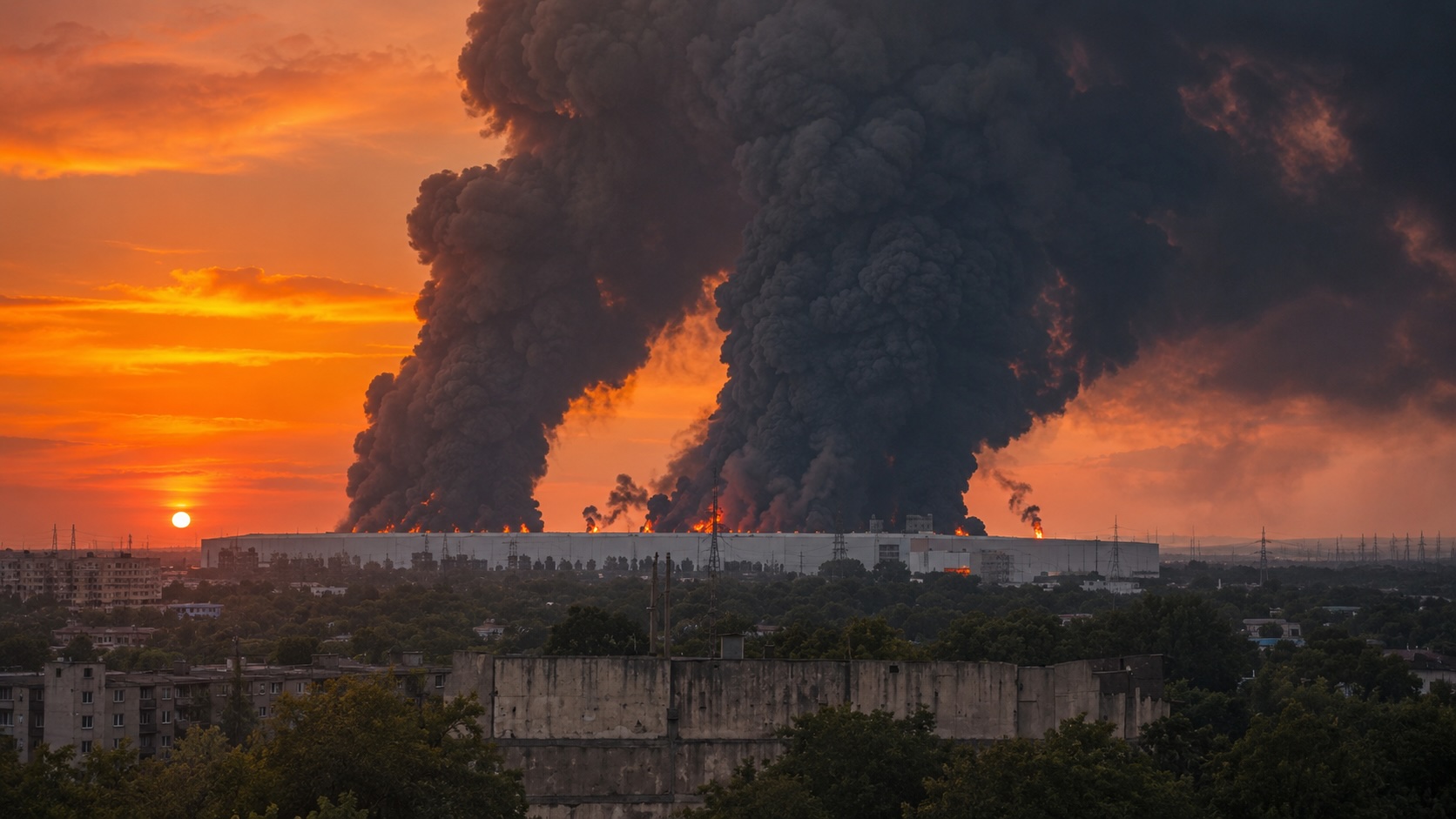
The Ozon logistics hub at Chapayevsk, Samara region, burning after the drone attack of August 22. Source: social media imagery, AI-enhanced.
Ukraine attacked Ozon, Russia’s second largest e-commerce platform, for the first time as the warehouse war between the two countries continues to escalate.
The logistics hub at Chapayevsk is the largest warehouse complex in the Volga region and cost around RUB5bn ($60mn) to build. Ozon said the fire forced it to evacuate hundreds of staff following the attack in the early hours of August 22.
"We evacuated more than 500 employees within a few minutes," the company's press service said.
Four people were injured, an emergencies service spokesman told TASS. One was in a critical condition after jumping from a second-floor window and was undergoing surgery.
Samara governor Vyacheslav Fedorishchev said several dozen drones had been shot down or intercepted and confirmed damage to "one of the industrial facilities", with several people receiving medical treatment. The same wave hit the Novokuibyshevsk oil refinery, which can process about 8mn tonnes of crude a year, and the Azov Sea port of Yeysk, the Kyiv Independent reported.
The Armed Forces of Ukraine (AFU) had avoided targeting Ozon until now, concentrating its fire on its larger rival Wildberries. Since mid-July it has struck at least 23 Wildberries sites, wrecking up to a third of that company's warehouse space and leaving its sellers with losses running into billions of dollars as part of the Operation Wildberries campaign. Pulling Ozon into the is an attempt to upgrade the fight from an attack on one of Russia’s most successful companies into a strategic blow against Russia’s economy by degrading its retail sector. The two platforms between them handle 77% of Russian online retail - Wildberries on 45%, Ozon on 32%.
Ukrainian President Volodymyr Zelenskiy has justified the attacks by claiming that in addition to coffee machines and shoes, Wildberries also sells military products such as drones and body armour, amongst other things, making it a legitimate military target. The wider logistics campaign has gone after warehousing since July used to move dual-use electronics, communications kit and drone components in bulk.
Ozon had seen the strikes coming. One of its warehouses was hit earlier this month, in what was assumed at the time was a targeting mistake as a Wildberries warehouse was located only 500m away and was untouched. Ozon ordered urgent installation of fire-protection systems on warehouse roofs across Russia after the Wildberries hits began, Ukrainska Pravda reported.
It is a costly moment for a business that had been the sector's strong performer. Ozon (MOEX: OZON) swung to a net profit of RUB15bn ($181mn) in the first half on revenue up 47% year on year, and its shares had already fallen in sympathy with Wildberries during the earlier rounds of strikes.
Russia's marketplaces have asked the state to cover their drone losses, and the central bank has urged lenders to ease loan terms for firms caught in the Wildberries attacks. Neither route puts a roof back on a warehouse.
Kryvyi Rih double tap
Sixteen people were killed when Russian drones struck a shopping centre in Kryvyi Rih, then struck it again while rescuers were working in the wreckage. A second drone hit on the Sunny Gallery mall in Kryvyi Rih half an hour after the first, killed dozens catching firefighters and medics already inside the building.
More than 130 people were hurt in the afternoon attack of August 21. Twenty-three of the wounded were children, regional governor Oleksandr Hanzha said, and 29 people were in a serious condition, five of them children. Nine were still listed as missing on the morning of August 22, two of them children, as crews cleared rubble.
Oleksandr Vilkul, head of the city's defence council, said it was a jet-powered Shahed-type machine flying at very low altitude, the Kyiv Independent reported.
"An absolutely cynical and vile strike was carried out by the Russians against an ordinary shopping centre in Kryvyi Rih," President Volodymyr Zelenskiy said on Telegram, calling the timing of the second drone a deliberate attempt to hit emergency services. "Those bastards. We will definitely respond."
Kryvyi Rih is Zelenskiy's home city, which gives the attack a symbolic edge. Danish household goods chain JYSK lost its Kryvyi Rih store in the strike. None of its staff were hurt, its Ukrainian chief executive Yevhen Ivanytsia said, describing the attack as deliberate.
"More than a hundred people have been injured, there are fatalities, including children. There are no words," Ivanytsia said, Ukrainska Pravda reported.
Russia makes regular use of the double-tap strategy, designed to kill first responders and terrify the population. Michael McFaul, the former US ambassador to Russia, called the attack an act of “terrorism” in a social media post, which was also roundly condemned by European Commission President Ursula von der Leyen and comes a day before Ukraine celebrates its Independence Day.
Retail destruction
Both sides have adopted similar strategy of moving from targeting military-industrial targets to attempting to destroy the retail infrastructure ahead of winter to make life as hard as possible to regular citizens.
Russia has also been trying to systematically destroy Ukraine’s retail infrastructure hitting not only warehouses and supermarkets in Ukraine, but in the last few weeks also destroying logistics, transport and distribution centres in an effort to collapse the sector, with some effect.
Supermarkets in Kyiv were running out of food at the weekend as not only were goods destroyed by Russian missile strikes, but even those goods and warehouses that survived have been unable to deliver them to shops after distribution centres were levelled by persistent Russian drone and missile strikes.
As IntelliNews reported, in retaliation for the first attack on Wildberries’s Moscow logistics centre and that end of July, Russia has disproportionately replied in kind, also targeting the biggest supermarkets and logistic companies like Nova Poshta.
While Ozon and Wildberries are significant players in retail, accounting for about 15% of the entire retail sector turnover, the attacks will only have a limited impact on the Russian economy. Wildberries sales run into the billions of dollars, and are equivalent to just under 3% of GDP, but that is only an equivalence. As the store is a distributor and not a producer of goods, its actual contribution to the economy is very limited – a few tenths of a percent of GDP, say experts.
Wildberries' gross merchandise value - the total worth of goods traded across the platform - has been put at around 2.85% of annual Russian GDP. But that is a measure of the flow of goods, not the value the company itself adds; most of that value is generated by the manufacturers, wholesalers, sellers and logistics providers whose products move through it and who have taken a real hit as their inventories were destroyed and not covered by insurance. Wildberries changed its insurance policies to exclude loss from drone strikes in June.
Economists also point out that sales Wildberries can no longer handle do not vanish - they migrate to rival platforms like Ozon or to physical retailers, so a portion of the loss is redistribution rather than destruction. The reconstruction of the destroyed warehouse does add value to the economy and mitigate part of the hit that the destruction has done. At a meeting of the “Third Rome” presidential advisory council on August 21, Russian President Vladimir Putin promised state aid to rebuild Wildberries’ logistics and hinted that state funds might be made avail to compensate the sellers that have lost their goods in the fires.
Wildberries is still trading with ten major logistics centres badly damaged of which seven have been totally destroyed from a network of around 20 centres in all nationwide.
While the economic consequences for Russia are limited, the Russian response is a lot more damaging. Ukraine has focused on only one, albeit it large and important, company. Russia’s retaliation is much broaded and stretches beyond stores and warehouses to include the entire retail network down to, and including, the systematic destruction of petrol stations.
Staples like buckwheat, potatoes and fresh dairy have gone missing from Kyiv's supermarket shelves, the first broad food shortages the capital has seen since the opening weeks of the 2022 invasion.
A Russian ballistic missile attack on August 5 wrecked distribution centres serving several of Ukraine's biggest grocery chains, and the gaps have widened as replacement stock has failed to arrive.
Amongst the leading supermarkets, two Silpo distribution centres were hit, killing six of the chain's employees. Novus lost a logistics centre - the second time that site has been targeted - which the retailer described as the heart of its entire network. Rozetka, Ukraine's largest online marketplace, had a warehouse handling more than 100,000 orders a day completely destroyed.
Fora stores have taken to putting cards on empty shelves reading "Russia destroyed this product", the Kyiv Independent reported. Barley, rice, greens, meat, pasta, flour and even baby formula have also become in short supply or vanished.
"A lot has definitely changed. There are not enough vegetables, not enough fruits, pasta, or flour," Inna, a 60-year-old merchandiser shopping in the capital, told The New York Times (NYT).
The physical machinery of Ukrainian consumption - the depots, the cold stores, the order-fulfilment sheds – are now in the crosshairs rather than the shops themselves. Both sides have worked out that a distribution centre is a softer, cheaper and more disruptive target than a factory.
Shoppers in Kyiv have already been forced to move to smaller retailers and to the summer farmers' markets, and the chains say they expect to be restocked by August 24, Ukraine's Independence Day.
However, what will happen when winter sets in remains an open question. Russian President Vladimir Putin clearly intends to attempt to freeze Ukraine into submission again and some experts say the current bombing of the retail infrastructure is a foretaste of a campaign that will only intensify as the mercury falls. Warehousing takes months to rebuild, the strikes have not stopped. Grocery networks running without spare distribution capacity has no margin left the next time a missile finds a depot.
The IntelliNews PRO service includes access to reports, exclusive market data, and more news that decision-makers care about. Stay ahead of the market with IntelliNews PRO.
Sign Up Now


