_3.jpg)
_3_1788079426.jpg)

Armenian, Azerbaijani leaders agree to advance peace process at Bishkek meeting
38 minutes ago
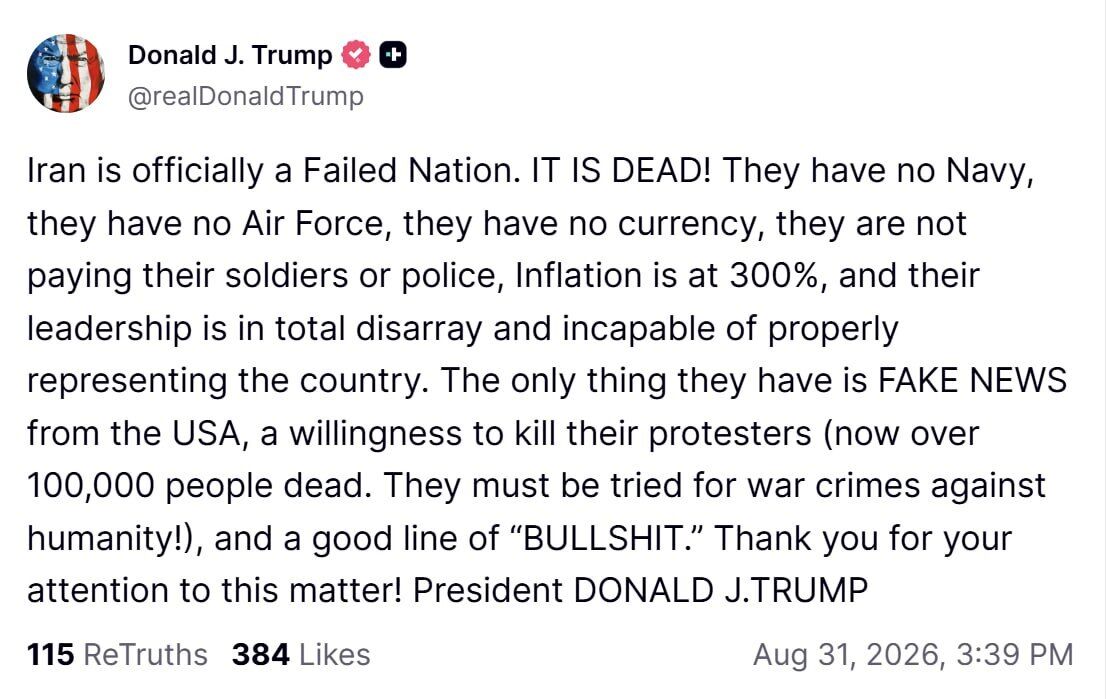
US President Donald Trump said Iran is a "failed nation" and called for its leadership to be tried for war crimes, in a post on his Truth Social platform on August 31.
The outburst sharpens Washington's rhetoric as the two sides trade fresh strikes across the Gulf, hardening the US line at a moment when Iran is courting Shanghai Cooperation Organisation (SCO) partners in Bishkek for diplomatic cover.
Trump claimed Iran had no navy, air force or currency, that it was failing to pay its soldiers and police, and that inflation had reached 300%. He said the country's leadership was in disarray and incapable of representing it. He also accused the authorities of a willingness to kill protesters, putting the death toll at more than 100,000 people, and said the leadership must be tried for crimes against humanity. He offered no evidence for the figures.
Iran's actual price data falls well short of Trump's claim, though inflation is severe. The Central Bank of Iran put point-to-point inflation at 83.1% for the month ending on June 21, while the Statistical Centre of Iran reported a year-on-year rate of 88.6% for the same period, IntelliNews reported.
The post came the same day Iran's Islamic Revolutionary Guards Corps (IRGC) said it fired ballistic missiles at two bases housing American forces in Jordan, in retaliation for a US strike on Larak Island in the Strait of Hormuz. Jordan's military said it intercepted eight missiles over its airspace at dawn.
The exchange is the sharpest in weeks in a conflict that began on February 28 when the US and Israel launched airstrikes on Iran and assassinated Supreme Leader Ali Khamenei.
Iran responded by closing the Strait of Hormuz, through which about 20% of the world's oil and gas passed before the war, and a June memorandum of understanding meant to wind down the fighting has repeatedly broken down.
The commander of Iran's Khatam al-Anbia Joint Air Defence Headquarters said the country had emerged as the "decisive victor" in its battle with the United States, Jam-e Jam Online reported on August 31.
The claim points to Tehran's effort to project strength on the home front even as Washington escalates its rhetoric and the two sides trade fresh strikes across the Gulf, with the outcome of the conflict fiercely contested by both.
Brigadier General Alireza Elhami said the Islamic Republic had prevailed on the battlefield by relying on its values, domestic capabilities and the central role of the velayat, or clerical leadership, according to the report. He was speaking at a ceremony marking the anniversary of the air defence headquarters' formation.
Elhami said Iran had shown such resistance under the leadership that military experts around the world now acknowledged it as the victor in the confrontation. He said the entire force of what he called global unbelief had come against the Islamic Republic but failed to carry out its plans.
He credited Iran's interception of manned and unmanned aircraft and various projectiles to entirely Iranian-made products, saying the country could meet its own needs on the battlefield. The general also pointed to the strategic Strait of Hormuz as among the assets Iran had turned into a "source of power during the recent war."


_1788121276.jpg)
