


Kurdish PKK’s Iran arm PJAK to maintain operations
1 hour ago
Six months into the war around the Strait of Hormuz, the world's emergency oil reserves are close to spent. They are being drawn down faster than at any time since they were built, and the buffer they were meant to provide has largely gone.
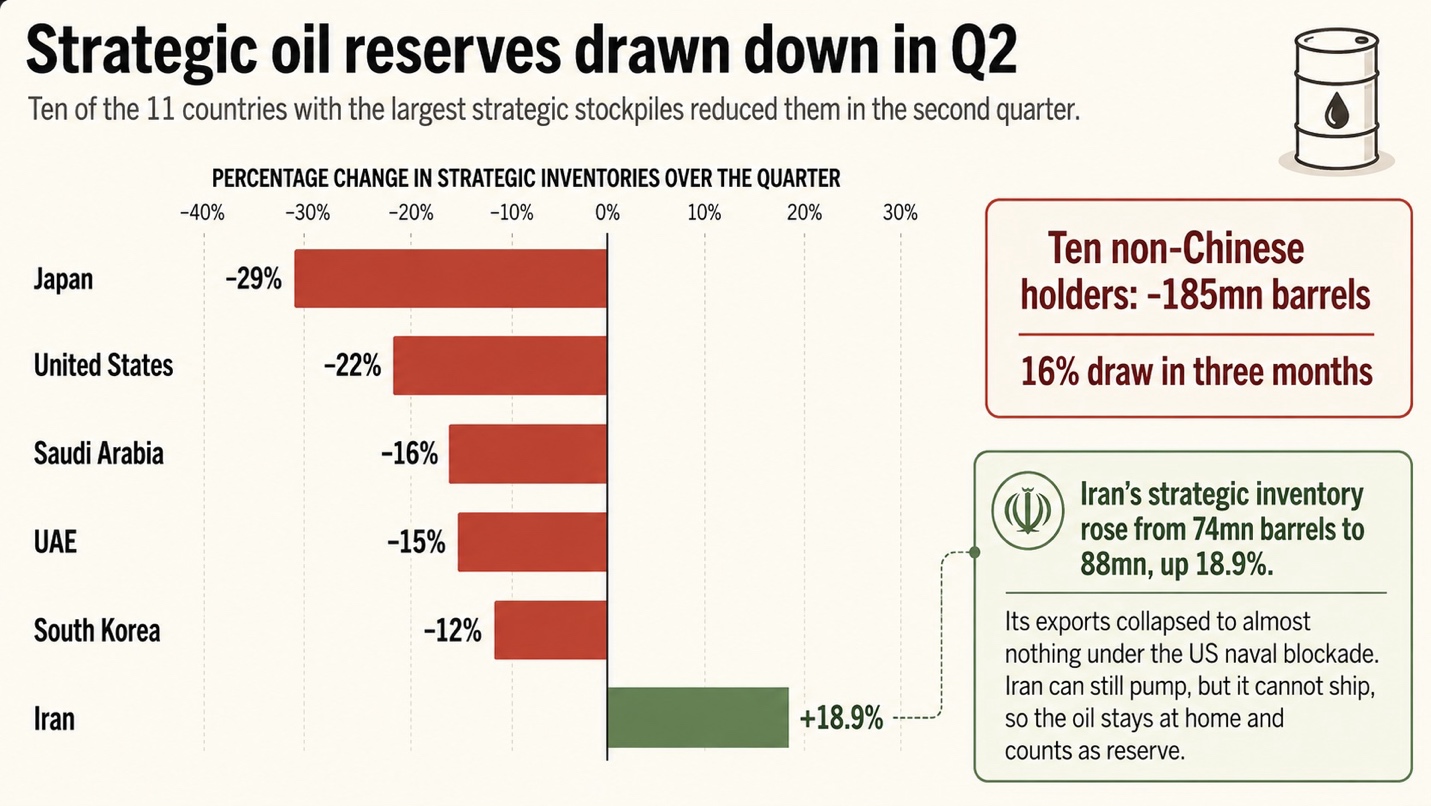
Ten of the eleven countries holding the largest strategic stockpiles shrank them in the second quarter. Between them, the ten non-Chinese holders gave up 185mn barrels, a 16% draw in three months. The United States drew 22%, Japan 29%, Saudi Arabia 16%, the UAE 15% and South Korea 12%.
The eleventh, Iran, went the other way. Its strategic inventory rose from 74mn barrels to 88mn, up 18.9%, over the three months its exports collapsed to almost nothing under the US naval blockade. Iran can still pump; it cannot ship. The oil has nowhere to go, so it stays home and counts as reserve.
The drawdowns are setting the world up for a new oil price spike, the problem is being little discussed and not reflected in the current oil prices, which remain in the mid$80s for now. Reserve releases were the West's answer to the chokepoint closing. They have calmed the markets over the last six months with some extreme predictions of oil prices jumping to a much as $350 per barrel failing to appear. However, as the reserves are depleted it is not clear if the markets will remain calm in the next six months if there is no end to the conflict.
America's barrels are a loan, not a sale
The 122mn barrels the United States has taken out of its Strategic Petroleum Reserve since March have to go back, with interest paid in oil.
The release is not a sale. The Energy Information Administration's own explainer says it "is structured as an exchange, which requires the original volume of oil, plus additional barrels, to be returned to the SPR at a later date". A Government Accountability Office report in May described the whole 172mn barrel drawdown as "emergency exchanges rather than sales". The companies that took the nation's emergency oil owe it back, plus extra.
The reserve peaked at 415.4mn barrels on March 20. By August 14 it was 293.4mn. That is 71% of what Washington committed to the international release, which means roughly 50mn barrels are still to go out of the door.
Two things follow that nobody has priced. When the exchanges unwind, refiners have to hand back more crude than they took, into a market that will still be short - so the SPR's recovery is itself a future call on supply. And a reserve that is contractually owed back is not a reserve that can be spent again in the meantime.
Crude for a diesel problem
All 172.2mn barrels of the American contribution were crude, all of it from public stocks, and it was the largest single line in the IEA’s 426mn barrel international programme – the largest in history - in which the next biggest was Japan at 79.8mn.
The shortage is in refined product. On July 21 the International Energy Agency's executive director said in writing that markets for diesel and gasoline were "considerably tighter than those for crude".
There is a reason the American contribution had to be crude: the country holds almost no emergency product. The Northeast gasoline reserve was sold off by act of Congress in 2024, and the same statute bars the energy secretary from creating a new regional product reserve without a line in the president's budget. What is left is one million barrels of heating oil in four New England terminals.
Releasing crude into a diesel shortage is the policy equivalent of sending flour to a bread queue. It helps, eventually, if there is a refinery with spare capacity in the right place - and the Asian refiners that would normally do that work are the ones the war has hit hardest.
China's share rises without China buying anything
China's stocks fell too, by 49mn barrels. But that is 3.2%, roughly a fifth of the rate everyone else was spending at, and China is still 95mn barrels above where it sat at the end of last year.
So, China's share of the tracked total rose from 57% to 61% in a single quarter without Beijing buying a barrel. Everyone else simply spent faster.
The EIA counts China's commercial inventories as strategic, because Chinese state oil companies have been instructed since 2024 to hold emergency barrels commercially. It refuses that treatment to every other country in the table, including Japan, whose mandated private stocks it leaves out. The comparison is tilted before a single barrel is counted.
China is not an IEA member. It is an association country under a 2015 declaration that describes the relationship as "non-binding", and the 90-day stockholding obligation applies to members. Whatever Beijing has, it has no legal duty to release.
Japan stops drawing
Japan will make no further releases from its national reserve in September or October, economy, trade and industry minister Ryosei Akazawa said on August 25.
September crude procurement is expected to fall to about 80% of last year's average monthly level, from 100% in August, because tankers that would normally pass through the Bab el-Mandeb Strait are going the long way round via Suez - 55 days to Japan against 21 to 23, Akazawa told a press conference.
"Of the national reserves for which a release has already been decided, there remains a portion that has not been utilised due to progress in securing alternative supplies. Using that portion would ensure [September] crude oil supply equivalent to an average month last year," he said, adding that procurement should return to last year's average monthly level in October.
Tokyo is saying it can cover September out of what it has already authorised. But that means Japan is husbanding what is left rather than finding an alternative supply. And it comes after the steepest quarterly draw of any major holder.
The IntelliNews PRO service includes access to reports, exclusive market data, and more news that decision-makers care about. Stay ahead of the market with IntelliNews PRO.
Sign Up Now


