Zelenskiy tops Ukraine's anti-rating for the first time, pollster says
3 hours ago
The global average fertility rate has just dropped below the 2.1 replacement rate for the first time ever and Thailand's is in the first rank of countries seeing its population shrink: the Thai fertility rate fell from six children per woman to two in twenty years - as fast as China's - and it did it while the country was still poor.
That is why Thailand now sits in a group it does not otherwise belong to. On UN estimates and medium projections, 66 countries and territories have already passed peak population, and almost all of them are in Europe or East Asia. Thailand is the only one in Southeast Asia.
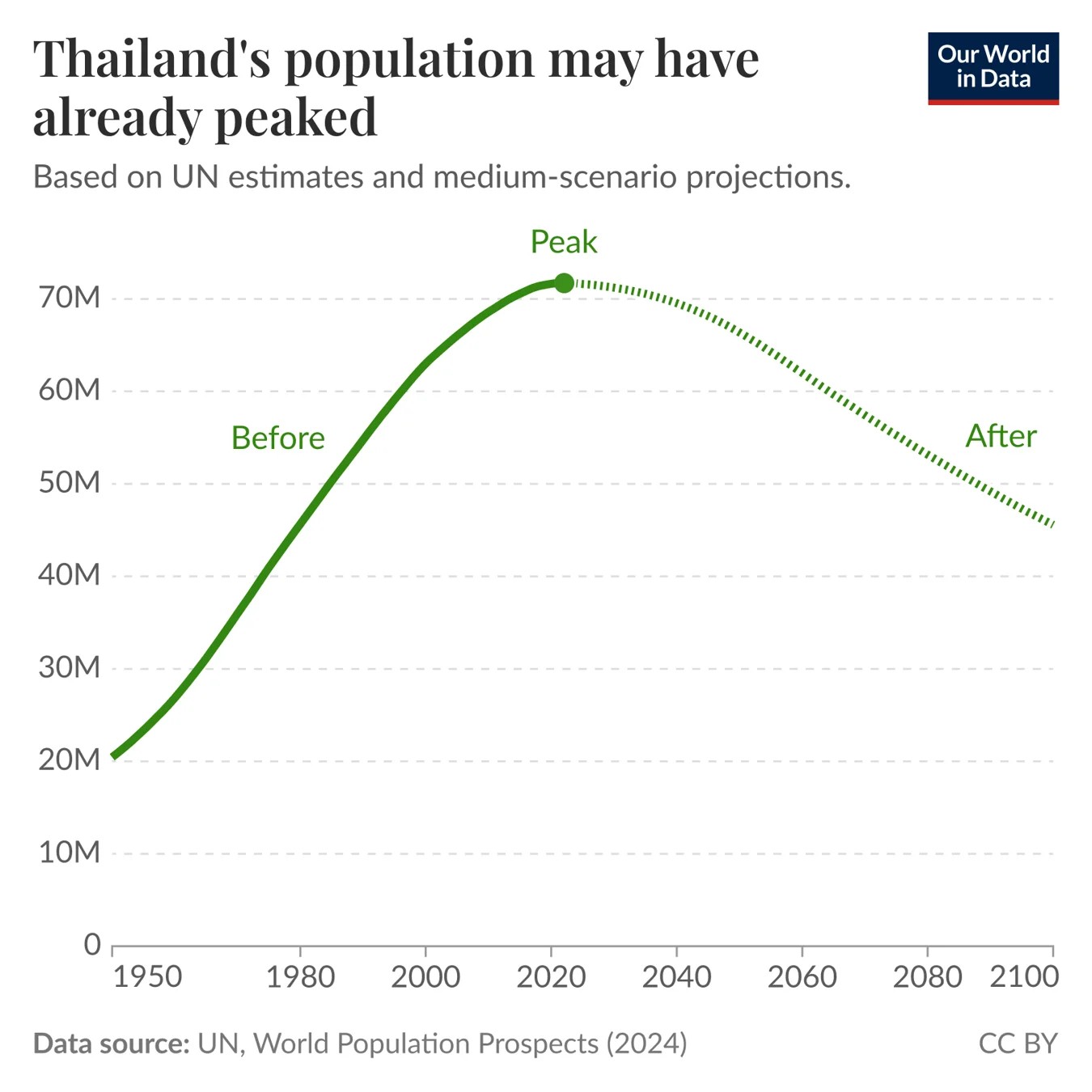
Thailand's population, 1950-2100, UN estimates and medium-scenario projections. The peak, at about 71mn, falls around 2022. Source: UN, World Population Prospects (2024), via Our World in Data (CC BY).
The chart shows a curve that rises steeply from about 20mn in 1950 to a peak near 71mn around 2022, then turns down and keeps going, reaching roughly 45mn by 2100. That is not a plateau with noise around it. It is a country projected to lose a third of its people inside eighty years.
Today the fertility rate is at most 1.2 children per woman, and some national statistics put it nearer one - far below the 2.1 needed to hold a population steady, and among the lowest anywhere.
The sequence is what makes Thailand a warning rather than a curiosity. Europe and Japan grew rich first and are now paying for their pension and care systems out of accumulated wealth. Thailand's decline started while it was a middle-income economy, so it faces the same shrinking workforce and the same rising dependency ratio without the same balance sheet behind it - the definition of getting old before getting rich.
The cause was policy, and largely a successful one on its own terms. Thailand launched its National Family Planning Program in 1970. It was voluntary and non-coercive, and it worked by widening access to contraception and family planning and by raising education levels for women, Our World in Data's Hannah Ritchie writes. Nothing about it was a mistake; the demographic bill simply arrives fifty years later.
Thailand is early rather than exceptional. The same collapse in births is working through most of the emerging world, which is why the world is running out of mothers and why the baby bust crept up on almost everyone. Bangkok has tried the usual responses, including a push to extend maternity leave to 180 days, with the results such policies get everywhere.
The IntelliNews PRO service includes access to reports, exclusive market data, and more news that decision-makers care about. Stay ahead of the market with IntelliNews PRO.
Sign Up Now