

Russia's saboteurs have followed the arms industry east into Nato
1 hour ago
For the first time in the modern history of the relationship, the European Union sells Russia more goods than it buys from it. The EU used to be one of Russia’s biggest trdae partners but what is left of the turnover folling the imposion of an extreme sanctions regime is a narrow, stubborn residue — and two product lines that never fell at all.
In March 2022, in the first full month of the war, the EU imported €23.5bn of goods from Russia. It was the highest monthly figure on record, and it was not an accident: energy prices had spiked, and Europe was still buying.
In June 2026, the most recent month for which Eurostat has published complete figures, the EU imported €2.3bn. That is a fall of 90.3% from the peak. The trough, in February 2026, was €1.6bn — less than the EU imported from Russia in a single fortnight before the invasion.
Annual figures tell the same story with less noise. EU imports from Russia were €163.6bn in 2021, rose to €202.5bn in 2022 as prices spiked even while volumes fell, and were €27.9bn in 2025. The 2022 number is the one that gets misquoted: it was a peak in value, not in dependence, and reading it as evidence that Europe increased its purchases after the invasion gets the causation exactly backwards, an analysis by IntelliNews Lambda found.
The 16 chapters covered 80.5% of Russian imports in January 2019 and 98.6% by June 2026. A percentage calculated against the column total silently changes definition as coverage moves. Shares here are taken against the published total.
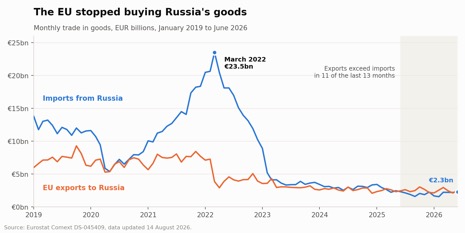
The more striking number is on the other side of the ledger. EU exports to Russia peaked much earlier — €9.3bn in October 2019 — and fell far less steeply: €89.2bn in 2021 against €30.4bn in 2025, a decline of two thirds rather than five sixths.
The two lines crossed. In June 2026 the EU exported €2.6bn to Russia and imported €2.3bn, a goods surplus of €295mn. That was not a one-off: EU exports have exceeded imports in 11 of the last 13 months.
For a relationship that ran a European deficit of nearly €8bn in a single month in January 2019, this is a structural reversal. Europe spent two decades as a net buyer of Russian commodities. It is now, in goods terms it is a net seller; pharmaceuticals, machinery and chemicals remain outside the sanctions regime and are still actively exported to Russia.
What is left
The residual trade is not evenly divided. Of the 16 product chapters Eurostat tracks, 14 have fallen since 2021, several to almost nothing, but tow remain unaffected.
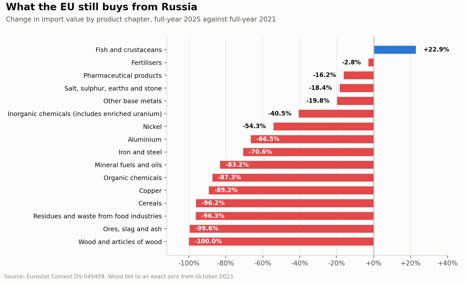
Wood is the cleanest case: imports have been an exact zero every month since October 2023 — a reported zero, not missing data. Ores and slag are down 99.6%, residues from the food industry 96.3%, cereals 96.2%, copper 89.2%.
Mineral fuels, still by far the largest single category at €15.8bn over the last twelve months, are down 83.2% on 2021. But they now account for 79.1% of everything the EU buys from Russia. The trade has become simultaneously much smaller and much more concentrated: what Europe still buys is, overwhelmingly, energy.
Then there are the two that did not fall.
Fertilisers are down 2.8% since 2021 — statistically flat. At €1.7bn in 2025 they are now the fifth-largest category, having been eleventh before the war. Nothing was done about them, and the volumes held.
Fish and crustaceans are up 22.9%, the only chapter higher than before the invasion on every basis tested. At €740mn in 2025 it is not a large trade. It is, however, a growing one, four years into a sanctions regime designed to shrink it. Russian pollock imports are booming; around half of all the fish and chips sold in the UK are Russian fish, according to reports.
Inorganic chemicals deserve a note of their own too. That chapter is down 40.5% — a real fall, but far shallower than the metals around it — and it is because it is the chapter that contains enriched uranium – something that neither the US or Europe can make for itself. Eurostat does not break uranium out at this level of aggregation, so the €1.1bn twelve-month figure for the chapter is not just a uranium number but it bumps up that chapter’s overall result and cushions the decline in trade turnover. Inorganic chemicals has proven to be considerably more resistant to sanctions than iron, aluminium, copper or nickel.
Russia's share of extra-EU imports has fallen sharply, but total EU trade grew over the same period. That means the collapse of the share of Russian goods in EU trade turnover understates the impact of sanctions as Russia has taken a fixed share of a market that has grown.
Another caveat is that Eurostat figures measure the volume of trade of goods that travel directly from Russia to the EU. Since the imposition of sanctions multiple indirect trade routes have opened up. The roaring container good trade via Istanbul’s port is an obvious example, which has also cushioned the collapse. As IntelliNews has reported, the sanctions regime on Russia looked like a colander from the beginning when you start digging into the details. The published Eurostat series itself carries a warning to that effect.
As IntelliNews reported, the story with foreign direct investment (FDI) is similar: when capital tripping through intermediate countries is taken into account, the US is by far the biggest foreign direct investor into Russia.
Figures throughout are from Eurostat Comext dataset DS-045409, covering January 2019 to June 2026, data updated 14 August 2026. Values are in current euros and are not adjusted for inflation, which flatters the pre-2022 comparison. Full series are held in the Eurostat folder of the bne data store: "EU trade with Russia, monthly", "EU imports from Russia by product chapter, monthly", and "EU member state trade with Russia, monthly".
The IntelliNews PRO service includes access to reports, exclusive market data, and more news that decision-makers care about. Stay ahead of the market with IntelliNews PRO.
Sign Up Now
_1787798245.jpg)


