

Sloviansk is declared a combat zone as Ukraine's air defence stops firing back
1 hour ago
Two target sets now define this war, and neither of them is military. Ukraine hits Russian oil refineries and the warehouses of its two big online retailers. Russia hits Ukraine's power system and its shops. Both sides describe the other's campaign as terrorism and their own as a legitimate military targets.
On the Russian side the refinery campaign has moved from raids that cost a plant a few days of repairs, to outages that last weeks. Ufa, Nizhnekamsk, Perm, Novokuybyshevsk, Afipsky, Novoshakhtinsk, Volgograd and now Kstovo have all been hit since mid-August, and the whole of Lukoil's major domestic refining is currently shut. Petrol, diesel and jet fuel exports are banned, motor oil prices are up 40%, a second wave of the fuel crisis is building and July crude output was the lowest in six years.
The retail campaign is the more expensive one. Between July 18 and August 24, the warehouse war got underway and drones hit 15 Wildberries logistics sites totalling about 1.8mn square metres, roughly a third of the company's entire warehouse estate, Kommersant calculates. Ozon has since been added to the target list, and its shares fell 28% in the last week.
Sellers on the two platforms now put their combined losses above RUB600bn ($7.1bn). Data Insight puts lost stock alone at between RUB517bn ($6.1bn) and RUB580bn ($6.9bn) for Wildberries sellers, and between RUB88.5bn ($1.05bn) and RUB107bn ($1.27bn) for Ozon's. Rebuilding the destroyed warehouses would cost a further RUB186bn ($2.2bn) to RUB344bn ($4.1bn) and RUB30bn ($356mn) to RUB62.5bn ($742mn) respectively.
On the Ukrainian side the power system is the constant target and the shops are the newer one. The Kryvyi Rih thermal power station can no longer generate at all after an August 18 strike; 90,000 customers lost supply in Kyiv on August 20; Kernel, the country's largest grain exporter, says it has lost about half its own generation. Two Epicentr megastores were hit in Odesa on August 24, three retail chains' Kyiv warehouses on August 20, and the largest shopping centre in Kryvyi Rih on August 21, killing 16 people.
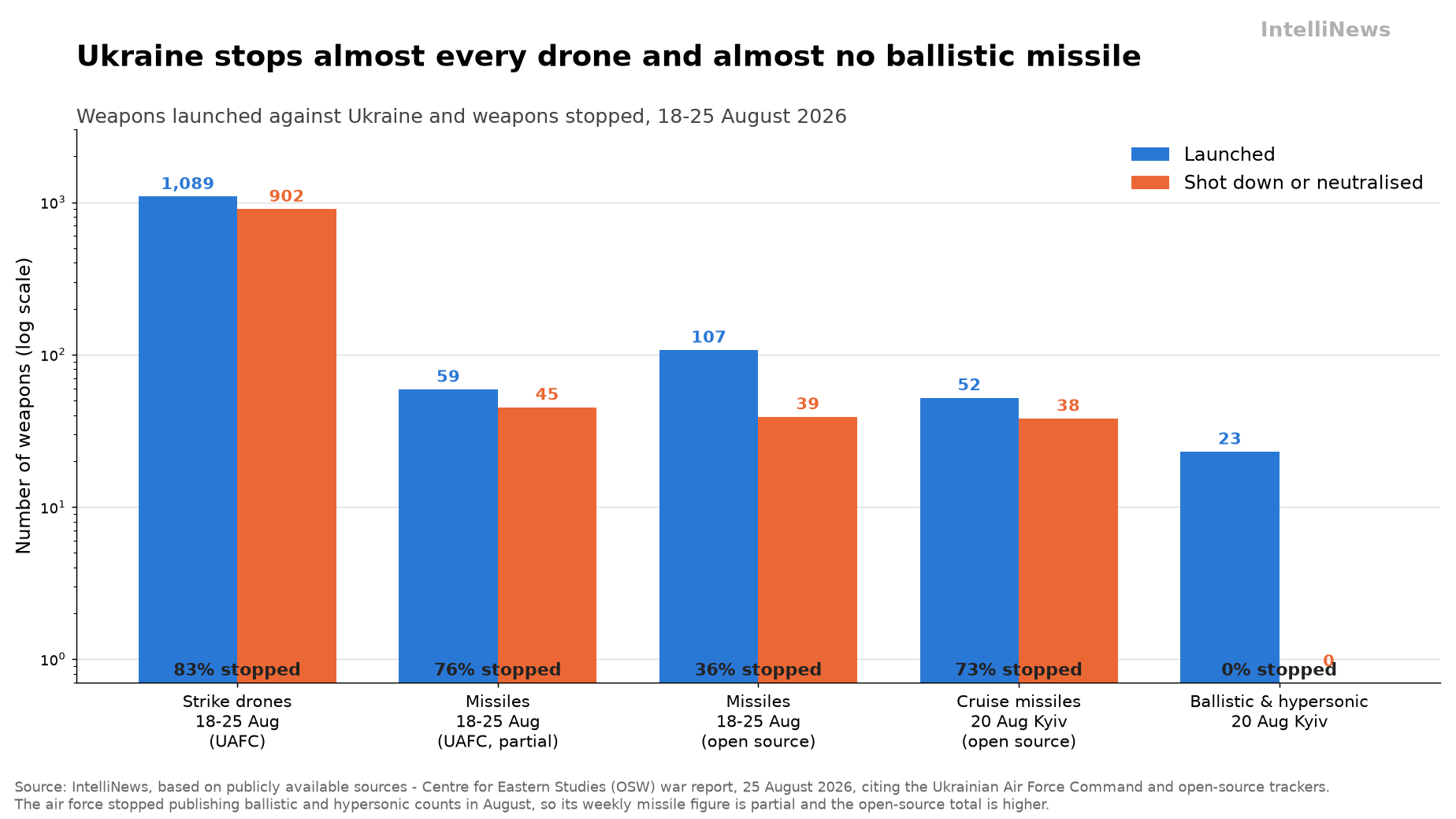
Interception rates for the week of 18-25 August 2026. The Ukrainian Air Force stopped publishing its ballistic and hypersonic counts during August, which is why its weekly missile figure is partial and the open-source total is higher. Source: IntelliNews, based on publicly available sources.
Drones are still being shot down at better than four in five. Missiles are not, and against the ballistic and hypersonic weapons that carry the heaviest warheads the rate on August 20 was zero out of 23, with only two Patriot interceptors fired in the capital's defence. That is not a failure of the system but the absence of ammunition for it, and it is the reason the interceptor shortage has become the single most consequential number in the war.
Russia's own claims run the other way and are not credible as counts: its defence ministry says it neutralised 1,671 fixed-wing drones in the 24 hours to August 18 and 1,504 on August 20. It also says it shot down all eight to 11 Flamingo cruise missiles Ukraine fired on August 24.
Major strikes & targets
| Strikes on targets in Russia | ||||
| Date | Target | Weapon | Region | Damage |
| 3 Jun | St Petersburg oil terminal | Drones | Leningrad region | Hit on the opening day of Russia's SPIEF investment forum |
| 7 Jul | Omsk refinery | Drones | Omsk | Largest refinery hit to that point and the deepest strike into Russia |
| 16 Jul | Salavat refinery | Drones | Bashkortostan | Key units hit; about 3% of national refining capacity |
| 18 Jul | Wildberries warehouse | Drones | Tambov region | Seven killed; opens the campaign against retail and logistics |
| 4 Aug | Wildberries hubs near Moscow and St Petersburg; a refinery | Drones | Russia | Warehouses hit; refinery ablaze |
| 7 Aug | Wildberries warehouse, Yekaterinburg | Drones | Sverdlovsk region | 2,000 km from the border |
| 12 Aug | Novorossiysk Grain Plant terminal | Drones | Krasnodar Krai | Loading equipment damaged; company puts repairs at one to four months |
| 14 Aug | Last working Novorossiysk grain terminal | Drones | Krasnodar Krai | All three of the port's grain terminals out of service |
| 17–18 Aug | Five bulk carriers | Sea and aerial drones | Novorossiysk and Tuapse | First large-scale strikes on ships carrying grain |
| 19–25 Aug | Refineries at Ufa, Nizhnekamsk, Perm, Novokuybyshevsk, Afipsky and Novoshakhtinsk | Drones | Russia | Perm and Novoshakhtinsk suspended processing |
| 22–24 Aug | Ozon warehouses at Chapayevsk, Orenburg, Druzhny, Nevinnomyssk and Tyube | Drones | Russia | Ozon shares fell 28% |
| 24 Aug | Astrakhan gas processing plant; Kamensky Combine | Drones | Astrakhan and Rostov regions | Two gas separation units hit |
| 25–26 Aug | Lukoil-Nizhegorodnefteorgsintez, Kstovo | Drones | Nizhny Novgorod region | Every major Lukoil refinery in Russia now offline |
| 26 Aug | Wildberries logistics centre, Kotovsk | Drones | Tambov region | More than 100,000 sq m burned; complex destroyed |
| Strikes on targets in Ukraine | ||||
| Date | Target | Weapon | Region | Damage |
| 15 Jun | Odesa ports | Missiles and drones | Odesa | Export infrastructure damaged; first sustained pressure on the sea corridor |
| 6 Jul | Crimean power grid | Drones | Occupied Crimea | Peninsula-wide blackout |
| 14 Jul | Togo-flagged merchant ship, Odesa port | Missile | Odesa | Three crew killed |
| 19 Jul | Kyiv and other cities | Missiles and drones | Ukraine | Largest bombardment of the war to that date, in response to the Tambov strike |
| 27 Jul | Drone-industry exhibition | Missiles | Kyiv region | At least 10 killed |
| 31 Jul | US-owned drone factory | Missile | Ukraine | Plant destroyed |
| 5 Aug | Kyiv | 24 ballistic missiles | Kyiv | Air defences unable to respond; interceptor stocks reported near exhaustion |
| 18 Aug | Kryvyi Rih thermal power station | Drones | Dnipropetrovsk region | Damaged beyond the ability to generate |
| 20 Aug | Antonov aircraft plants; drone and cruise missile component sites; three retail chains' warehouses | About 75 missiles, 23 ballistic or hypersonic | Kyiv | 18 killed, 42 injured, 90,000 customers cut off; no ballistic missile intercepted |
| 21 Aug | Largest shopping centre in Kryvyi Rih | Drone | Dnipropetrovsk region | 16 killed, 140 injured, three missing |
| 22 Aug | Ukrzaliznytsia rail depots and repair works, Darnytskyi district | 11–13 ballistic missiles | Kyiv | Extensive fires; air defences inactive |
| 22–25 Aug | DTEK energy assets; Odesa and Chornomorsk ports; Rozdilna rail junction; two Epicentr stores; fuel depots | Missiles and drones | Odesa region | Six ships damaged in Greater Odesa between 18 and 24 August |
Strikes on economic infrastructure since 1 June 2026. Compiled by IntelliNews based on publicly available sources, including our own reporting and the Centre for Eastern Studies' war reports. Dates are of the strike where known and of first report otherwise; the list is of significant strikes on economic targets and is not exhaustive.
The pattern in the dates is a conversation. The Tambov warehouse strike of July 18 killed seven people and was followed the next day by the heaviest Russian bombardment of the war to that point. The Novorossiysk grain terminals went down in mid-August; the Odesa ports and the Danube crossings were hit through the rest of the month. Each side is now answering the other inside 48 hours, and both are aiming at the part of the other's economy that generates foreign currency.
Neither campaign is winning in the sense either government uses the word. Russia's refining is being removed faster than it can be rebuilt and its crude cannot be exported instead, because the ports and the tankers are being hit too. Ukraine's grain cannot leave and its power stations cannot be replaced before winter. The monitor exists to keep count of a process that has no obvious stopping point.
The IntelliNews PRO service includes access to reports, exclusive market data, and more news that decision-makers care about. Stay ahead of the market with IntelliNews PRO.
Sign Up Now


_1787798245.jpg)