


Missile War Monitor: Russia and Ukraine strip out each other's delivery networks
4 hours ago
Europe has little more than nine weeks left until November 1 to rebuild gas inventories to 90% full that are on 77% full now, unusually low for this time of year. High prompt prices and weak summer-winter spreads continue to complicate the economics of putting gas into storage.
The TTF front-month contract climbed above €68/MWh on August 24, reaching its highest level since January 2023 as renewed US-Iran tensions reduced hopes of a return to normal shipping through the Strait of Hormuz. It subsequently eased to around €66.2/MWh on August 26, according to Argus Media, but that is still twice the pre-war levels and quadruple the long-term averages.
High prices is only part of the problem. The shape of the forward curve determines whether traders can make money by buying gas now, paying to store it and selling it during the winter.
At TTF, the balance-of-month contract was still trading at a €0.91/MWh premium to winter 2026-27 on August 26, while the September-winter spread closed at €1.05/MWh. Those spreads provide little incentive to inject gas for later sale once storage and financing costs are included. If the prices stick to the curve then traders will lose money when they sell their stored gas in the midst of winter.
The picture is not uniform, however. At Germany's THE hub, the September contract had moved to €0.84/MWh below January by August 26, according to Argus Media, an improvement from earlier in the summer. The economics of storage are therefore becoming less hostile at parts of the curve, but the change comes late in the injection season and after a large stock deficit has already accumulated, making it next to impossible to close the gap and reach the mandatory 90% full storage target by November 1.
EU aggregated storage stood at about 712TWh, or 63% of capacity, on August 24. That was below the 724TWh, or 64.7%, held on the same date in 2021, the previous low for the period.
Low stocks are not simply the product of one bad summer. Europe emerged from last winter’s big freeze with depleted inventories, injections have repeatedly lagged historical rates, the Iran war disrupted Middle Eastern LNG supply, the hottest summer on record lifted gas-fired power demand in recent months and, for much of the summer, the forward curve gave traders little reason to pay to store gas.
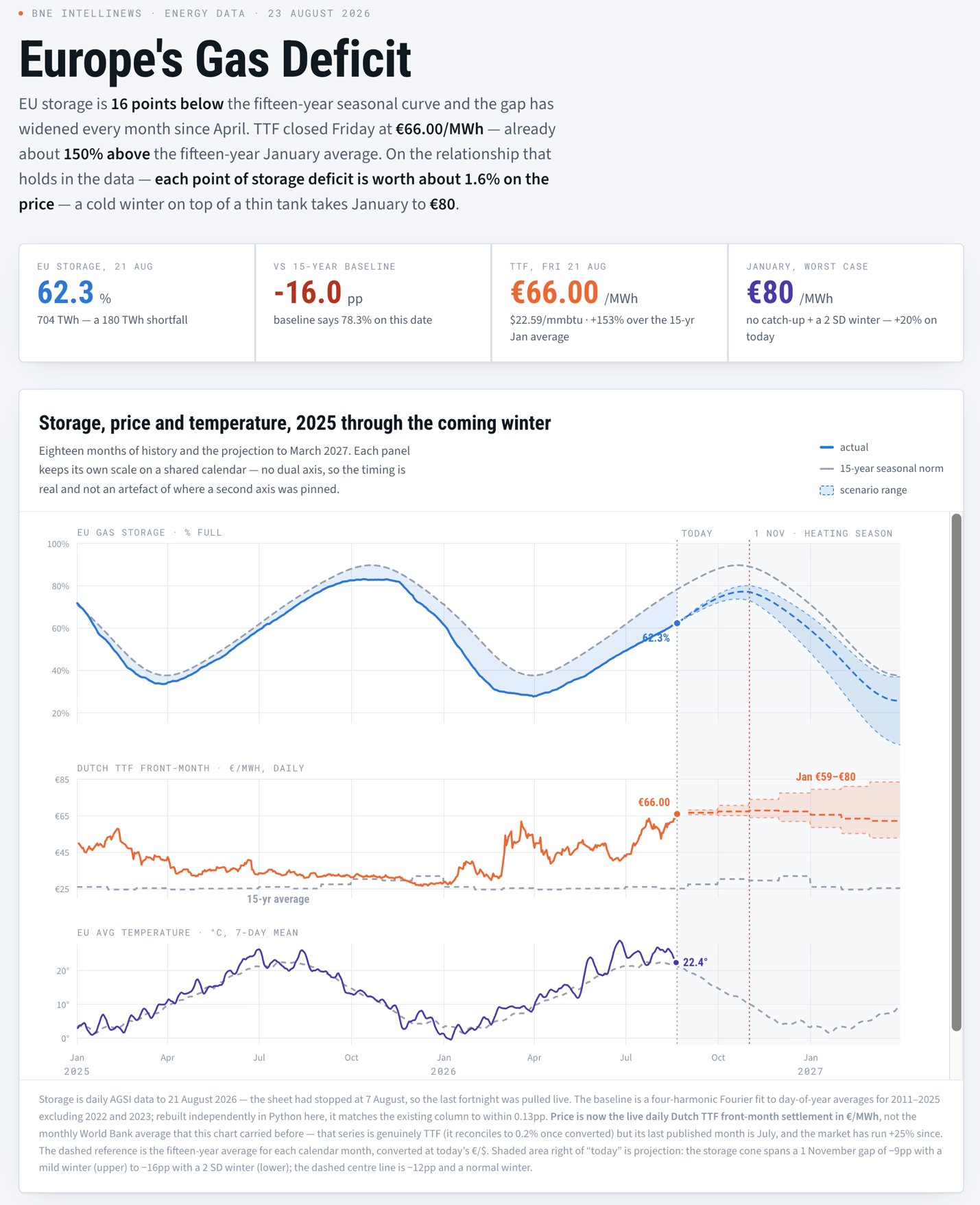
IntelliNews Lambda forecasts of storage volumes and price set against the weather. Find an intereactive version of these charts here.
Low German storage is the problem
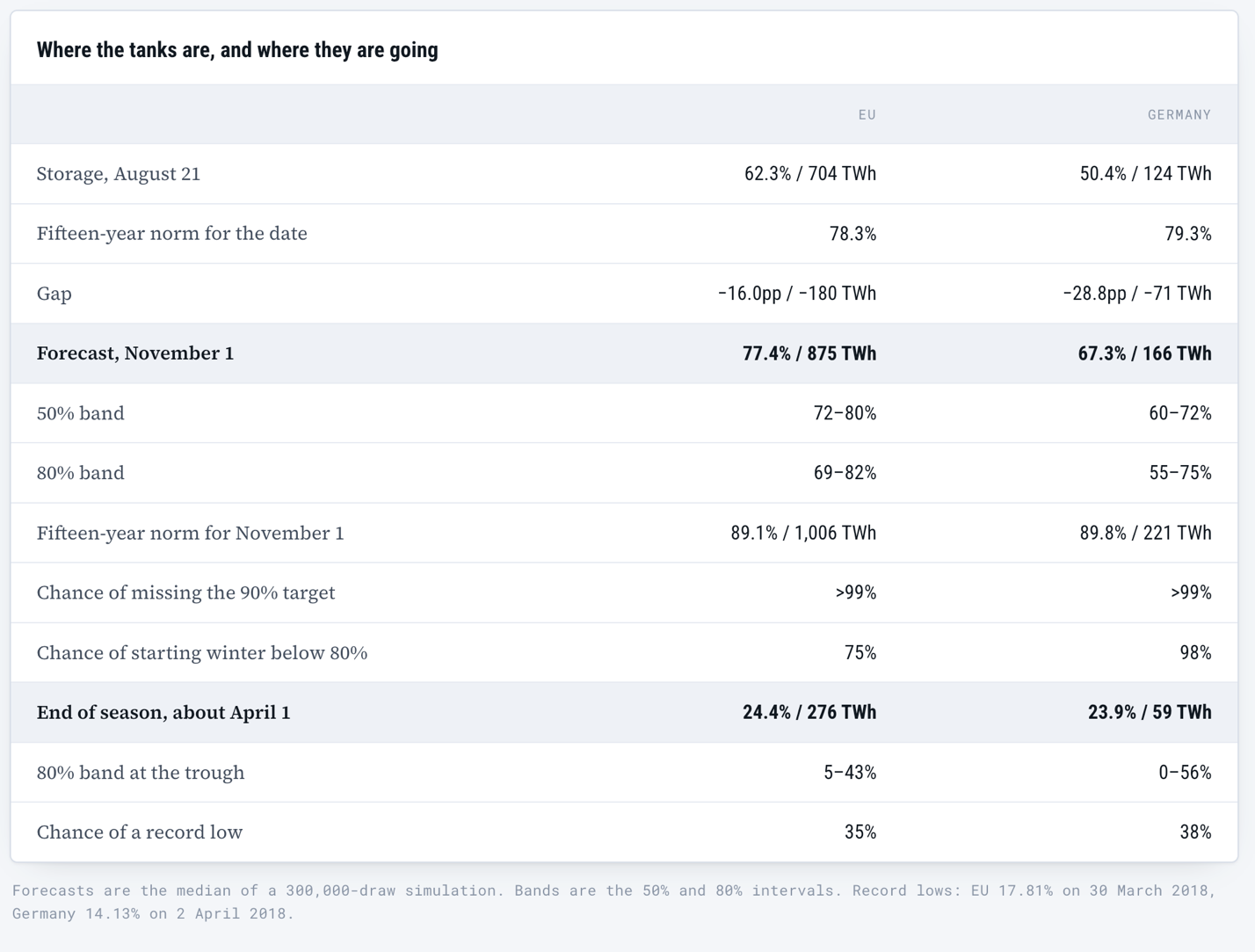
Germany matters disproportionately because it has the EU's largest storage system, accounting for about 22% of the bloc's working capacity. Its sites were only around 51% full on August 24, compared with levels in the mid-80s on average over the previous three years.
Germany is not, however, the lowest-filled large European market: Dutch storage was only about 44% full at the same point. Germany's problem is its combination of low stocks and sheer scale.
The country is supposed to enter November with an aggregate storage level of roughly 70% under this year’s relaxed EU rules. But as German rules are actually set site by site, most storage facilities have an 80% November 1 requirement, while six large porous storage sites, including Rehden, have a lower 45% requirement.
The government also has a backstop, although intervention is not triggered automatically at a particular storage level or date. Under German energy law, market-area manager Trading Hub Europe (THE), with approval from the economy ministry and in agreement with the Federal Network Agency, can procure market-based filling instruments and take additional measures if commercial injections are insufficient.
Berlin has so far resisted pressure to use that mechanism. The economy ministry argues that suppliers themselves are responsible for securing enough gas to meet their contractual obligations to customers. At a government press conference on August 24, the ministry said it saw no current threat to security of supply and declined to specify a storage level at which the state would intervene.
Its reasoning is partly economic. State purchases would add another large buyer to an already tight market, potentially raising prices and displacing private-sector injections. Argus earlier quoted the ministry as warning that intervention could "stoke demand, push up prices and crowd out private-sector injections" and damage "normal market functioning".
The politics are uncomfortable too. Germany introduced a gas storage levy after the 2022 energy crisis to recover the cost of emergency storage measures. The levy was abolished on January 1, 2026, with the federal government taking over the remaining costs.
Fresh intervention would therefore create a new cost for the state, although it would not automatically mean that the storage levy had to be reintroduced.
The arithmetic is becoming increasingly difficult. Recent Argus calculations put Germany about 49TWh short of its November target, requiring net injections of roughly 670 GWh/d to close the gap, compared with a three-year average of about 251 GWh/d for the comparable period.
The government says it does not currently expect a physical gas shortage but some analysts are already warning of possible blackouts if the winter is exceptionally cold. The economy ministry has acknowledged that the situation is less comfortable than during the past two winters, while pressure for action is growing. Germany's Green party on August 28 called for a gas crisis summit, with storage at only about 52%.
France and Italy better off
France and Italy illustrate how government intervention can alter the storage calculation.
France's regulated system requires holders of storage capacity to fill 85% of their booked capacity by November 1, with penalties for missing the obligation. All French capacity for the 2026-27 storage year has been booked.
Italy has instead used financial incentives, including payments designed to compensate companies for otherwise unattractive storage economics.
The result is a substantial divergence despite all three countries facing broadly the same international gas market. By late August, Italian sites were around 80-82% full and French storage was in the mid-60s, compared with barely more than 50% in Germany.
That does not make France or Italy immune from a difficult winter, but their larger stocks provide a greater buffer both domestically and for the wider interconnected European gas market.
Hot weather has made the refill task harder.
According to Argus calculations, gas demand from the power sector across Italy, Spain, France, Germany, Belgium, the UK and the Netherlands was 9.6TWh above the three-year average during the injection season.
Italy and Spain alone used 16.8TWh more gas than average between April 1 and August 18, with air conditioning demand and weak hydro generation increasing the call on gas-fired plants. In France, heat, drought and restrictions affecting nuclear generation added further pressure. Germany and the UK offset some of the increase by burning more lignite and coal.
Supply starting to respond
European LNG deliveries rose to 1.7mn tonnes in the week to mid-August, the highest since early June, as high European prices and weaker Asian demand made Atlantic cargoes more likely to head to Europe.
Argus Analytics forecasts LNG sendout of 322mn cubic metres a day in September and 413mn cubic metres a day in October, up substantially from August levels.
Norwegian supply should also improve. Lighter offshore maintenance could lift production to around 281mn cubic metres a day in September, compared with 257.3mn cubic metres a day a year earlier, although maintenance schedules can change.
But even these gains leaves a large hole. EU inventories were 212TWh below the five-year average and 146TWh below last year's level in late August. Rebuilding stocks to last year's level by November 1 would require net injections averaging 3.3TWh/d from August 17 to the end of October, more than double the 1.4TWh/d achieved during the same period last year. Reaching 70% by November 1 would require around 2.2TWh/d.
The 70% figure should not be confused with the EU's headline legal target of 90%. Changes to the bloc's storage rules give member states considerably more flexibility than in the immediate aftermath of the 2022 energy crisis, including a wider October 1-December 1 window and scope to deviate from the headline 90% requirement when market conditions are unfavourable. National derogations reduce the effective EU-wide requirement still further.
Even so, the injection rates now required are high. The closest recent precedent was 2022, when net injections averaged around 2.9TWh/d over the comparable late-summer period as Europe scrambled to replace disappearing Russian pipeline supplies.
Weather may help
A lot will depend on the weather. As a recent study by IntelliNews Lambda found, the level of storage has little impact on the price of gas in the short-term, but the main effect of colder than normal winters is to empty out the gas tanks faster. Last winter was very cold and these is a non-negligible chance that the polar vortex will collapse this year as well, bring another big freeze.
However, the European Centre for Medium-Range Weather Forecasts indicated on August 11 that temperatures were likely to remain above normal across much of Europe in September and October. A mild autumn would delay heating demand and leave more gas available for storage.
In southern Europe the same weather could extend the air-conditioning season and keep gas-fired electricity demand elevated.
Europe's post-2022 energy strategy sharply reduced its dependence on Russian pipeline gas by increasing access to LNG and expanding import infrastructure. That diversification removed one major source of geopolitical exposure but increased Europe's dependence on the global LNG market.
The Iran war has demonstrated the trade-off. Roughly a fifth of global LNG supply normally passes through the Strait of Hormuz, largely because of Qatar's position as one of the world's biggest exporters. Traffic through the strait has remained severely disrupted since the war began in February and fell to a fraction of pre-war levels again in late August.
Europe is therefore entering the final part of the storage season with more LNG arriving, improving Norwegian supply and somewhat better storage economics, but with inventories still far below normal.
The immediate question is no longer whether Europe can reproduce the exceptionally high storage levels achieved after the 2022 crisis. It is how much gas the market can put away before heating demand begins, and how much governments are prepared to pay if commercial incentives are not enough.
The IntelliNews PRO service includes access to reports, exclusive market data, and more news that decision-makers care about. Stay ahead of the market with IntelliNews PRO.
Sign Up Now


