


Tashkent and Beijing are expanding political dialogue across key institutional areas
1 hour ago
Four EU foreign ministers have told Brussels the money already promised to Ukraine will not be enough, and that the question of how to use Russia's frozen Central Bank of Russia (CBR) reserve funds must come back onto the table.
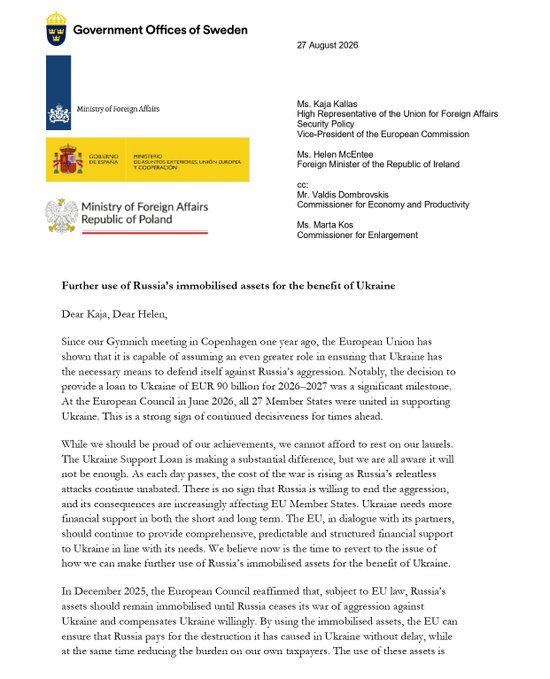
The letter, dated August 27 and signed by Sweden's Maria Malmer Stenergard, Poland's Radoslaw Sikorski, the Netherlands' Tom Berendsen and Spain's Jose Manuel Albares Bueno, is addressed to High Representative Kaja Kallas and to Ireland's foreign minister Helen McEntee, whose country holds the Council presidency, Euronews reports.
"While we should be proud of our achievements, we cannot afford to rest on our laurels," the ministers write. "As each day passes, the cost of the war is rising as Russia's relentless attacks continue unabated. There is no sign that Russia is willing to end the aggression, and its consequences are increasingly affecting EU Member States. Ukraine needs more financial support in both the short and long term."
The EU holds about €210bn ($244.5bn) of immobilised Russian sovereign assets, the bulk of it at Euroclear in Belgium.
The original idea of issuing the Reparation Loan – basically confiscating Russia’s frozen $300bn and giving that to Ukraine as a “loan” – got shot down by Belgium as it remains illegal under the EU’s own rules.
As a fall back, the bloc agreed last December to lend Ukraine €90bn ($104.8bn) for 2026 and 2027, which the four call "a significant milestone" before saying plainly that it will not cover Ukraine’s needs. A study by Kyiv School of Economics (KSE) said that Ukraine needs a total of some €140bn over two years and it has been assumed that the missing money can be scrounged from the other G7 members.
During Ukraine’s Independence Day celebrations Ukrainian President Volodymyr Zelenskiy said that this year’s budget is now short $27bn after too much money was spent at the start of the year buying drones. He called on partners to send him more money and missiles. European Commission President Ursula von der Leyen announced the same day that Europe would send an extra €6.1bn to pay for weapons.
Sweden led the letter and deliberately assembled one country from each of the EU's four corners - north, east, west and south - which is a way of showing that the constituency for this has stopped being the Nordic supporters alone. Spain in particular has not been in this camp before.
After December's row over the Reparation Loan, the ask is procedural. "As a next step, we therefore propose that the Commission's technical experts are invited to explore, in close consultation with Member States, new options on how to use the immobilised assets for the benefit of Ukraine, which ensure that the risk rests with all EU Member States and where no Member State holds a disproportionate burden," they write, adding that "managing financial and economic risks, as well as compliance with international law, will constitute important components of this technical analysis".
The announcement is clearly aimed at addressing Belgium’s key concern: as it holds the money in the Brussel-based Euroclear, if the assets are seized, then Belgium, not the EU, would be in the legal firing line when Russia inevitably launches a legal retaliation. Previously Belgium’s Prime Minister Bart De Wever said he was willing to seize the money if the rest of Europe were willing to share the risks. The other EU members refused. The statement suggests the members are toying with one possible solution: move Russia’s money out of Euroclear and put it upstairs into some jointly control EU body to share the exposure between all 27 members.
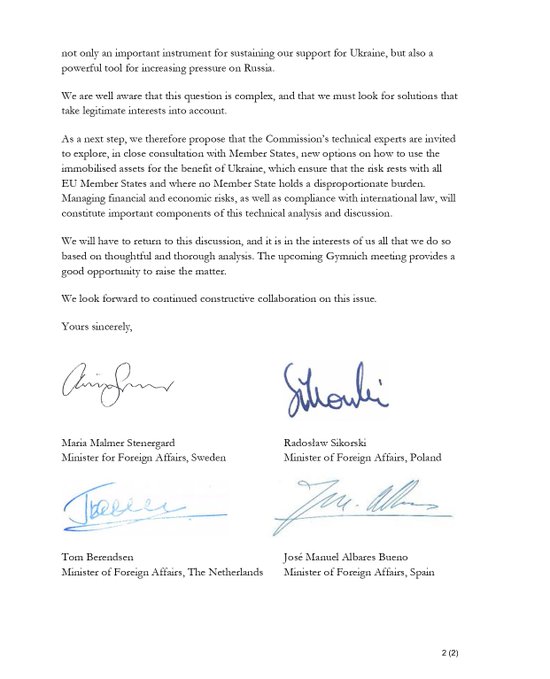
The signature page: Maria Malmer Stenergard, Radoslaw Sikorski, Tom Berendsen and Jose Manuel Albares Bueno. Source: Government Offices of Sweden.
Foreign ministers meet informally in Ireland on September 1-2, which the letter names as "a good opportunity to raise the matter", and a run of national elections next year is expected to turn member states inward.
This will be the third attempt to unlock Russia’s frozen money. KSE wrote an analysis of the litigation risk arguing that it was possible to legally confiscate the cash, but it largely remains untouched. Since then the bloc has largely repackaged aid already promised rather than find new money.
Six other member states, three of which do not overlap with these four, spent the same day demanding that the EU's next seven-year budget be cut by hundreds of billions as the increasingly dysfunctional European economy runs into budget problems of its own. The two letters are only compatible if Ukraine is paid for with Russian money.
The IntelliNews PRO service includes access to reports, exclusive market data, and more news that decision-makers care about. Stay ahead of the market with IntelliNews PRO.
Sign Up Now

_2_1787907014.jpg)
_4_1787906055.jpg)
