
US President Donald Trump said he was indifferent to whether Iran signed a peace agreement, claiming Washington now held near-total control of the Strait of Hormuz, in a post on his Truth Social platform on September 2.
The remarks come hours after Iran and the US traded strikes, with several military personnel airlifted out of a Jordanian base following IRGC strikes on the location and US military strikes hitting a wedding in the south of Iran, killing five people, including children.
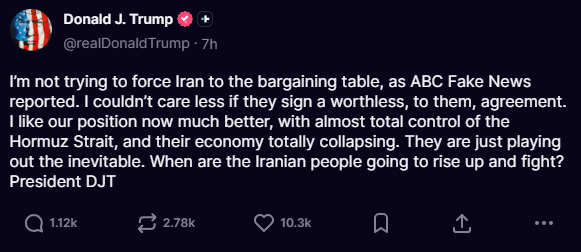
Trump’s statement can be seen as a hardening of the US position as the June memorandum of understanding meant to end the war collapsed in the latest round of fighting, with Trump signalling little interest in reviving the deal while American forces tighten their grip on the waterway.
"I couldn't care less if they sign a worthless, to them, agreement," Trump wrote. He said he liked Washington's position "now much better", suggesting the US had "almost total control" of the strait.
He added “When are the Iranian people going to rise up and fight? President DJT,” in his latest plea to the Iranian population to overthrow the Iranian government, which has been in power since 1979, ending 3000 years of monarchy in the country.
Trump’s latest claim of control sits against a waterway that remains largely shut but has also seen an increase in strikes and damage in recent hours.
Earlier on September 2, Iran’s Islamic Revolutionary Guards Corps (IRGC) says two oil tankers attempting to pass through an unauthorised route near the Strait of Hormuz were hit by mines and set on fire; IntelliNews energy sister agency Newsbase has yet to confirm this claim, with Omani authorities not yet reporting the incident.
Iranian threats and attacks on shipping have halted most traffic through the route, and while some oil tankers have moved through it in recent weeks, volumes remain far below levels at the start of the war.
A memorandum of understanding, signed in June to extend an April ceasefire, has expired between Tehran and Washington, with the global economy hoping that would calm the region down.
The agreement had committed Iran to allow commercial vessels to pass through the strait, but repeated exchanges of fire pushed it to collapse.
The war began on February 28, when the US and Israel launched strikes on Iran and killed Supreme Leader Ali Khamenei.
Iran responded by closing the Strait of Hormuz, through which about 20% of the world's oil and gas passed before the conflict. US Central Command said it struck IRGC targets in Iran on September 1, citing attempted Iranian attacks on Gulf shipping and American forces.
Related Articles
Iran's IRGC says two tankers 'hit mines' in Strait of Hormuz
Iran's Islamic Revolutionary Guard Corps (IRGC) said two oil tankers "struck mines and caught fire" in the Strait of Hormuz after their crews disembarked and the vessels were used to attempt an ... more
US launches fresh strikes on IRGC targets in Iran
US forces began striking Islamic Revolutionary Guard Corps (IRGC) targets in Iran at midday Eastern time on September 1, US Central Command (CENTCOM) said. The ongoing strikes are the latest ... more
Iran says Kharg oil hub remains operational after Trump AI video
Iranian Deputy Oil Minister Hamid Bovard dismissed a video shared by US President Donald Trump purporting to show Kharg Island under attack, calling Trump’s posts “laughable” and saying oil ... more