


COMMENT: COP17 desertification summit delivered mixed results but important momentum
17 hours ago
Uzbekistan may be everybody's favourite these days, but Central Asia has other countries that deserve investor attention. Tajikistan’s new medium-term macro framework, published just weeks ago, is not a timid forecasting exercise. It is closer to a development manifesto dressed up as a macro table.
Table 1: Betting on the good times to last
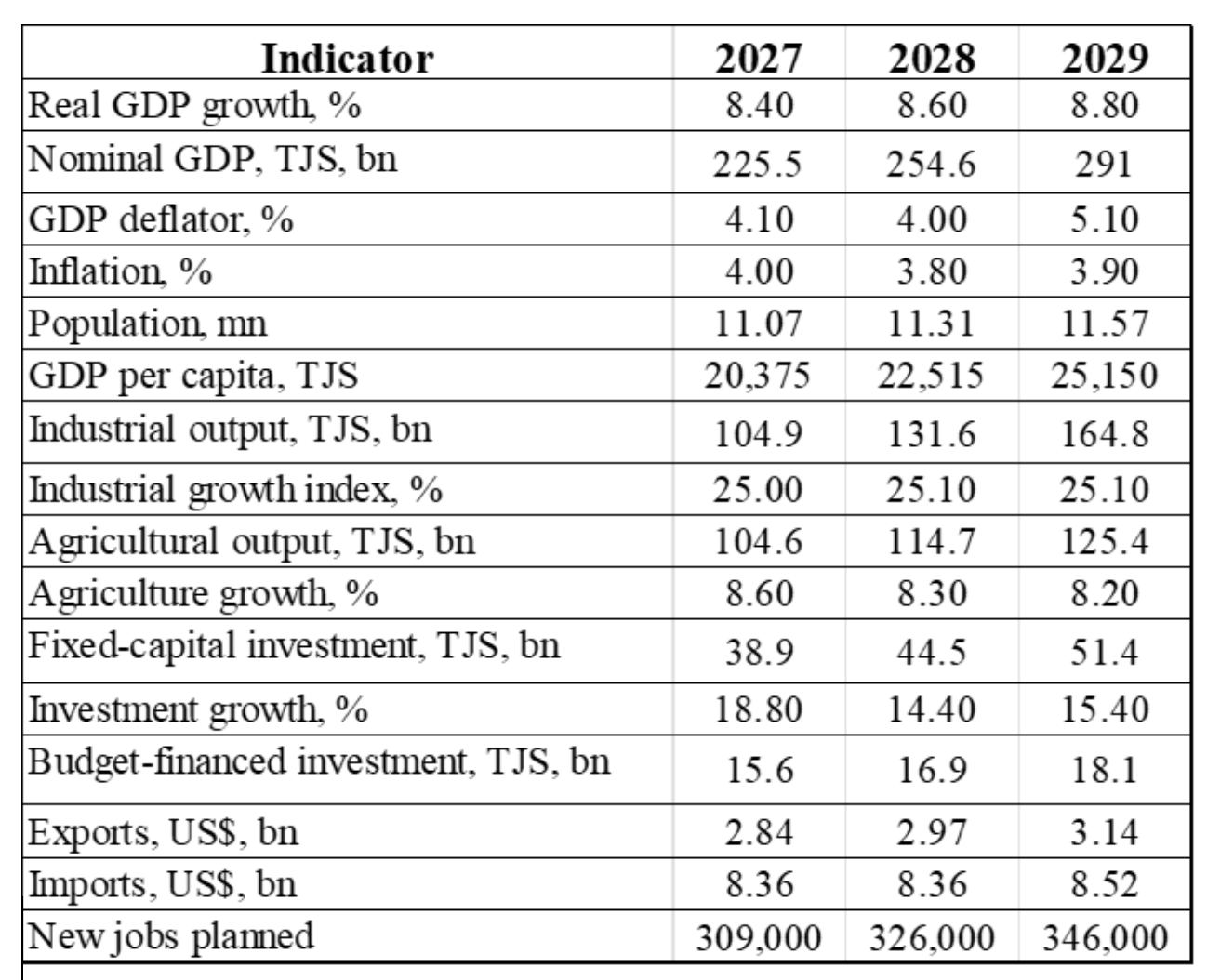
The government is betting that the economy can keep running at 8-9% per annum, industrial production can rise by roughly 25% a year, investment can expand at double-digit rates, inflation can hover around 4%, imports can barely move, and close to one million jobs can be created along the way. None of these assumptions looks absurd in isolation. Put together, however, they form an unusually demanding economic high-wire act. For investors, this looks less like a conservative baseline and more like an aggressive development scenario.
Growth remains the headline attraction
Tajikistan enters the forecast period with momentum. Real GDP growth averaged around 8.5% in 2021-25 and was still running at 8.2% y/y in 1H26. The government sees growth staying above 8% throughout 2027-29. That is considerably more bullish than the external consensus. The IMF expects 6.0% growth in 2027 and 4.8% in 2028, while the World Bank sees 6.5% and 5.0%. The gap largely reflects different assumptions about remittances and household consumption. Remittances, overwhelmingly linked to Russia, reached an extraordinary 57.5% of GDP in 2025. Even a modest normalisation would matter.
Still, the government’s story is not simply “more consumption”. Its centrepiece is industrialisation. Industrial output is forecast to grow by about a quarter every year. Given that industry accounted for 16.2% of GDP in 2025, it could generate roughly half of overall GDP growth. Hydropower sits at the heart of the strategy, led by Rogun and rehabilitation of existing plants, while the authorities also want more processing of agricultural commodities and higher output of coal, aluminium and cement.
Agriculture provides the second leg. Output is forecast to rise by a little over 8% annually. For a sector worth roughly 22% of GDP, that implies a contribution of about 1.8 percentage points to national growth. Together, industry and agriculture are expected to generate around two-thirds of the growth story.
Investment is the fuel — but somebody has to pay for it
Fixed investment is projected to rise 18.8% in 2027, 14.4% in 2028 and 15.4% in 2029, lifting annual investment from TJS38.9bn to TJS51.4bn ($4.2bn to $5.5bn) in two years. The twist is that budget-financed investment grows much more slowly. The model therefore increasingly depends on external financing, SOEs, private capital and other non-budget sources. The government’s 2026-30 Public Investment Programme contains 864 projects worth around $15.7bn, concentrated in energy and transport. Yet more than $11bn was still described as lacking secured financing earlier this year. That is both a huge opportunity and an obvious execution risk.
The macro magic trick: 9% growth, 4% inflation
Perhaps the most eye-catching combination in the framework is the inflation profile. The government expects CPI inflation of just 4.0% in 2027, 3.8% in 2028 and 3.9% in 2029, even while GDP expands above 8%, investment surges and industry accelerates. That sounds suspiciously benign, but Tajikistan has earned some credibility. A strong currency, huge remittance inflows and falling global food prices have provided a powerful disinflationary cocktail. Imported goods represent roughly 60% of the CPI basket, while food carries a particularly large weight, so lower global wheat, vegetable-oil and other food prices have worked in Tajikistan’s favour since the 2022 peaks.
The catch is straightforward: this benign inflation regime depends heavily on the currency staying strong and food prices remaining tame. Curiously, however, the government gives investors no exchange-rate path. The forecast table includes an FX line, but future values are replaced with asterisks. That is more than cosmetic. Without an exchange-rate assumption, investors cannot properly reconcile nominal GDP, dollar GDP, external debt or the trade forecast.
The trade story is probably the hardest sell
Exports are projected to rise from $2.84bn in 2027 to $3.14bn in 2029. Imports, meanwhile, are basically frozen at $8.36bn in 2027-28 and $8.52bn in 2029. That is a bold assumption. An economy growing 8-9%, with investment rising around 15% and industrial output expanding 25%, would normally suck in machinery, equipment, construction materials and intermediate goods at a furious pace.
So the near-flat import profile implicitly assumes rapid import substitution and a much stronger domestic production base. If that works, it would be transformative. If not, imports will overshoot, the trade deficit will remain wider, and Tajikistan will continue relying heavily on remittances and external financing to square the balance-of-payments circle.
The missing variables matter
For such an ambitious framework, the document is surprisingly thin on several variables investors care about most. There is no fiscal-deficit path, no revenue or expenditure forecast, no public-debt trajectory and no government financing profile. Nor is there a forecast for workers’ remittances, arguably one of the most consequential macro variables in the economy. Remittances underpin consumption, imports, the FX market and banking liquidity. Russia is expected to slow, migration policies have become less predictable, and Tajikistan’s remittance ratios are already extraordinarily high.
Then there is Rogun — simultaneously Tajikistan’s great economic promise and one of its largest fiscal wild cards. Once completed, the plant could produce around 14,400 GWh annually, 60% of today’s national electricity generation, opening export opportunities to Uzbekistan and Kazakhstan. But IMF estimates put remaining construction spending at about $6.4bn, with roughly $3bn expected from external loans and grants.
Investor takeaway: aggressive numbers, unforgiving execution
The direction of travel is hard to dislike. Tajikistan wants to turn today’s remittance-supported boom into something more durable: power generation, industrialisation, infrastructure, domestic production and eventually a better trade balance. The results of this scenario look truly impressive if everything goes according to the plan. Real GDP growth compounds to almost 9%, nominal GDP comes close to TJS300bn by 2029, there is low inflation, and import dependence is reduced.
But the margin for error is thin. Remittances must stay strong, Rogun must progress, investment financing must arrive, industrial capacity must expand rapidly, the somoni must remain supportive, food prices must behave, and import substitution must become strong enough to keep imports almost flat.
For investors, Tajikistan’s 2027-29 framework is best read not as a forecast carved in stone, but as a map of what the government wants the economy to become. The destination is attractive. The road there is considerably steeper.
Ivan Tchakarov is partner for the Caucasus and Central Asia at GlobalSource Partners.
_Cropped_1788296994.jpg)

_3_1788079426.jpg)

