


World Bank puts Venezuela earthquake damage at nearly $20bn
17 minutes ago
Ukraine's drone campaign against Russian refineries has made the country's refining sector a strategic liability for the Kremlin, and the resulting fuel crisis has pushed Russian refining to record lows even as LNG exports to Europe hit record highs.
Two independent data trails, exchange trading records and a crowdsourced petrol-station tracking app, now offer the clearest picture yet of just how deep the shortage has been, and how slowly it is healing.
Refineries with a combined annual capacity of about 40mn tonnes have resumed selling fuel on the St Petersburg Exchange (SPIMEX) after scheduled and emergency maintenance, according to a report from Platts, the S&P Global-affiliated analytical agency, cited by Kommersant on July 20. Refineries accounting for a further 45mn tonnes of annual capacity have not yet resumed trading.
From July 20, SPIMEX also widened the permitted price-fluctuation range for some fuels — the ceiling on price rises for AI-92, AI-95 petrol and diesel on "free tank" delivery terms moved from 0.01% to 5%, with the permitted fall widened to 10% — in what one Open Oil Market executive described as an attempt to revive exchange trading, which had become a less relevant price indicator as more volume moved to off-exchange channels.
The price moves that followed were mixed: AI-92 rose 0.7% on July 20 to RUB 72,290 a tonne, while AI-95 fell 2.3% to RUB 74,610 and diesel slipped 0.38% to RUB 74,420 — a decline analysts said could point to increased supply. Wholesale volumes also rose, up 4.6% day-on-day on July 17 to 13,740 tonnes, though 81.9% of bids to buy petrol still went unsatisfied (92.9% for premium AI-98/100 grade). Between July 1-17, gasoline sales on SPIMEX were down 47.8% y/y to 277,300 tonnes; reserves have dropped below 1.5mn tonnes.
What fuel lines show
Separately, German economist Janis Kluge has been tracking Russia's fuel crisis using crowdsourced data from the petrol-station app Gdebenz. His most recent charts, posted on July 21, show the share of operating stations gradually rising and average queue lengths gradually falling, alongside improving availability of the three main fuel grades (92, 95 and diesel) — though he cautioned that the app's data confidence has fallen over time as fewer users report updates, and some responses may be unreliable given reports that Ukrainian users have deliberately skewed the app's data.
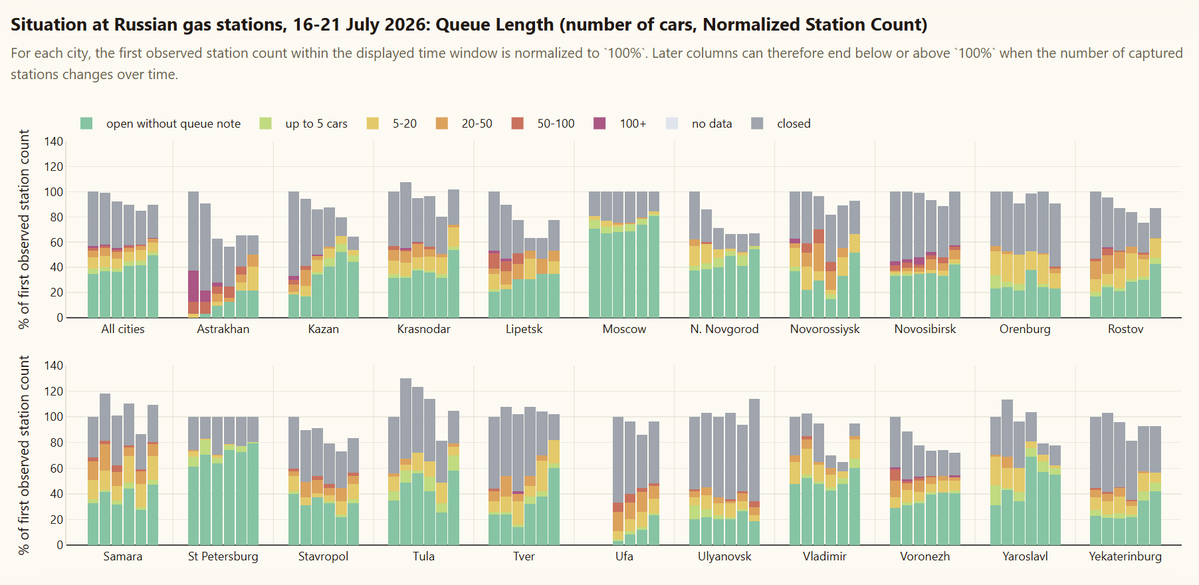
chart: Janis Kluge
How bad is "more than half"?
The scale of the shortfall is itself disputed. One energy analyst calculated that using Russia's 6.5mn b/d of nameplate primary distillation capacity, roughly two-thirds of refining capacity would need to be offline to match reports of 4.1mn b/d in outages — while another argued that on a more realistic 5.5mn b/d of usable capacity, that same outage figure implies about 75% offline, calling the “more than half” framing understated rather than overstated. Either way, both estimates point to a shortfall well beyond half of Russia's realistic refining capacity, even before accounting for the still-mothballed capacity at sites like Omsk that could be reactivated to offset losses.
Taken together, the exchange and queue data tell a consistent story: the worst of the shortage may have passed its peak, but recovery is slow, uneven across regions, and vulnerable to any fresh wave of strikes.
The IntelliNews PRO service includes access to reports, exclusive market data, and more news that decision-makers care about. Stay ahead of the market with IntelliNews PRO.
Sign Up Now


