


COMMENT: The four-power alliance that needs no treaty
19 hours ago

“Cargo corridor” journalism might have seemed a dull proposition to most reporters just a few years ago, but when it comes to geographies including the Middle East, Turkey, the Caucasus and Central and South Asia, it is by now a big thing among many news outlets.
First-came the full-scale invasion of Ukraine by Russia in early 2022, then in June 2025 the world took stock of the first of the US-Israeli attacks on Iran in the “Twelve Day War”. Russia’s actions caused great numbers of traders to seek transit routes that avoid the use of traditional Northern Corridor options through Russian territory, while this year’s prolonged continuation of the military assault on Iran has sparked energy market spasms stemming from the blockading and fight for control over the strait of Hormuz energy transit chokepoint. The latter crisis in particular, given its effect on oil prices, has served as a rude reminder of how vital it is for countries to maintain a variety of secure and dependable import-export cargo routes across land and sea.
Each week in corridor reporting, there are manifold developments, while speculative scenarios envisaging new trade route options, breakthroughs and setbacks are tested against the realities of the neverending geopolitical headaches and conniptions. Suffice to say, the discord mixed with efforts at finding a workable peace keeps freight forwarding companies on their toes.
Two striking developments
Let’s take two striking developments that have lately risen to some prominence, at least in some regional media. Firstly, suggestions that China, after nearly a century, is poised to agree a transformative border opening with Afghanistan that would make possible the creation of a cargo corridor running all the way from the East China Sea to the Persian Gulf. And, secondly, dire warnings that the day could come when Tehran decides to bomb an emerging Turkey-South Caucasus-Central Asia corridor that bears the name of Trump and passes as near as 40 kilometres (27 miles) from Iran’s northern border.
With the US renewing its blockading of Iranian ships seeking passage to the shipping lanes of the Indian Ocean, the Iranians have been busy reviewing their logistical options in trade at all points of the compass. The potential presented by Iran’s border with Afghanistan, a country that in turn has borders with China, Central Asia and Pakistan is one item that has moved much higher on Tehran’s economic agenda.
As Eldaniz Gusseinov and Daniel Longerich write in a July 13 article for Central Asia-Caucasus Institute’s Substack (“Iran’s Turn to the East: Afghanistan and the Contest Over Eurasia’s Corridors”): “The war has accelerated a reshaping of overland corridors around Iran. Tehran is strengthening its rear in Afghanistan, where it has already become the top trading partner and is extending a railway northward from Herat.”
Decision from Beijing awaited
The possibilities offered by Afghanistan as a corridor, however, will not be clear until Beijing takes a crucial decision. Add Gusseinov and Daniel Longerich: “The Afghan route gives Iran only partial insurance, since a through connection to China is not yet built and depends on Beijing’s willingness to open the border.”
Iran and Afghanistan can, of course, look to develop road and rail infrastructure that could provide for transformative expansions of Iranian, Afghan and other goods flows to China via Central Asia and Pakistan (though the Afghan Taliban’s extremely poor and volatile relations with Islamabad might preclude Pakistan as a viable, regular transit partner), but the big prize for both Tehran and Kabul would be a decision from Beijing to allow trade passage to and from China directly via Afghanistan with the opening of a border gateway at the end of the Afghan Wakhan Corridor.
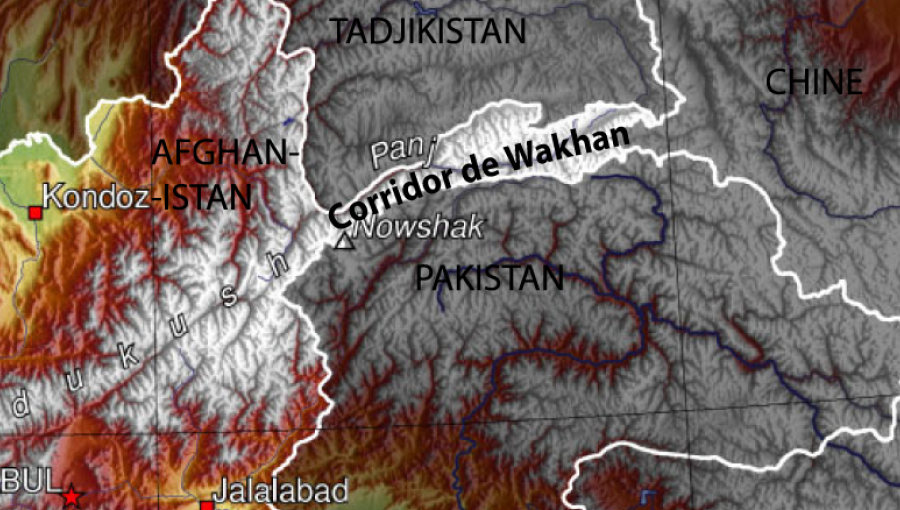
China's only border checkpoint with Afghanistan, which lies at the end of the Wakhan Corridor, is closed. Opening it could give Afghanistan a huge economic boost and provide China with a route straight through to the Middle East and Iran with a road into China (Credit: GMT, cc-by-sa 3.0).
“Iran’s answer to its maritime vulnerability [exposed by the US blockade] lies in overland infrastructure,” conclude Gusseinov and Longerich, pointing to the Khaf-Herat railway, opened in 2020, which connected the Iranian rail network to the ancient oasis city of Herat in western Afghanistan.
With the ambition to build rail and road links right through the Wakhan Corridor, an elevated mountain valley, and into China, what hope is there that Beijing will give the green light?
China, till now, appears to have remained wary about opening the single border crossing at the junction of the Wakhan Corridor with its Xinjiang Uyghur Autonomous Region over concerns about possible infiltration of East Turkestan Islamic Movement (ETIM) Uyghur militants from Afghan territory as well as its commitments to Pakistan, which would like to see regional trade increasingly flowing through the China-Pakistan Economic Corridor (CPEC) undertaking. However, March brought an interesting development when China established a new county, Cenling County, across from the frontier and border checkpoint in question.
"Administrative change hints at China's plan
Analyst Philip Acey in The Diplomat assesses that “the administrative change hints at China’s plan for greater integration with Afghanistan – and beyond to Central Asia”, adding: “The creation of Cenling County aligns with a broader pattern of deepening regional integration and potentially signals strategic intent to realize the long-discussed Wakhan Road. If completed, the route would reconnect Afghanistan and China for the first time in nearly a century.”
For Afghanistan’s Taliban administration, achieving the border opening is a national priority that can be sold to Beijing as a way of connecting China with the Middle East. And just perhaps lobbying from Kabul is paying off. Officials in Badakhshan province, through which the Wakhan Corridor runs, are on the record as stating that China’s ambassador has assured them that the Chinese government will approve the Wakhan Road.
As Acey observes, security remains the central concern of China and other regional actors in weighing up the merits of the Wakhan link. “Militant groups operating in Afghanistan – including Islamic State Khorasan Province and the East Turkestan Islamic Movement (ETIM) – pose a direct threat to infrastructure and transit projects, personnel, and regional stability,” says the analyst. “Attacks on Chinese targets in Afghanistan, Tajikistan, and Pakistan demonstrate the vulnerability of such projects to asymmetric threats from militants, drug traffickers, and criminal groups.”
Nevertheless, if the security risks can be overcome with joint patrols and surveillance, the Wakhan Road could well become viable, offering major gains.
Trump's TRIPP project. Not a favourite with Tehran
Over in the South Caucasus, the US remains engaged in establishing the ambitiously named Trump Route for International Peace and Prosperity (TRIPP). Following the peace reached by Armenia and Azerbaijan, it is designed to create a trade corridor running from Turkey, through the Azerbaijani exclave of Nakhchivan and across a short stretch of Armenian territory and through to Azerbaijan, handily placed on the Caspian Sea for interconnection with the China-to-Turkey/Europe Middle Corridor that traverses Central Asia. But what if efforts at realising TRIPP become a target for Iranian bombing?
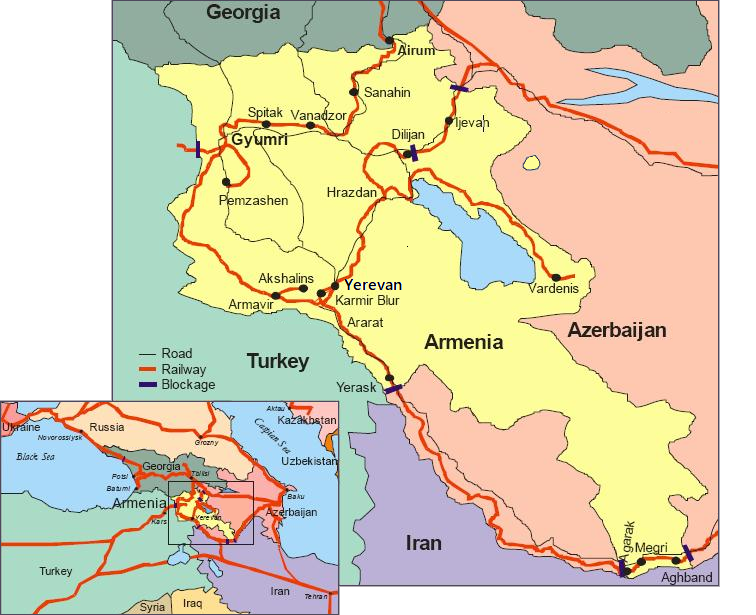
Unblocking the currently blocked railway line seen running along the south of Armenia near its border with Iran is key to realising the TRIPP project. The line connects Azerbaijan and its Nakhchivan exclave (Credit: Saguamundi, cc-by-sa 3.0).
The planned corridor, as previously mentioned in this article, is well within range of Iran and President Trump is unlikely to want to wake to morning news informing him of persistent bombing of the Trump route, especially one proclaiming peace and prosperity.
Under an agreement struck in January, the US holds 74% of the TRIPP investment management company for an initial 49 years.
Tehran, however, has made clear its opposition ot the corridor, contending that it will effectively cut off Iran from its transit link to the Black Sea and Europe that runs through Armenia and Georgia. The prospect of another permanent US presence on its border, even a non-military one, is in no way enticing.
The IntelliNews PRO service includes access to reports, exclusive market data, and more news that decision-makers care about. Stay ahead of the market with IntelliNews PRO.
Sign Up Now


