

Kazakh billionaire Turlov bids for presidency of World Chess Federation
12 minutes ago
Russia is rebuilding its drone war around the jet-powered Geran-4, a faster machine built to slip past the cheap interceptors now knocking down its slower first generation Geran-2 drone, based on the Iranian-designed Shahed-136 loitering munition that Moscow bought from Tehran at the start of the Ukraine conflict.
Russia has invested heavily in its defence industry to stay ahead in the drones arms race with Ukraine. It is now churning out around 3,000 of the newer Geran-4 and Geran-5 attack drones a month and has stopped building the earlier Geran-3, Ukraine's Defence Intelligence directorate (HUR) told the Ukrainian outlet Militarnyi on August 12. Serial assembly runs at Russia’s drone factory in the Alabuga Special Economic Zone in Tatarstan, where fresh satellite imagery shows construction that points to still more capacity being added.
The switch matters because it shores up Moscow's lead in the corner of the war it has been quietly winning. Ukraine had taught itself to knock down the propeller-driven Shahed with interceptor drones costing a couple of thousand dollars each; a jet engine roughly halves the seconds defenders have to react and pushes them back towards the scarce, costly interceptor missiles they cannot afford to use.
And Russia is still escalating the number of drones it is launching at Ukraine. On August 12 Kyiv was hit twice in a day by jet-powered drones closing on the capital from several directions. “Stay in shelters,” mayor Vitali Klitschko told residents as air defences opened up overhead.
The Geran-4 has grown out of the Iranian Shahed original. Last year, Moscow signed a technology transfer deal with Tehran as the CRINK alliance (China, Russia, Iran and North Korea) partners begin a much closer military cooperation. The short-lived Geran-3 was the next iteration developed by Russian technicians and is now already being replaced by the jet powered Geran-4 that now dominates the production line followed by the “cruise missile-lite” Geran-5 waiting behind it. Each step has aimed at the same target — Ukraine's thinning air defences — and each has been built, in growing numbers, at the sprawling site in Tatarstan, which remains well out of range of Ukraine’s missiles for now.
From Shahed to jet
Russia's drones began as Iranian imports. The Geran-2, the workhorse of its mass night raids, is a licensed copy of the Shahed-136 loitering munition, a slow, propeller-driven flying bomb that Moscow has fired at Ukrainian cities in their thousands. The first attempt to make it faster, the Geran-3, kept the Shahed airframe but swapped the piston engine for a Chinese Telefly turbojet, lifting its speed to 300-370 km/h. It made its debut in numbers on July 30 last year; HUR now says its production has stopped.
The Geran-4 is the replacement. It carries a sturdier airframe and a turbojet producing around 160 kilogram-force of thrust, roughly double its predecessor's, giving a cruise speed of 350-500 km/h against 280-330 km/h for the Geran-3. Its range has stretched from 600 to about 850 kilometres, it can loiter for some two and a half hours carrying a warhead of at least 50 kilograms.
The Geran-5 goes further still. It drops the delta-wing Shahed shape for a fuselage that looks like a cruise missile, carries a 90-kilogram warhead and is credited with a range of around 1,000 kilometres. Ukrainian intelligence says it can be launched from Su-25 jets and even fitted with R-73 air-to-air missiles, which would let it turn on the aircraft sent to hunt it. It had already surfaced in Russian strikes on Ukrainian energy infrastructure this spring.
What is striking is how far Moscow has diverged from the Iranian template. “A great example of a distinct Russian branch of an originally Iranian evolutionary tree,” is how the defence analyst Shahryar Pasandideh described the Geran-4, which owes little to Iran's own jet-powered Shahed designs.
Made in Alabuga
Every strand of the family now runs through the Alabuga Special Economic Zone in Tatarstan, the drone plant Russia built after a technology-transfer deal with Iran and then poured money into. HUR says serial assembly of the Geran-4 and Geran-5 has been established there, with other Russian firms feeding in components, and that the defence ministry wants to expand it further. Construction of new buildings began in May and was visible on satellite imagery by early July.
For all the talk of import substitution, the newer Gerans are only as good as their foreign parts. HUR says Russia remains wholly dependent on Chinese turbojet engines for the Geran-4 and Geran-5, each costing $35,000-$40,000, and that a teardown of a Geran-3 turned up 45 foreign components — parts from the United States, China, Switzerland, Germany, Britain and Japan. A Chinese mesh-radio module recovered from a Geran-5 helps the drones shrug off Ukrainian jamming; its maker under no Western or Ukrainian sanctions.
The scale is what alarms Kyiv's backers. Russia turned out an estimated 2mn drones and 2,500 missiles in 2025, roughly double the year before, and its arms production went into surplus this summer for the first time since the invasion. Ukraine has struck drone plants deep inside Russia, but Alabuga — the biggest of them — has stayed beyond reach.
Racing the interceptor
Russia’s drone technology innovation has just gone up a level. The point of the jet engine is time. Through 2025 Ukraine taught itself to kill the slow Shahed cheaply, with newly developed interceptor drones and mobile fire teams. Serhii Beskrestnov, then an adviser to Ukraine's defence minister, said defenders had stopped 95% of the drones in one recent raid and predicted Moscow would answer by building more jet-powered Gerans. But the lead in the drone arms race has flip flopped back and forth between the Armed Forces of Ukraine (AFU) and the Armed Forces of Russia (AFR)throughout the war. Russia has the lead again: a machine cruising at 500 km/h rather than 180 km/h collapses the reaction time to a few seconds when those cheap Ukrainian defences will still work.
The impact of the Geran-4 is already making itself felt on the battlefield. At the start of 2025 only about 5% of Russian drones were getting through Ukraine's air defences; by the summer that had climbed to 15%, even as those defences held. Ukraine's former commander-in-chief, Oleksandr Syrskyi, has said jet-powered drones could eventually make up half of all Russian attack drones.
And the Geran-4 is not the only new jet-powered drone to make a debut this summer. Russia has also ramped up the production of the S8000 Banderol, a jet-powered cruise-missile hybrid that flies above 500 km/h and now accounts for the bulk of strikes on Odesa's food infrastructure.
“We must not underestimate the enemy,” Yurii Ihnat of Ukraine's air force told the Kyiv Independent; the growing use of such weapons, he said, reflects a broader move towards jet propulsion that is complicating Ukraine's defence of its skies at a time when it has run out of US-made interceptors that could bring them down.
In the drones-versus-missiles arms race, Russia is now well ahead. Short of interceptor ammunition, Kyiv looks increasingly exposed against sustained barrages, and President Volodymyr Zelenskiy has spent months trying to buy his way out of the gap. He told CNN on August 12 he wanted “5% of America's Patriot missile stockpile to get through the winter.”
“I have 1%” — and said Ukraine had received two and a half times fewer Patriot interceptors this year than last with little prospect of getting any more before the cold weather sets in.
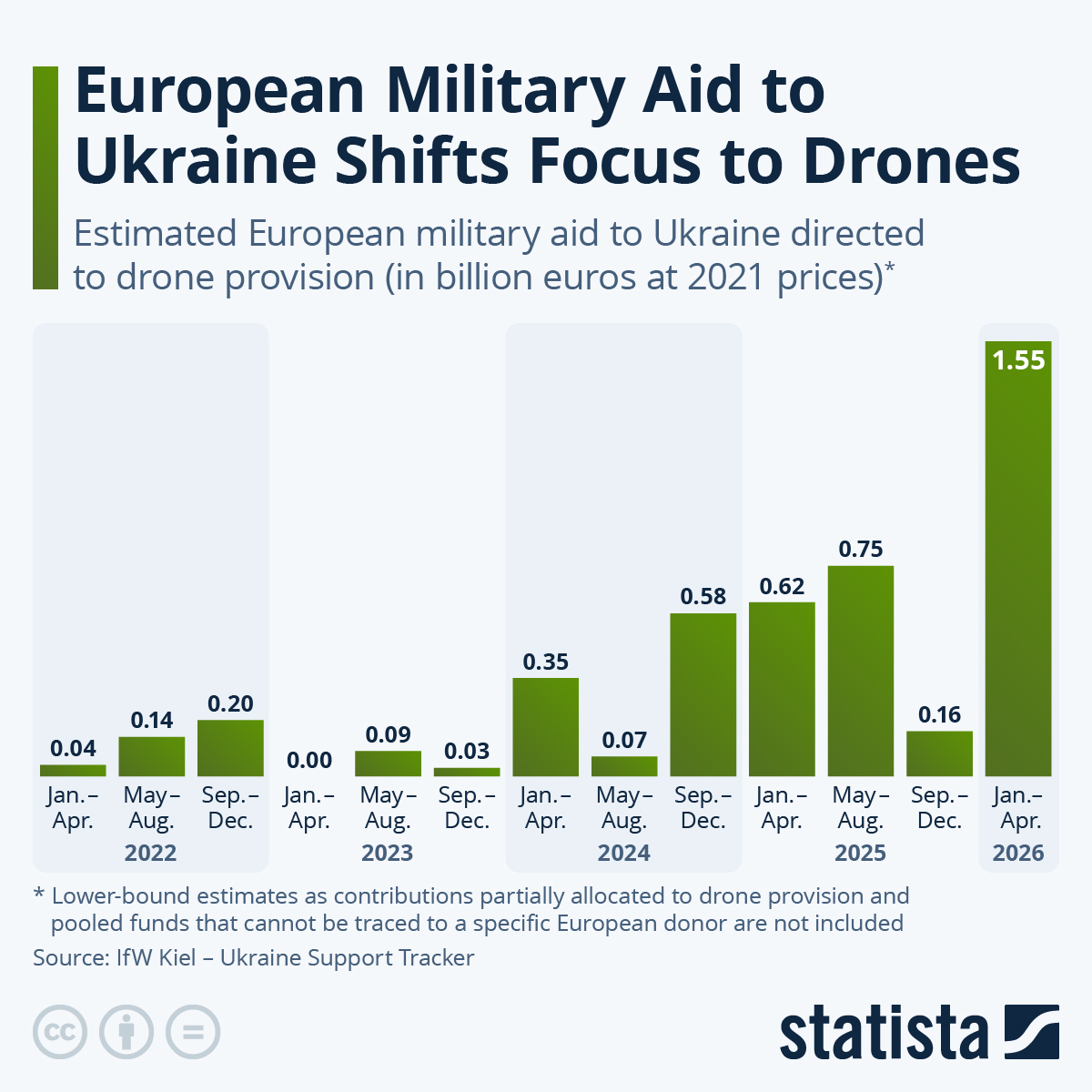
European military aid to Ukraine earmarked for drones has jumped past €1.5bn in early 2026, a measure of how completely the war has tilted towards unmanned systems. Source: Statista / IfW Kiel Ukraine Support Tracker (CC BY-ND).
Stockpiling for winter
Numbers are the nub of the Battle of Britain-like winter to come. HUR puts Russia's Geran stockpile at about 6,200 drones of all versions as of August, held back deliberately because production still cannot sustain the heaviest attacks indefinitely. In its largest strikes Russia has loosed between 600 and 1,000 drones in a single night; while it rebuilds reserves it launches 150 to 200, occasionally 300, according to milblogger reports.
Usage has already set records — 6,000 to 6,500 drones in the busiest months of 2026, against a 2025 rhythm of a few hundred a night. A year ago, Russia was building roughly 170 to 190 Geraniums a day and, on July 9 2025, fired 728 in a single raid. The 3,000 jet-drones-a-month figure sits on top of continued Geran-2 output, so the flow of airframes is still rising even as the mix turns faster.
At around 3,000 jet Gerans a month plus its older-model production, Russia can already average some 200 drones a day; a 6,200-strong reserve lets it stack that into intensive spells. Drawn down over a winter month, the stockpile could add roughly another 200 a day on top of what rolls off the line, putting a sustained rate nearer 400 a day within reach and leaving room for one-off barrages of 600 to 1,000 — several times the pressure Ukraine faced for much of 2025.
That is the backdrop to warnings of a heavier winter bombardment of Ukraine's power and heating grid. Kyiv's interceptor drones tamed the Shahed just as Moscow found a way to fly faster than them; its stocks of the missiles that can still catch the jets are thin; and the factories turning out the new machines sit deep inside Russia, running, for now, on Chinese turbojets the Kremlin cannot yet build for itself.
The IntelliNews PRO service includes access to reports, exclusive market data, and more news that decision-makers care about. Stay ahead of the market with IntelliNews PRO.
Sign Up Now


