


Ukraine halted Black Sea tanker strikes after Vance's July 31 call with Zelenskyy, FT reports
14 minutes ago
Chinese Belt and Road Initiative investment announcements in Africa surged 254% year on year to a record $33.5bn in H1 2026, driven overwhelmingly by megaprojects in Ethiopia and Egypt as Chinese companies increasingly favour direct investment in energy, manufacturing and processing over the sovereign lending model that defined an earlier phase of Beijing’s economic engagement with the continent.
Africa accounted for about 67% of all Chinese BRI investment announcements globally during the period, according to the Green Finance & Development Center (GFDC). But the importance of the figure lies less in the scale of a single six-month period than in what it suggests about the changing structure of China’s relationship with Africa.
During the first decade of the BRI, Chinese engagement was associated above all with policy-bank loans to African governments, which then hired Chinese state-owned groups to build railways, roads, ports, dams and power plants. The emerging model gives a greater role to companies investing directly in productive assets and assuming more of the commercial risk themselves.
That points to a gradual shift in China’s role from creditor and contractor towards investor and industrial owner. For African governments, the question is increasingly not simply how much Chinese capital arrives, but how much of the resulting value, technology and industrial capability remains on the continent.
The $33.5bn figure requires careful interpretation. GFDC’s tracker includes credible investment announcements and signed implementation agreements, generally involving projects worth about $20mn or more. It therefore measures an investment pipeline rather than capital already transferred into African economies.
China’s Ministry of Commerce, by contrast, recorded $17.52bn of non-financial direct investment across all BRI partner countries worldwide in H1, down 7.4% year on year in dollar terms. The figures are not directly comparable: GFDC records announced project values, while the ministry measures outward investment flows.
But the contrast is instructive. Africa’s pipeline is expanding rapidly at a time when officially measured Chinese investment across the wider BRI is declining.
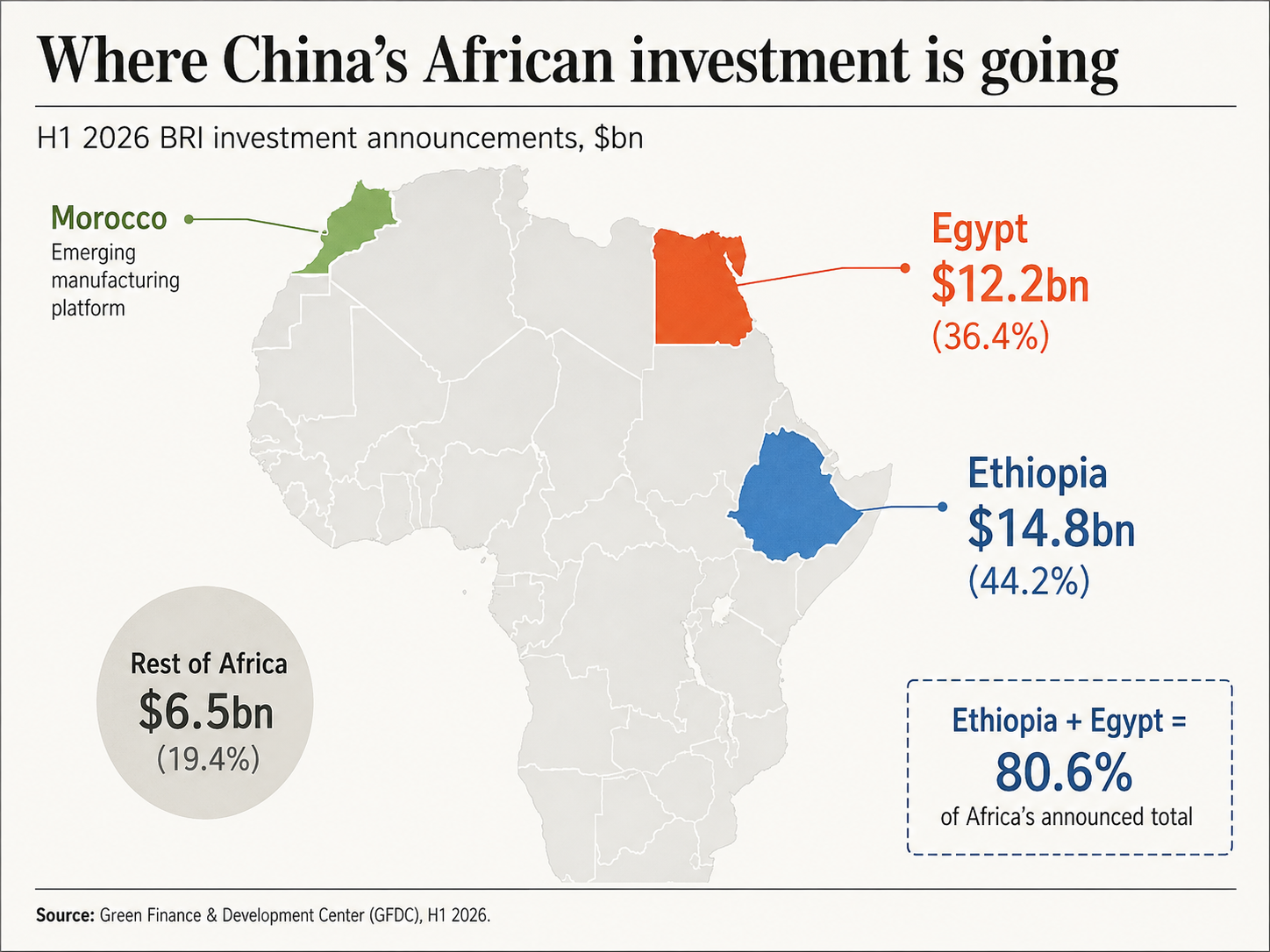
The African total is also highly concentrated. GFDC recorded $14.8bn of investment announcements in Ethiopia and $12.2bn in Egypt, meaning the two countries accounted for about 80.6% of the continental total.
At project level, the concentration is sharper still. Ming Yang Smart Energy Group’s (SSE: 601615) proposed programme in Ethiopia is valued at about $14.17bn, while XinFeng Steel’s planned expansion in Egypt is worth roughly $10bn. Excluding those two projects would reduce Africa’s H1 total to about $9.3bn.
The record is therefore not evidence of a uniform investment boom across Africa. It is better understood as two exceptional megaprojects sitting on top of a broader, but considerably smaller, pipeline.
Ethiopia provides perhaps the clearest illustration of how the emerging model differs from the infrastructure lending of the past.
Ming Yang’s renewable-energy programme was initially presented at the Invest in Ethiopia forum in March as an investment exceeding $10bn. GFDC subsequently recorded its scope as having expanded to about $14.17bn after an investment licence was granted in May.
The proposed programme includes wind and solar generation, green-ammonia production and renewable-energy equipment manufacturing, with a reported generation capacity of about 8.4GW.
More important is the investment structure. Ming Yang is not simply proposing to supply equipment or build a power station under contract. The plan envisages a Chinese company owning and operating productive assets while locating parts of the manufacturing and energy value chain inside Ethiopia.
That is particularly notable in a country that has spent years dealing with sovereign debt stress. Rather than a government borrowing billions of dollars to hire a Chinese contractor, a Chinese corporate investor would take direct exposure to the project’s commercial performance.
There nevertheless remains a large gap between an investment licence and $14bn of funded assets. Questions over financing, electricity offtake and customers for green-ammonia production will determine whether the project develops at anything close to its announced scale.
Egypt’s $12.2bn tally is similarly dominated by one industrial proposal. XinFeng began construction in April 2025 on an integrated metals complex at Sokhna in the Suez Canal Economic Zone valued at $1.65bn. By 2026, the project had expanded into a proposal for about $10bn of investment in an integrated steel complex targeting roughly 10mn tonnes of annual automotive and higher-value steel capacity.
For Cairo, the project fits its industrial strategy: attract foreign manufacturers, reduce reliance on imported industrial goods and use the Suez Canal Economic Zone as an export-oriented base connecting Europe, the Middle East and Africa.
For Chinese manufacturers, such locations are becoming more attractive as weaker domestic demand, excess capacity in some sectors and higher trade barriers in the US and EU increase the appeal of overseas production.
The strongest evidence of a broader shift comes from the decline of the financing model that preceded it.
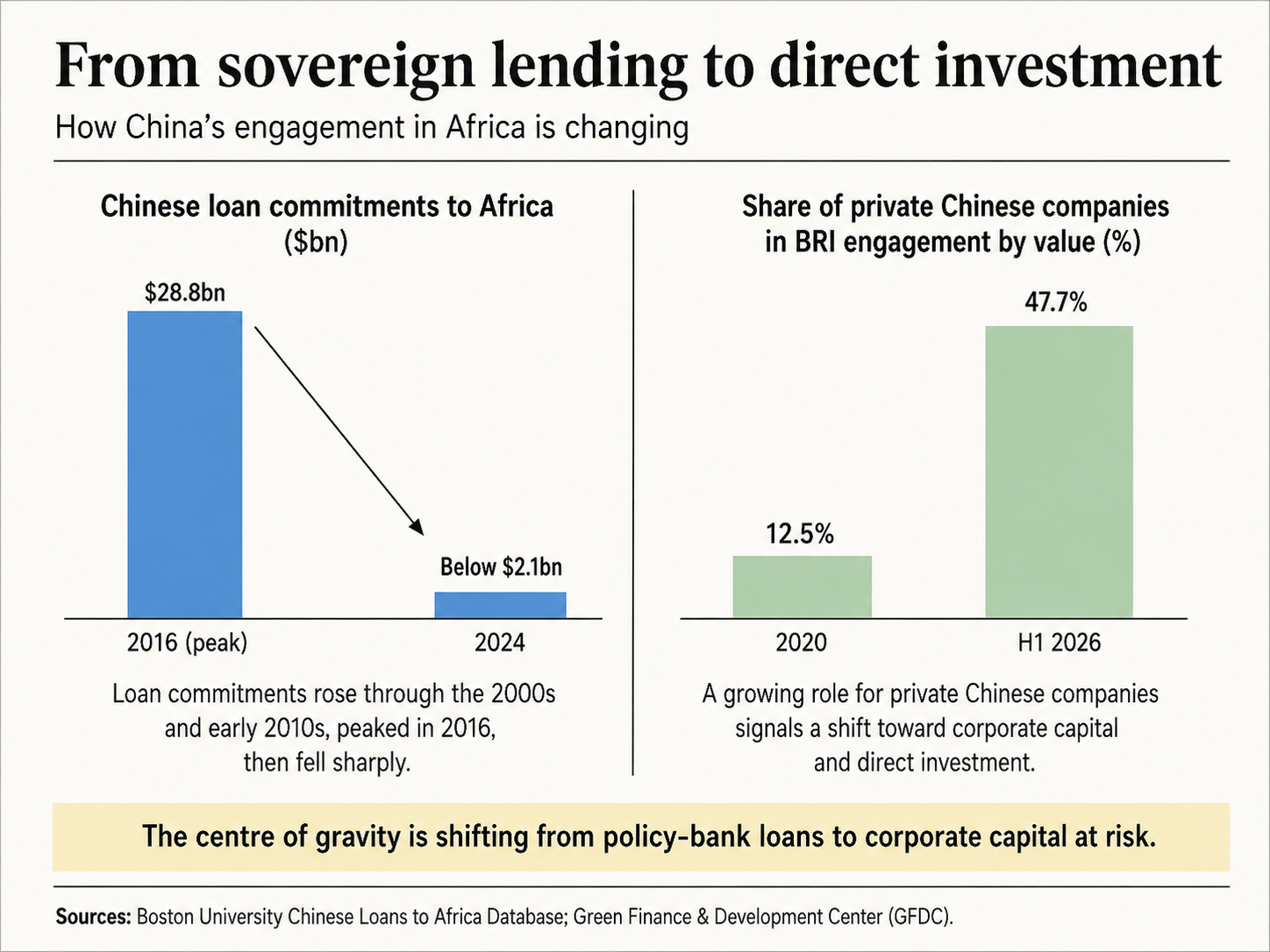
Boston University’s Chinese Loans to Africa Database identifies about $180.87bn of Chinese loan commitments to African governments and regional institutions between 2000 and 2024. Annual commitments reached about $28bn in 2016, but had fallen to just under $2.1bn by 2024.
At the same time, private Chinese companies have become much more prominent within the BRI. GFDC estimates that privately owned companies accounted for 47.7% of global engagement by value in H1 2026, up from 12.5% in 2020.
This does not amount to a withdrawal of the Chinese state from Africa. Policy banks, state-owned enterprises and diplomatic ties remain important. But the commercial mechanism is becoming more diversified.
Under the earlier model, a Chinese bank might lend to an African government, which would then employ a Chinese contractor. Under the newer model, a Chinese company invests directly in a power plant, steel mill or processing facility and earns returns from ownership and operation.
For African governments facing tighter fiscal space, this can reduce the need to place new debt directly on the sovereign balance sheet. But it also gives Chinese companies a more durable presence in national economies. A contractor may leave once a railway or dam is completed; an investor owning a strategic industrial asset can remain for decades.
The more important question for African economies is increasingly not whether Chinese investment brings factories and infrastructure, but how much local value those assets create.
GFDC’s sectoral figures suggest the composition of Chinese engagement is changing. Chinese metals and mining engagement reached a record $21.8bn globally in H1, with roughly 80% involving processing facilities rather than extraction. Manufacturing engagement was entirely investment-led.
For African governments, this offers a potential route away from the longstanding pattern of exporting raw materials and importing higher-value manufactured goods. Steel mills, mineral-processing plants and renewable-energy equipment factories can create jobs and place more stages of production inside African economies.
But physical location does not necessarily determine who captures the value. A factory in Ethiopia, Egypt or Morocco can remain Chinese-owned, dependent on Chinese machinery and intermediate inputs, while the most sophisticated parts of the supply chain remain elsewhere.
Technology transfer therefore becomes a central test. Senegalese economist Mamadou Ndione, cited by The Africa Report, has argued that Chinese investment can allow African engineers to build expertise alongside Chinese companies. Whether that happens depends on workforce training, local procurement, management structures and the ability of domestic suppliers to move into more sophisticated parts of the value chain.
Renewable energy illustrates the tension. Chinese companies can help African economies add generation capacity and establish local manufacturing rapidly. Yet much African solar production still depends heavily on Chinese cells and upstream components. Local assembly can increase industrial activity while leaving control over key technologies elsewhere.
China’s investment strategy is also increasingly intertwined with trade policy, with bilateral trade at CNY1.41 trillion ($209bn) in H1 2026, according to Beijing.
On May 1, China also extended zero-tariff treatment to all 53 African countries with which it has diplomatic relations, widening preferential access beyond the continent’s least-developed economies.
For African governments, that access could become more valuable if Chinese investment helps create the productive capacity needed to export processed and manufactured goods rather than predominantly commodities. It also fits with the ambitions of the African Continental Free Trade Area, which could make individual countries more attractive as production bases serving a wider continental market.
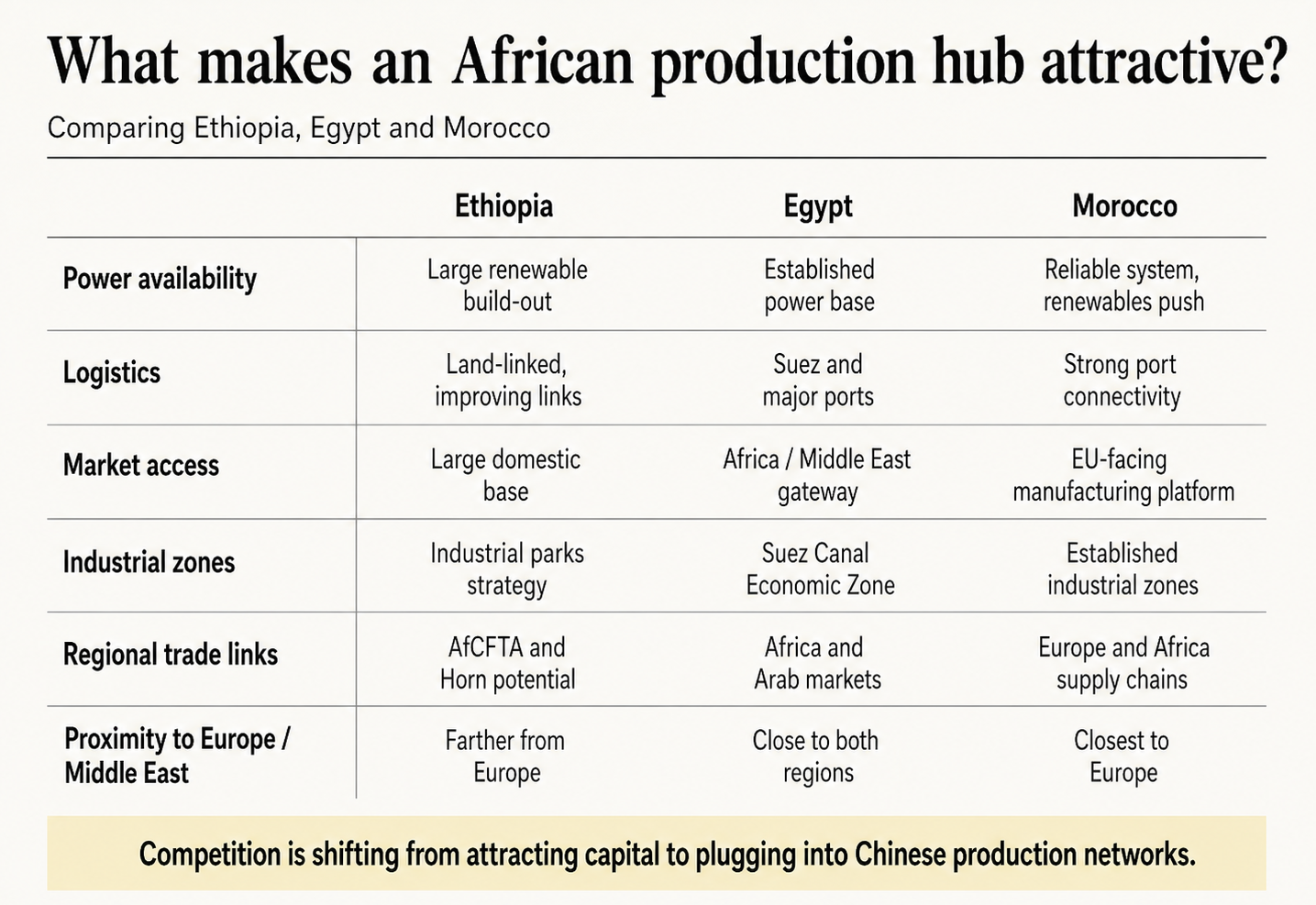
But this creates a sharper divide between countries able to offer reliable power, transport, predictable regulation and access to regional markets and those that cannot.
Morocco has increasingly presented itself to Chinese investors not simply as a domestic market but as a manufacturing platform linked to European and African supply chains. Egypt’s Suez Canal Economic Zone reflects a similar strategy.
The competition among African economies is therefore becoming less about attracting Chinese capital at any cost and more about securing a position within Chinese companies’ international production networks.
The move from sovereign lending towards direct investment changes the nature of economic dependence rather than necessarily reducing it.
Under a sovereign loan, the main risk is the government’s repayment obligation if a project underperforms. Under direct investment, more commercial risk sits with the company and its financiers. But governments can still assume indirect liabilities through land concessions, tax holidays, guarantees, power-purchase agreements and supporting infrastructure.
Nor does local manufacturing automatically reduce reliance on China. An economy can become less dependent on imports of finished goods while becoming more dependent on Chinese capital, machinery, technology and intermediate inputs.
That makes the quality of investment at least as important as its quantity. The longer-term effect will depend on whether domestic suppliers participate, local workers acquire transferable skills and increasingly sophisticated stages of production move into the host economy.
The evidence that China’s economic model in Africa is changing is increasingly persuasive. Sovereign lending has fallen sharply from its 2010s peak, private companies account for a much larger share of BRI engagement, and investment is increasingly directed towards manufacturing, processing and energy assets.
But the $33.5bn H1 record remains exceptionally dependent on a handful of announcements. Ethiopia and Egypt account for more than four-fifths of the total, while the Ming Yang and XinFeng projects alone represent about $24bn of planned investment.
If those projects materialise at anything close to their stated scale, 2026 could mark an important stage in the evolution of China-Africa economic relations: a period in which Beijing’s presence shifted more clearly from financing governments and constructing infrastructure towards owning factories, energy projects and processing facilities.
If they are delayed, downsized or struggle to secure financing, the same numbers will instead demonstrate how quickly BRI announcements can run ahead of realised capital flows.
The IntelliNews PRO service includes access to reports, exclusive market data, and more news that decision-makers care about. Stay ahead of the market with IntelliNews PRO.
Sign Up Now


