
_0_1785753234.png)

China expands nuclear build as capacity overtakes France
5 hours ago
Carbon capture and storage (CCS) - technology that catches CO2 from a factory or power plant and injects it underground - is central to most official net-zero roadmaps, but remains marginal in practice, mired in cost overruns and under preformance, according to a detailed explainer published by Carbon Brief on August 3. CCS is not going to be the pancea to end the Climate Crisis is was sold as.
As of February 2026, 75 operational CCS projects worldwide capture 62.5mn tonnes of CO2 a year (MtCO2) - roughly equivalent to Ecuador's entire annual greenhouse gas output, and under 0.2% of the 38.1bn tonnes the world's fossil-fuel use emits each year. Almost all of that captured CO2 comes from fossil-fuel extraction sites, and around three-quarters of it is pumped back into depleted oil wells to force out more oil - a process called enhanced oil recovery - rather than stored purely for climate reasons. Most of the rest is a by-product of gas purification, meaning the bulk of CO2 "captured and used" today primarily helps the fossil-fuel industry extract and sell more oil and gas.
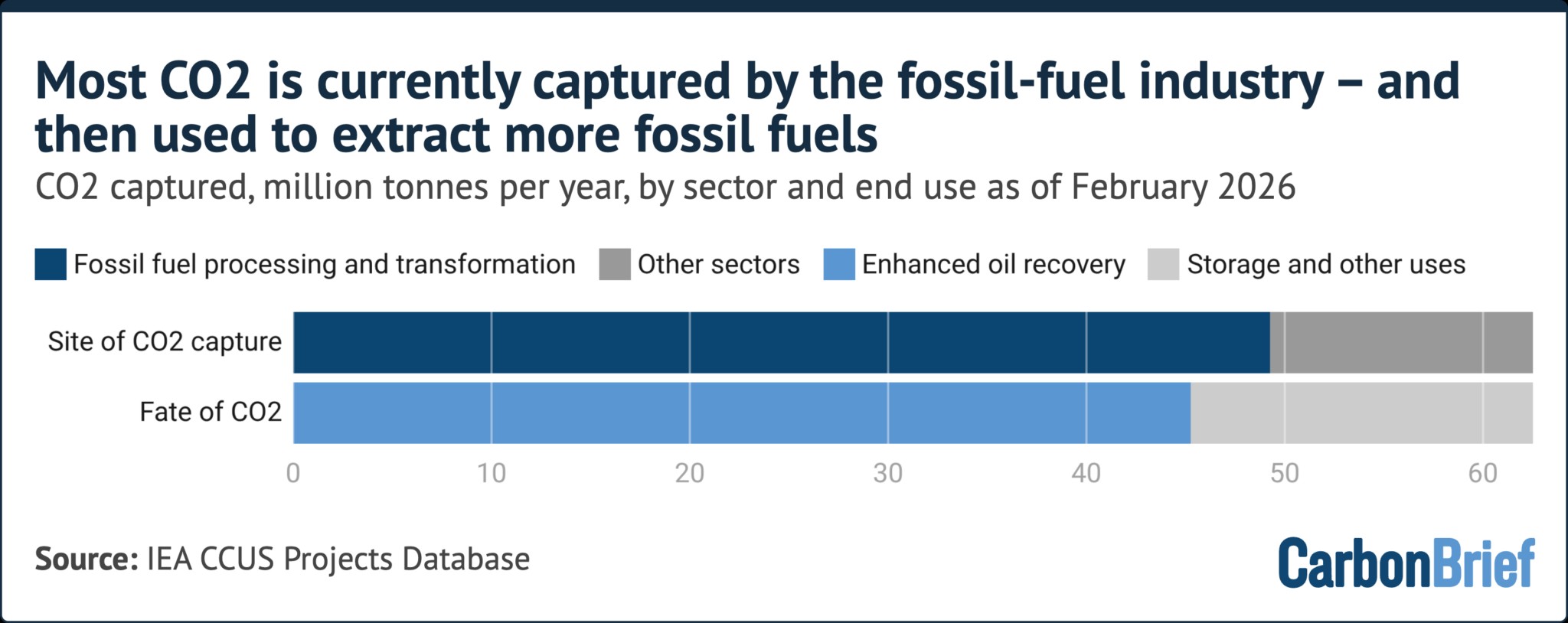
Global CO2 emissions from fossil fuels versus the amount currently captured and stored: 38.1bn tonnes against 0.06bn tonnes. Source: IEA, Global Carbon Budget, via Carbon Brief.
Yet the pipeline is expanding fast: the IEA counts 93.7 MtCO2 of capacity under construction and a further 1,279.6 MtCO2 in planning, though the industry has a long history of cancelling or delaying announced projects. Most net-zero pathways - including the majority of the scenarios assessed by the IPCC that limit warming to 1.5C - lean heavily on CCS to decarbonise "hard-to-abate" industries such as cement and steel, where the IEA calls it "virtually the only technology" that can meaningfully cut emissions. The IEA's own net-zero scenario assumes 1.7 gigatonnes of CO2 captured annually by 2035 - nearly 30 times today's total.
The gap between ambition and delivery is the main line of attack for critics, who call CCS a costly distraction that lets fossil-fuel companies keep drilling. A 2023 University of Oxford working paper found a net-zero pathway that minimises CCS use would cost around $1tn a year less than one that relies heavily on it, and found "no evidence" of the cost reductions from technological learning that CCS proponents have long promised. Performance data compiled by the Institute for Energy Economics and Financial Analysis (IEEFA) shows existing projects routinely fall well short of the 90-95% capture rates regulators and industry consider the baseline for a credible climate technology - ranging from as low as 17% for steel projects up to 80% for hydrogen production.
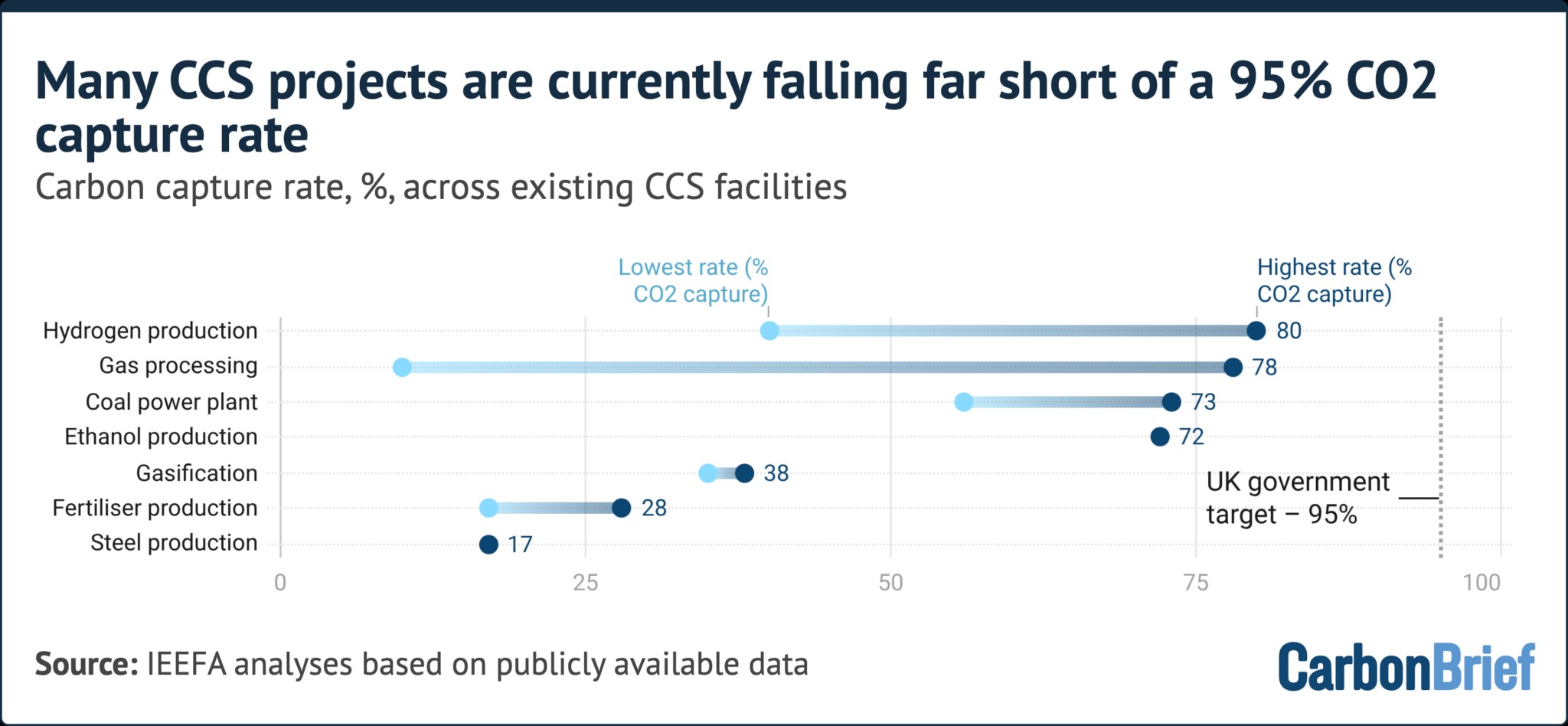
Carbon capture rates achieved by existing CCS facilities, by sector (lowest-highest reported rate), against the UK government's 95% target. Source: IEEFA analysis, via Carbon Brief.
"Is there really any point in trying to decarbonise fossil fuels, which comes with significant technical, timing and additional cost risk?" IEEFA energy finance analyst Andrew Reid asked Carbon Brief, though he added that for cement and chemicals - where low-carbon alternatives remain nascent and expensive - CCS investment "most likely should" be prioritised. CCS advocates counter that some fossil-fuel use, particularly gas power kept as backup capacity, is likely to persist regardless. "If we're going to burn gas, then we should be fitting CCS on that," said Prof Stuart Haszeldine of the University of Edinburgh. "Otherwise we're just going to say it's OK for us to burn lots of gas and carry on emitting."
The UK is Carbon Brief's central case study for how the theory meets practice. The government has committed up to £21.7bn over 25 years - three-quarters of it ultimately funded through consumer levies rather than the exchequer - to build the country's first CCS "clusters" in north-east and north-west England, Scotland and the Humber, aiming to be an "early leader" in the sector. But the UK's own climate advisers, the Climate Change Committee, have cut their CCS capacity assumptions from 46 MtCO2 to 41 MtCO2 between successive carbon-budget reviews, and a 2025 Public Accounts Committee report found the government's cluster-based funding approach "does not ensure" support reaches the sectors that need it most, singling out cement. BP separately withdrew from a blue-hydrogen project at the Teesside cluster at the end of 2025, and the state-backed Net Zero Teesside gas-CCS plant has faced an unsuccessful court challenge over claims its true emissions savings could be as low as a quarter, rather than three-quarters, if it relies on imported gas with high upstream methane leakage.
Elsewhere in the emerging markets bne covers, some economies are cutting industrial CO2 through cheaper routes that sidestep CCS altogether: Thailand's cement industry has cut 3.8mn tonnes of emissions since 2019 simply by substituting clinker, the most carbon-intensive ingredient in cement, for lower-carbon alternatives - a reminder that CCS is not the only lever being pulled on the sector Carbon Brief identifies as most reliant on it.
The IntelliNews PRO service includes access to reports, exclusive market data, and more news that decision-makers care about. Stay ahead of the market with IntelliNews PRO.
Sign Up Now


