
_1_1785989653.png)

_0_1785753234.png)
Babies for cash: Indonesia convicts child-smuggling syndicate
18 hours ago
EU gas storage is refilling at one of its slowest paces in 15 years, and the numbers say the bloc has almost no chance of reaching its 90% target by November.
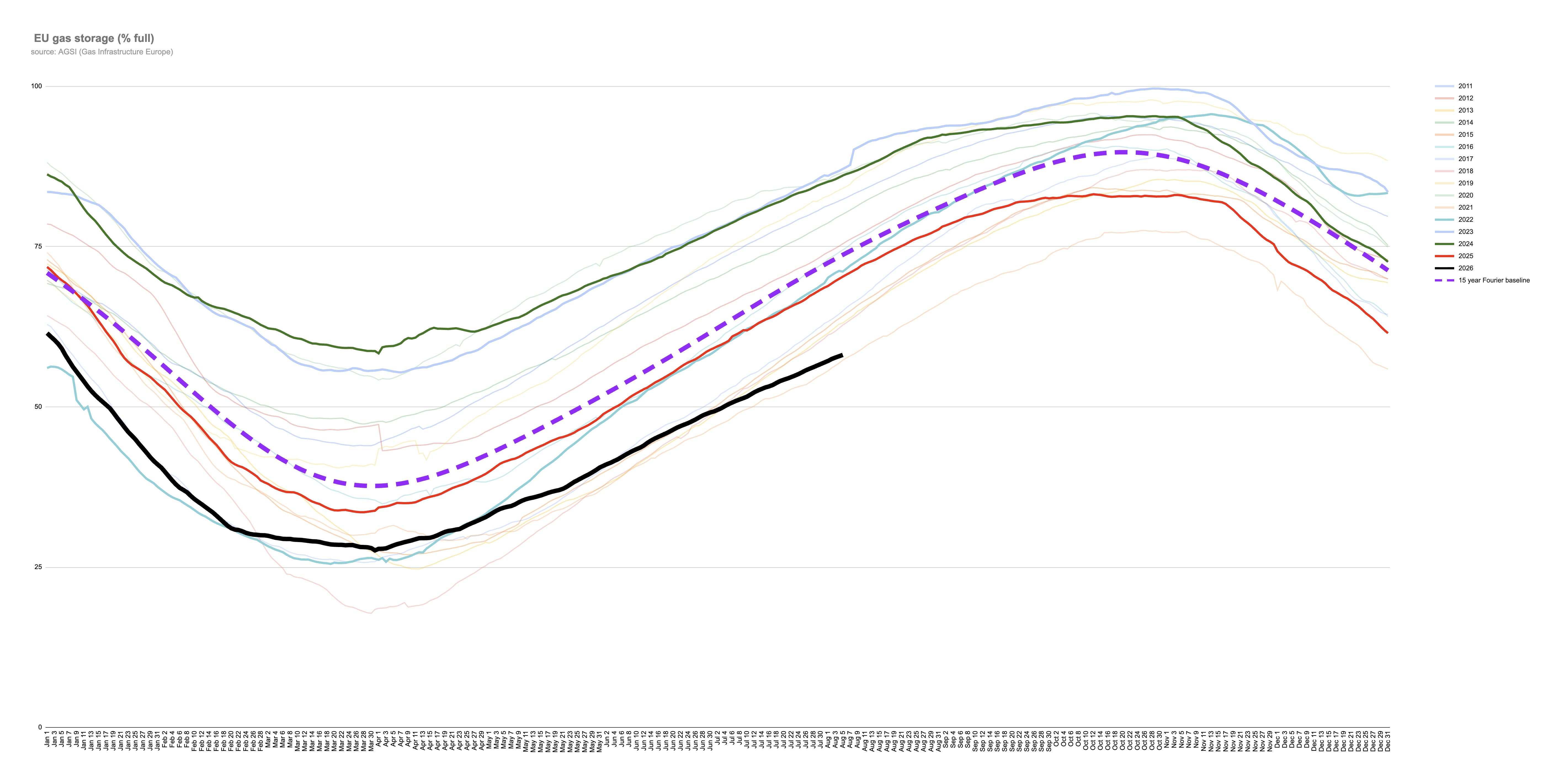
Storage across the EU stood at 58.1% full on August 5, according to Gas Infrastructure Europe (GIE) data - 15.6 percentage points below where the bloc would normally sit on that date, based on IntelliNews Lambda’s seasonal baseline built from 15 years of storage history.
The Fourier-curve model of the EU's seasonal storage cycle, fitted to 2011-2025 data with the crisis years of 2022 and 2023 stripped out, was recalculated this week, and broken out country by country for the first time rather than just for the EU as a whole. The model shows a continent splitting in two: some countries tracking close to a normal year, others falling far enough behind that catching up before winter looks next to impossible.
How the year unravelled
Storage looked strong heading into the winter of 2025/2026. It was back to normal by late November 2025 after months of surging LNG supply and subdued demand, with tanks 77% full and Lambda's deviation-from-trend reading at its narrowest in 15 years. An early-January cold snap barely dented that picture - storage was still unusually full at 85% on January 7 last year, with strong LNG imports into Spain, France and the Netherlands offsetting the extra withdrawals.
And then it started to go wrong. A deep freeze across Germany, Austria and Poland, a precursor to the annual disaster season caused by the Climate Crisis kicked in, pushing daily withdrawals above 500 GWh, and storage dipped below the seasonal trend for the first time that winter by January 18, down almost 10 percentage points in 11 days.
From a comfortable position, by February Lambda's modelling was already warning not only of problems, but that Germany was slipping into a gas crisis and that the EU would struggle to restock over summer - a forecast events have since borne out.
By March, the metrological problems were compounded by geopolitics. With EU storage already thin and tanks going into the restocking season with less gas than normal, Russian President Vladimir Putin put the knife in, suggesting cutting off supplies to Europe early in retaliation for Brussels' phase-out plan.
“If the EU plans to ban Russian gas imports entirely, why should we wait? Let’s cut the gas off ourselves,” said Putin, obviously enjoying the panic he was causing in Brussels. And this to and fro came just as Operation Epic Fury was launched on February 28 taking the whole gas supply crisis up to to the next level. Within a month Qatar’s Ras Laffan LNG plant was bombed to a stand still taking a substantial amount of gas off the market for years. Nor did it look hard to refill Europe’s gas tanks, the EU was now looking at a rerun of the 2022 energy crisis.
Europe ended up skewered on the horns of a contradiction. In Brussels the European Commission (EC) was adamant about a total ban on Russian gas imports due to come into effect on January 1, 2027, the first steps already phased in in April this year. In major European capitals, the governments were buying up every drop of Russian LNG they could get their hands on.
EU imports of Russian Arctic LNG from Novatek's Yamal plant hit a record high in the first four months of 2026, worth an estimated €3.88bn. In February Europe bought every single shipment of LNG produced by Russia's Yamal LNG plant.
The gap between rhetoric and dependency has only widened since. By August, Belgium had become wholly reliant on Russian LNG after the Gulf war choked off Qatari supply, and Ukraine's state gas producer Naftogaz was pleading for another €650mn to repair production facilities hit by Russian strikes
A widening gap from normal
To put a number on how unusual this summer is you need to take a look at the standard deviations from the norm. A mathematical measure of how unlikely things can be, usually two thirds of all outcomes are only one standard deviation from the mean, and 95% of all outcomes are within two standard deviations.
Lambda calculated the base line distribution of gas storage in Europe based on 15 years of GIE data, once the exceptional 2022 and 2023 crisis years are stripped out of the comparison. As a rule of thumb: under two standard deviations is normal variation, two to four is a genuine problem, and anything beyond four is a crisis.
On that measure, Europe as a whole is not doing badly. The EU storage currently sits at -1.56 standard deviations as of August 5 - a meaningful shortfall, but not yet the kind of outlier that defines an actual crisis. Even in an average year, Lambda's baseline only reaches 89% by November 1, just short of the EU's headline 90% target; the amended Gas Storage Regulation in any case gives member states until December 1 to hit the mark, and allows them to fall as low as 80% under unfavourable market conditions. This year is not going to be another 2022.
A two-speed Europe
But severe problems emerge once you start to dig into the details. Two countries are actually already ahead of the game. Poland's tanks were 86.6% full on August 5, 2.1 points above normal (a deviation of just +0.28 standard deviations), while Hungary sat 3.6 points ahead of its own baseline (+0.20) - though Hungary's normal trajectory never gets close to 90% even in a good year, since its own baseline only reaches 70.6% by November 1.
Italy and Austria look worse on paper than they really are. Italy's 76.7% is 5.1 points below its baseline, but that's only -0.95 standard deviations - well within normal variation - because Italian storage is one of the more predictable series in the dataset.
Austria's headline gap looks alarming - 61.5% against a 70.1% baseline, an 8.6-point shortfall - but Austrian storage swings so much from year to year (a standard deviation of 19 points on this date alone) that the anomaly registers as just -0.45 standard deviations, genuinely unremarkable by its own history.
France (-1.23), Slovakia (-1.33) and the EU aggregate itself (-1.56) sit in a middle band: meaningfully behind, but not yet a statistical outlier.
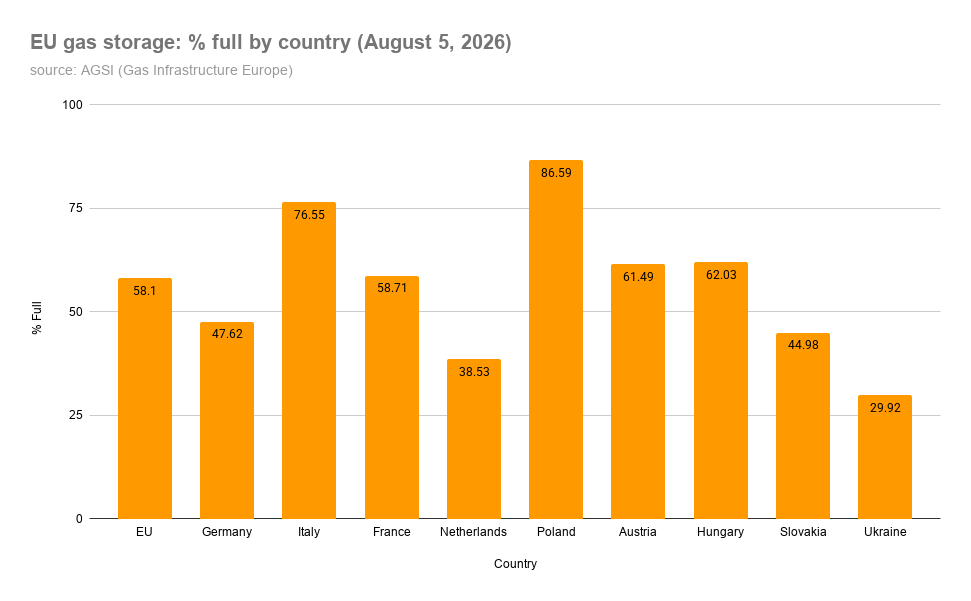
Then comes the problem kids. Germany and the Netherlands are the two genuine outliers and far behind normal. Germany's storage was 47.6% full on August 5 against a normal 75.1% - a 27.5-point gap worth -2.06 standard deviations, crossing into what Lambda's rule of thumb calls "problem" territory.
The Netherlands is worse still in raw terms: 38.5% against a 77.0% baseline, a 38.4-point shortfall, though its unusually volatile storage pattern (a 15.5-point standard deviation on this date, the widest of any series bar Ukraine's) means the anomaly registers as -2.47 standard deviations rather than something even larger.
Another factor that needs to be factored in is the relative sizes of each country's storage tanks. Slovakia's tank is tiny (36.7 TWh, smallest of the nine) — even a 25-point deviation only works out to 9 TWh missing gas, a rounding error at EU scale. France and Austria are mid-sized and their gaps stay modest in absolute terms too.
Germany is the standout problem: its 246.5 TWh capacity is the second-largest of any country here, and it's also 27 points below normal — so it accounts for -67.4 TWh, by far the biggest absolute hole in European storage, more than a third of the entire EU-wide shortfall on its own. The Netherlands has the worst percentage deviation (-38 points) but a smaller tank, so its absolute gap (-54.9 TWh) is real but second to Germany's.
Ukraine actually has the largest tank capacity of any country in this set (320.7 TWh, bigger than Germany's) but since it banned the transit of Russian gas after the start of the war, it no longer takes much gas apart from a few speculative trades from Europe.
|
European gas storage tanks capacity |
|||||
|
Country |
Tank capacity (bcm) |
In storage now (bcm) |
% full |
vs normal (pp) |
Shortfall/surplus (bcm) |
|
Ukraine |
30.4 |
9.14 |
30.00% |
10.9 |
#ERROR! |
|
Germany |
23.36 |
11.17 |
47.80% |
-27.4 |
-6.39 |
|
Italy |
19.28 |
14.8 |
76.70% |
-5.1 |
-0.98 |
|
Netherlands |
13.63 |
5.29 |
38.80% |
-38.1 |
-5.2 |
|
France |
11.75 |
6.95 |
59.20% |
-12 |
-1.41 |
|
Austria |
9.51 |
5.86 |
61.60% |
-8.5 |
-0.81 |
|
Hungary |
6.42 |
4 |
62.30% |
3.9 |
0.25 |
|
Poland |
3.5 |
3.03 |
86.80% |
2.3 |
0.08 |
|
Slovakia |
3.48 |
1.57 |
45.20% |
-25 |
-0.87 |
|
source: IntellINews, 1 bcm ≈ 10.55 TWh |
|||||
Ukraine is the outlier that isn't really comparable. Its 29.9% actual level is technically +4.62 standard deviations above Lambda's own baseline for the country. The real story in Ukraine is qualitative, not statistical: Naftogaz has reported more than 250 Russian strikes on its gas production facilities so far this year, forcing the country to rely more heavily on storage and imports than any seasonal model built for peacetime Europe was designed to capture.
What the data says about November 1
To forecast where storage actually lands by November 1, Lambda doesn't just extrapolate the baseline curve - it looks at what happened in each of the 13 non-crisis years between 2011 and 2025 between today's date and November 1, and applies each of those historical trajectories to this year's actual starting point.
The result is a range of outcomes, not a single number, and the share of those 13 scenarios that clear 90% becomes the model's estimated probability of hitting the target.
For the EU as a whole, none of the 13 scenarios reach 90%. The range runs from 66.5% in the weakest historical year to 82.1% in the strongest, with an average of 74.1% - meaning even a repeat of Europe's best refill season since 2011 wouldn't be enough to hit the target this year. Germany, France, Slovakia and the Netherlands all show the same 0% reading, with projected ranges of 52-75%, 73-89%, 49-88% and 43-72% respectively.
Italy and Poland are the exceptions. Italy's 13 scenarios average 91.6% and clear 90% in eight of them - a 61.5% chance by Lambda's method. Poland does better still: 12 of its 13 scenarios clear the target (92.3%), and several imply storage effectively full well before November, since Poland is already close to its own baseline today. Austria has a genuine but modest chance (15.4%); Hungary shows 0%, but only because its own historical trajectory never reaches 90% regardless of starting point.
So: is this a crisis? By Lambda's own rule of thumb, not yet - only Germany and the Netherlands have crossed into "problem" territory, and none of the real, data-backed series has reached "crisis". But the trajectory is bad enough that the EU as a bloc is very unlikely to hit its 90% target on current form, and the countries furthest behind - Germany, the Netherlands and Slovakia - have essentially no historical precedent for closing a gap this size in three months.
The biggest swing factor from here on in is the same one that broke the pattern last winter: weather. A mild, calm autumn would let injection rates run at their historical average and land the EU somewhere in the 70s; an early cold snap, a repeat of this year's Hormuz-driven price spike, or another shock at one of the world's shipping chokepoints would push the whole distribution lower, and could tip Germany or the Netherlands from "problem" toward "crisis" well before winter even starts.
That leaves Europe's gas story roughly where it was in March and May: stuck between a genuine supply problem and a market that keeps finding enough Russian gas, one way or another, to paper over the gaps.
The IntelliNews PRO service includes access to reports, exclusive market data, and more news that decision-makers care about. Stay ahead of the market with IntelliNews PRO.
Sign Up Now


