


Foxconn posts record August sales in Taiwan on AI server demand
3 hours ago
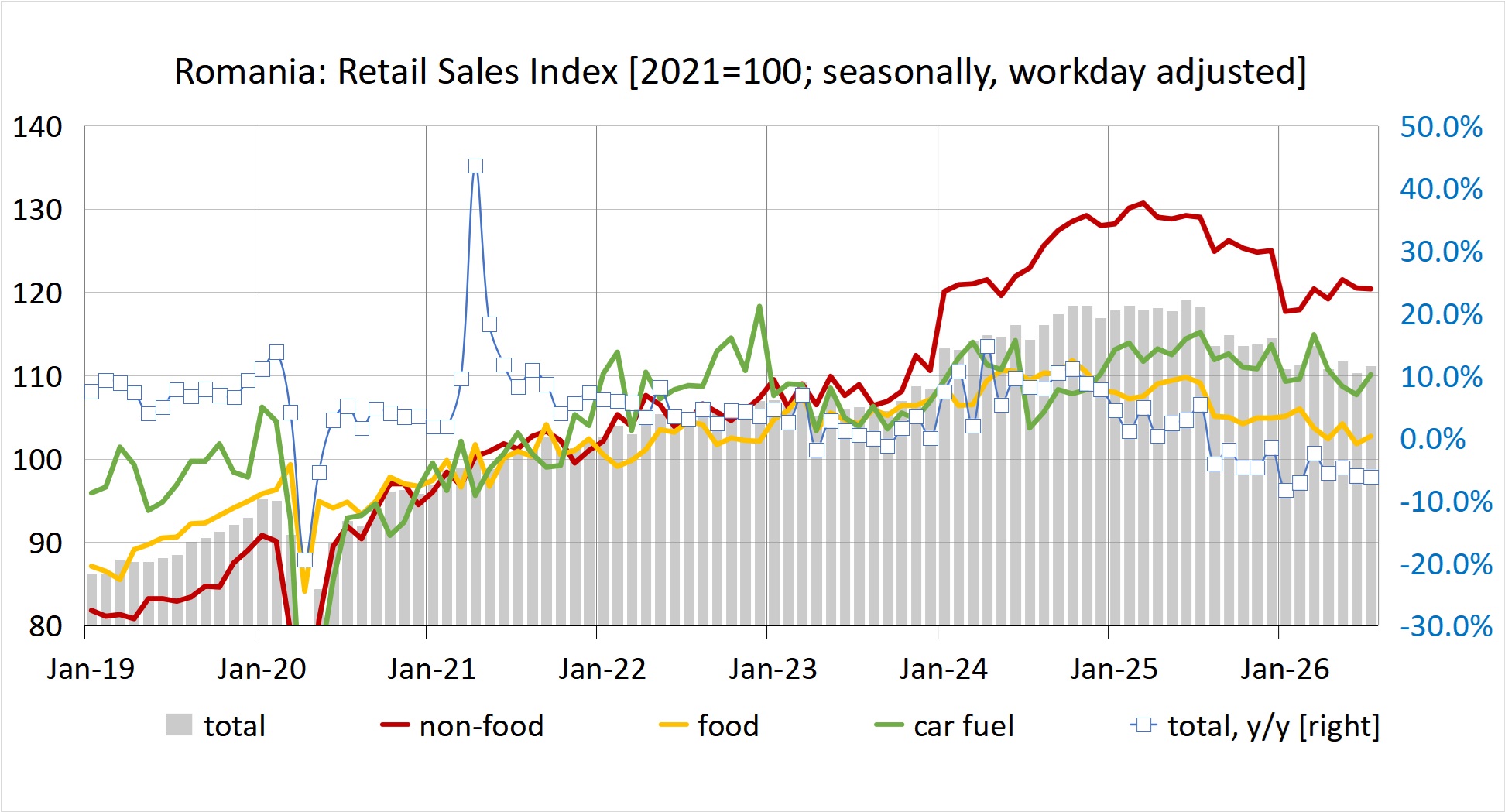
Romania’s seasonally adjusted retail sales volume (chart) remained broadly unchanged in July for the seventh consecutive month, indicating that household consumption has stabilised at the lower level reached after last year’s correction. The index was nevertheless 6.2% below its July 2025 level, according to data published by the National Institute of Statistics (INS).
The annual contraction, which stood at around 5%-6% in the first two quarters of the year, remained at 6.2% in July. The rate should start easing from August as favourable base effects emerge: the VAT rate increase implemented in August 2025 pushed up inflation and reduced households’ real purchasing power.
In seasonally adjusted terms, total retail sales remained roughly 10% above their 2021 average throughout 2026. The exception was March, when sales were temporarily boosted by car-fuel purchases as prices increased and consumers anticipated possible shortages.
The three main retail segments have followed broadly similar downward trajectories over the past 12 months, despite different dynamics beforehand. However, non-food sales have shown signs of stabilisation and a modest recovery in 2026, while food and car-fuel sales have continued to decline.
In July, food sales were 5.4% below their year-earlier level, non-food sales were down 6.4% and car-fuel sales fell 7.0%.
Retail sales remain significantly above 2021 levels
Despite the annual contraction, Romanian retail sales have increased at double-digit rates overall over the past five years. Nevertheless, there were visible discrepancies among the three market segments. In seasonally and working-day adjusted terms, food sales in July were only 2.7% above their 2021 average, while non-food sales were 20.4% higher and car-fuel sales 10.1% higher. Overall, retail sales were 11.2% above their 2021 average.
The increase was nevertheless comparatively modest within the region. Bulgaria recorded a 28.8% increase compared with its 2021 average, followed by Croatia at 19.7% and Poland at 14.2%. In contrast, Hungary recorded a 7.4% increase, while Slovakia and Slovenia posted increases of 3.0% and 4.6%, respectively.
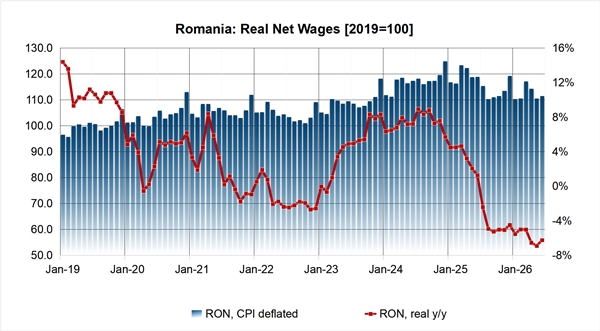
The rise in Romanian retail sales over the past five years was supported and shaped by real wage growth and the expansion of consumer lending.
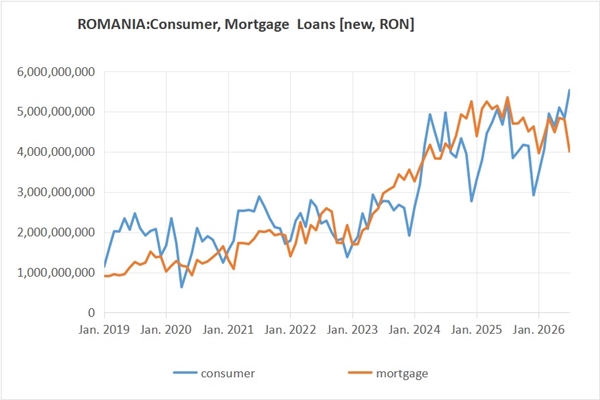
Despite the negative correction compared to 2025, the average net wage in Romania was 5.7% higher in real terms in Q2 2026 than its 2021 average (chart). The average monthly volume of consumer loans was 63% higher than its 2021 average (chart, real terms as well), supporting the stronger performance of non-food sales.
Consumer lending surged in 2024 and has remained relatively stable in nominal, seasonally adjusted terms since then, although its real value has declined since headline inflation accelerated last August. The significantly larger volume of consumer credit compared with 2021 has nevertheless helped keep non-food sales at comparatively high levels, while the erosion of real purchasing power has exerted the opposite pressure.
Retail sales are unlikely to recover significantly in H2 2026, in our view, although annual contraction rates should progressively narrow as the unfavourable VAT-related base effects from 2025 disappear. A more sustained recovery in 2027 will depend primarily on wage dynamics and the broader economic recovery, with fiscal consolidation continuing to weigh on household purchasing power.


The IntelliNews PRO service includes access to reports, exclusive market data, and more news that decision-makers care about. Stay ahead of the market with IntelliNews PRO.
Sign Up Now


_2_1788757992.jpg)
