

,_Tajik_counterpart_Emomali_Rahmon_(right)_AND_Chinese_foreign_minister_Wang_Yi_030926_1788458208.jpg)

Shanghai Cooperation Organization summit comes up short on achievements
2 days ago
Kazakhstan’s appointment of Yerlan Karin as the country’s first 21st-century vice-president has inevitably fuelled speculation that he could eventually succeed President Kassym-Jomart Tokayev. Karin, a longtime presidential adviser and former state counsellor, has spent seven years in senior government positions under Tokayev and has played a prominent role in designing and implementing the president’s reform agenda.
Yet analysts caution against treating Karin's appointment to the newly created position of vice-president as evidence that he has already been selected as 73-year-old Tokayev’s successor. The powers assigned to the 'veep' under Kazakhstan’s new Constitution leave considerable scope for the president to determine the realities of the role.
Tokayev nominated Karin, 50, for vice-presient on August 31, describing him as a “genuine patriot” with extensive government experience. He highlighted Karin’s contribution to major reforms, his “clear vision of long-term state strategy” and his understanding of Kazakhstan’s prospects for socioeconomic development. The country's new single-chamber legislature, the Kurultai, subsequently approved his nomination by 141 votes out of 145.
It was back in January that Tokayev proposed forming the vice-presidency as an institution that would “organically complete” Kazakhstan’s political architecture. Tokayev said the office would help stabilise governance and clarify the hierarchy of state power, while stressing that the presidency would remain “the central pillar of the state system”.
Under the new Constitution, the vice-president acts on the president’s instructions and represents the president’s position in dealings with the Kurultai, the government and other state bodies. Unlike the powers of the chairman of the Kurultai and the prime minister, however, the vice-president’s responsibilities are not defined in detail.
That ambiguity has prompted speculation about whether the post could have been designed as a mechanism for a future transfer of power.
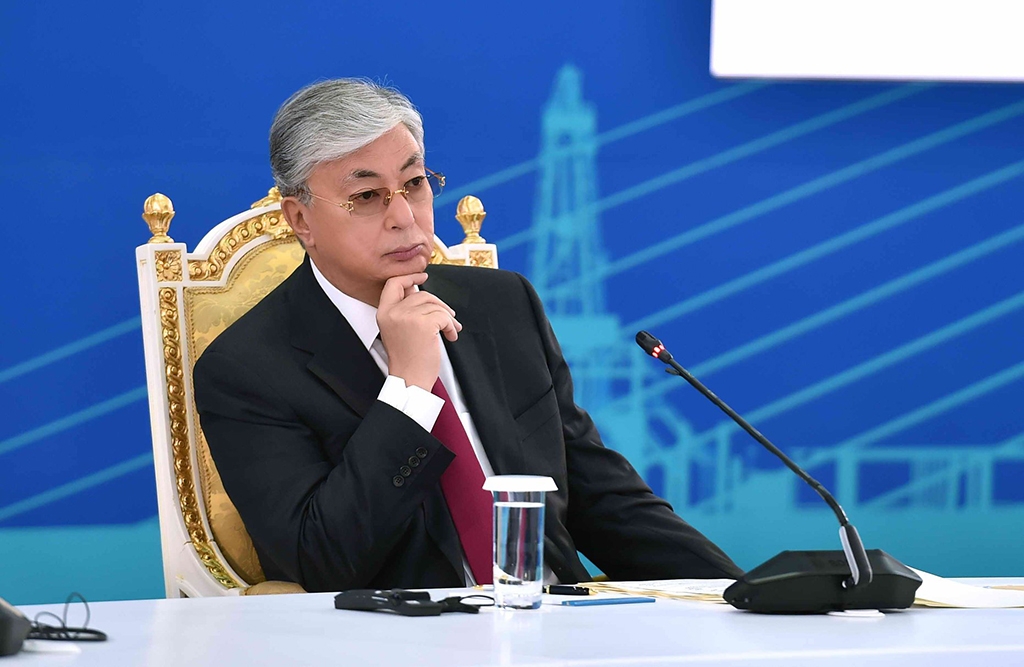
The powers of the new vice-presidency are vague. Only President Kassym-Jomart Tokayev will be able to define their extent (Credit: Akorda press service).
Journalist and political commentator Asylkhan Mamashuly told Azattyq that the vice-president is assumed to hold the second-highest-ranked position in the state after the president but has few powers actually specified in law.
“We call him the person that comes after the president of Kazakhstan, and he himself says so," Mamashuly said. He also noted that the powers and responsibilities of other roles are "written in stone ... the powers of the vice president are not specified at all."
In contrast, "the powers of the chairman of the Kurultai and the prime minister are clearly spelled out," Mamashuly said.
Given this distinction, what purpose does the new vice presidential post actually serve?
A position associated with transitions
"It is written that [the vice president's powers] are determined only by the president himself, that is, the president says ‘the vice president will deal with such and such an issue’, and he will deal with that [issue] only. But since this is a constitutionally high position, his powers should have been clearly spelled out. Yet the Constitution does not say it is so.”
Mamashuly sees an important historical parallel in the return of the office of vice-president. The vice-presidency existed during the early 1990s, when Erik Asanbayev was appointed to the post in the run-up to Kazakhstan’s first presidential election.
“The position of vice president seems to me to be a position that appears during a power transition and then disappears. Perhaps this is the similarity, because we are now on the verge of a power transition, and we can say that it is such a period.”
Asanbayev was chairman of the Supreme Soviet until October 1991, when he was dismissed from that post and elected vice-president by the deputies on the same day. Two months later, on December 1, 1991, he appeared on the presidential election ballot as the vice-presidential candidate alongside Nursultan Nazarbayev.
Mamashuly continued that “of course, it was not a vice-presidential election, but a presidential election, but it was clearly indicated on the ballot. Erik Asanbayev was the most influential person at that time. The reason for his influence was that Erik Asanbayev was a doctor of economic sciences and a respected person as the chairman of the Supreme Council. That is why he was needed: he believed that during the presidential election he would increase the political weight of Nursultan Nazarbayev.”
The arrangement did not last. The vice-presidency was abolished after the adoption of the 1995 Constitution.
“In 1995, when the direction of economic reforms began to be determined, Erik Asanbayev was no longer needed. After all, a new Constitution was adopted, and all power was fully concentrated in the hands of the president. The main thing is that the executive branch changed, a government was formed, and the prime minister began to work independently. Then Nazarbayev took all power into his own hands. The main thing is that trust in the government was established. At that time, the vice president was no longer needed.”
Precautionary measure or succession mechanism?
Mamashuly believes the current vice-presidency is indeed linked to the prospect of a future transition, although he does not regard Karin’s appointment as proof that the succession has already been decided.
“President Kassym-Jomart Tokayev has all the power in his hands, but we all know: he himself said during the previous elections, 'I will not run for president again.' Therefore, there is a power transition ahead, everyone knows and feels it," he argues. “No one can say exactly how the transition of power will take place. I don't think the president himself knows exactly what it will be like. So I think this [vice-presidency] is one of the precautionary measures.”

Karin at the August 31 session of another domestic political innovation of Tokayev, the country's new single-chamber parliament, the Kurultai (Credit: Akorda press service).
Asked whether the current vice-president could be regarded as Kazakhstan’s future third president, he rejected that conclusion.
“This [appointment] does not yet mean that he will ‘become president’. There is at least a year and a half to two years before the election. During that time, different situations can occur, and many things can change. Perhaps it is not surprising that Tokayev himself is determined to run for re-election, but we do not know for sure. In general, in Kazakhstani politics, no one can say for sure that 'this will happen the next day', because the president changes things as he sees fit. Therefore, the position of vice president does not provide any guarantee of becoming president.”
The uncertainty is reinforced by the aforementioned fact that the vice-president’s responsibilities are not defined in detail under the new constitution.
Asked whether the vice-president should be regarded as superior in status to the Kurultai or the government, Mamashuly said the practical authority of the position ultimately depends on Tokayev.
“There is only one way: the president decides what the vice president will do next. That is, the president himself will dictate what the role of the vice president will be. Whether he will be an assistant or a truly independent political figure - only time will tell," he said,
“If he doesn't want to be that, he can just remain as an advisor to the president, performing tasks as a ‘come and go, come and go’,” he added.
For now, “nothing more than an assistant”
Human rights lawyer and political analyst Yevgeny Zhovtis, commenting in an article published by Respublika.kz, likewise acknowledged the intrigue surrounding the appointment but said there was not enough evidence to conclude that Karin had been chosen as Tokayev’s successor.
“But there was also an intrigue surrounding the fact that the position of vice-president was supposedly a kind of springboard to supreme power. In other words, the person appointed vice-president today would be the future president. It is difficult for me to say at this point whether Mr Karin was considered from such a perspective.”
Zhovtis said that, for now, Karin should be viewed primarily as an administrative figure operating under the president rather than as an autonomous political actor.
He added: “Technically, he [Karim] can become president, as stated in Article 51 of the Constitution, but from the perspective of the political process, questions remain.”
Zhovtis also remarked that, for now, “the vice-president should be regarded as nothing more than an assistant.”
He said he believed that the division of responsibilities would be broadly administrative: the vice-president would take on operational management, while Tokayev would retain strategic and foreign policy responsibilities. Under that interpretation, Karin would be expected to focus largely on domestic policy, an area in which he already has extensive experience.
Russian Central Asia analyst and political commentator Arkady Dubnov wrote for Novaya Gazeta that "according to Kazakhstan’s new constitution, the position of vice-president does not imply an independent political profile. The vice-president is not elected on a ticket with the president, as in the United States; rather, he is essentially the president’s chief aide. If he fails to carry out the assignments given to him by Tokayev, the president has the right to dismiss him and appoint someone else in his place."
"This feature of the current system of government is perhaps the most intriguing," he continued. "Does the rise of Erlan Karin to such a high position necessarily mean that he is destined to succeed Tokayev? There is no clear-cut 'yes' to this question."
"The only thing that can be stated with certainty is that Erlan Karin will help Kassym-Jomart Tokayev consolidate his power in Kazakhstan, maintaining the country’s independent status, distancing it from destructive alliances and ensuring its socio-economic development. Incidentally, this was precisely the message Tokayev delivered today to Prime Minister Bektenov as he once again sent him back to lead the government," Dubnov wrote.
Tokayev’s lead ideologue
Karin’s record gives him a strong institutional connection to Tokayev’s reforms. Since 2019, he has served as presidential adviser, assistant to the president, state secretary, state counsellor and first deputy head of the presidential administration.
"Erlan Karin is known as the ideologue of the “New Kazakhstan” and the architect of the “ideas” shaping the Tokayev era," according to Dubnov.
In October 2025, Tokayev appointed Karin to head the working group on parliamentary reform. Karin later became deputy chair of the Constitutional Commission, giving him a direct role in shaping reforms that are now taking effect.
He has also been closely involved in Tokayev’s effort to combine political reform with a particular conception of Kazakhstan’s national identity.
Before entering the highest levels of government, Karin taught history and geography at a school in Aktobe. His academic interests subsequently focused on Kazakhstan and the wider history of the steppe. In 2013, he published Balbaltas: From Orkhon to the Caspian, a study of Turkic stone monuments, and later co-authored a catalogue of historical maps of Kazakhstan as seen from the 17th to the early 20th centuries.
In a 2023 essay on national identity, Karin argued that nation building required the development of state institutions and national identity in parallel. He traced Kazakh statehood through the Golden Horde and the Kazakh Khanate while presenting modern Kazakhstan as a multi-ethnic and multi-religious state. He defined patriotism as an attachment and service to the country rather than through nationalism or xenophobia.
Tokayev has similarly sought to connect Kazakhstan’s historical identity with its current political transformation. Explaining the decision to call the new parliament the Kurultai, he referred to historical gatherings at Talas and Ordabasy, while arguing that the name should connect Kazakhstan’s political traditions with a modern system of government and link the country’s identity to its future ambitions.
The IntelliNews PRO service includes access to reports, exclusive market data, and more news that decision-makers care about. Stay ahead of the market with IntelliNews PRO.
Sign Up Now


_1788348967.jpg)