
_0_1788433617.jpg)

_1788348967.jpg)
Bank Negara Malaysia expected to hold OPR at 2.75%
33 minutes ago
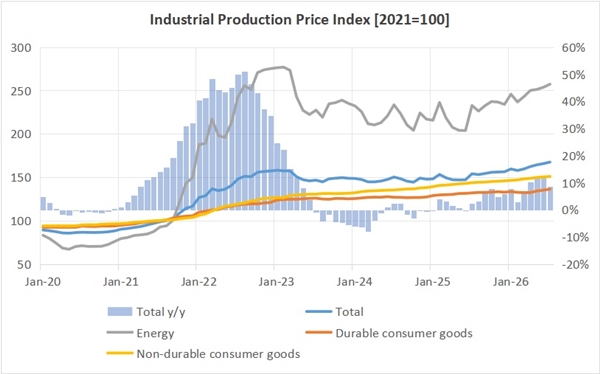
Romania’s industrial producer price inflation (chart) eased to 8.8% year on year and 0.7% month on month in July, from double-digit rates in May and June, according to data from the National Institute of Statistics (INS). However, energy and intermediate goods continued to exert significant upward pressure on industrial prices, which is likely to slow the disinflation of both industrial and consumer prices.
The moderation in annual producer price inflation was largely driven by base effects. Factory-gate inflation accelerated in the second half of 2025 following the liberalisation of electricity prices and has remained elevated more recently amid higher fuel prices linked to the war in the Middle East.
The expected tightening of Romania’s electricity market this autumn could add further pressure to industrial and consumer prices, particularly given the already elevated level of energy costs.
Prices in oil refining increased 5.48% month on month and 44.86% year on year in July, although their longer-term increase has remained broadly in line with the overall trend. Prices in the industry were 66% above their 2021 average, broadly in line with the overall increase in industrial prices over the period.
Energy prices, including electricity, gas and heating, increased 10% year on year in July, slowing from rates above 20% during the second quarter. Despite the moderation, their level remains historically high, at 157% above the 2021 average.
Intermediate goods prices increased 11.4% year on year in July, accelerating from 10.2% in June, 9.1% in May and 5.1% at the end of 2025. Prices in this category were 42% above their 2021 average, indicating continued moderate, if any, cost pressures on consumer prices.
Consumer goods recorded more moderate price increases. Prices of durable consumer goods rose 3.3% year on year in July, while non-durable consumer goods increased 5%. Their prices were 36% and 51% above their respective 2021 averages, respectively.
The moderation of producer-price pressures parallels the recent softening of consumer price inflation, which has also benefited from base effects. The National Bank of Romania has nevertheless raised its full-year inflation forecast to 6.1%, on expected elevated fuels and electricity prices, with consumer inflation not expected to return to the central bank’s target range of 2.5% plus or minus 1 percentage point before the end of 2027.
The IntelliNews PRO service includes access to reports, exclusive market data, and more news that decision-makers care about. Stay ahead of the market with IntelliNews PRO.
Sign Up Now

_3_1788360049.jpg)

