A post-war return of constrained barrels could tip today’s uneasy balance into oversupply, forcing OPEC+ back into a market-share struggle it may no longer control.
WHAT: The risk is not just renewed supply growth, but the simultaneous return of barrels now constrained by war, sanctions and route disruption.
WHY: OPEC+ is already raising targets in small steps even though actual output remains materially below pre-war levels and non-OPEC supply has kept expanding.
WHAT NEXT: If Iran, Russia-linked flows and safer Red Sea and Gulf routes recover together, the group could face another race to the bottom in defence of market share.
This is the third of a three-part series on the outlook for OPEC and its oil-producing partners.
For much of this year, the oil market has been balanced less by deliberate management than by lost barrels. The war centred on Iran, repeated disruption around the Strait of Hormuz and fresh insecurity in the Red Sea have kept part of the Gulf system operating below its normal capacity, while the war in Ukraine has continued to distort Russian flows and freight patterns.
Libya and Venezuela have remained erratic suppliers for their own reasons, but the broader point is that the current equilibrium has emerged under abnormal conditions.
That matters because the market now appears to be functioning at price levels and physical balances that assume those constraints persist. If that assumption breaks, the adjustment could be abrupt. A market that has learned to live with disruption may discover that it has much less room for returning supply than recent price action suggests.
Quotas rising before the war ends
Reuters reported on July 23 that seven core OPEC+ producers are likely to approve another increase of roughly 188,000 barrels per day for September when they meet on August 2. The same group – Saudi Arabia, Russia, Iraq, Kuwait, Algeria, Kazakhstan and Oman – has already approved comparable increases for June, July and August, continuing the phased unwinding of the 2023 cut.
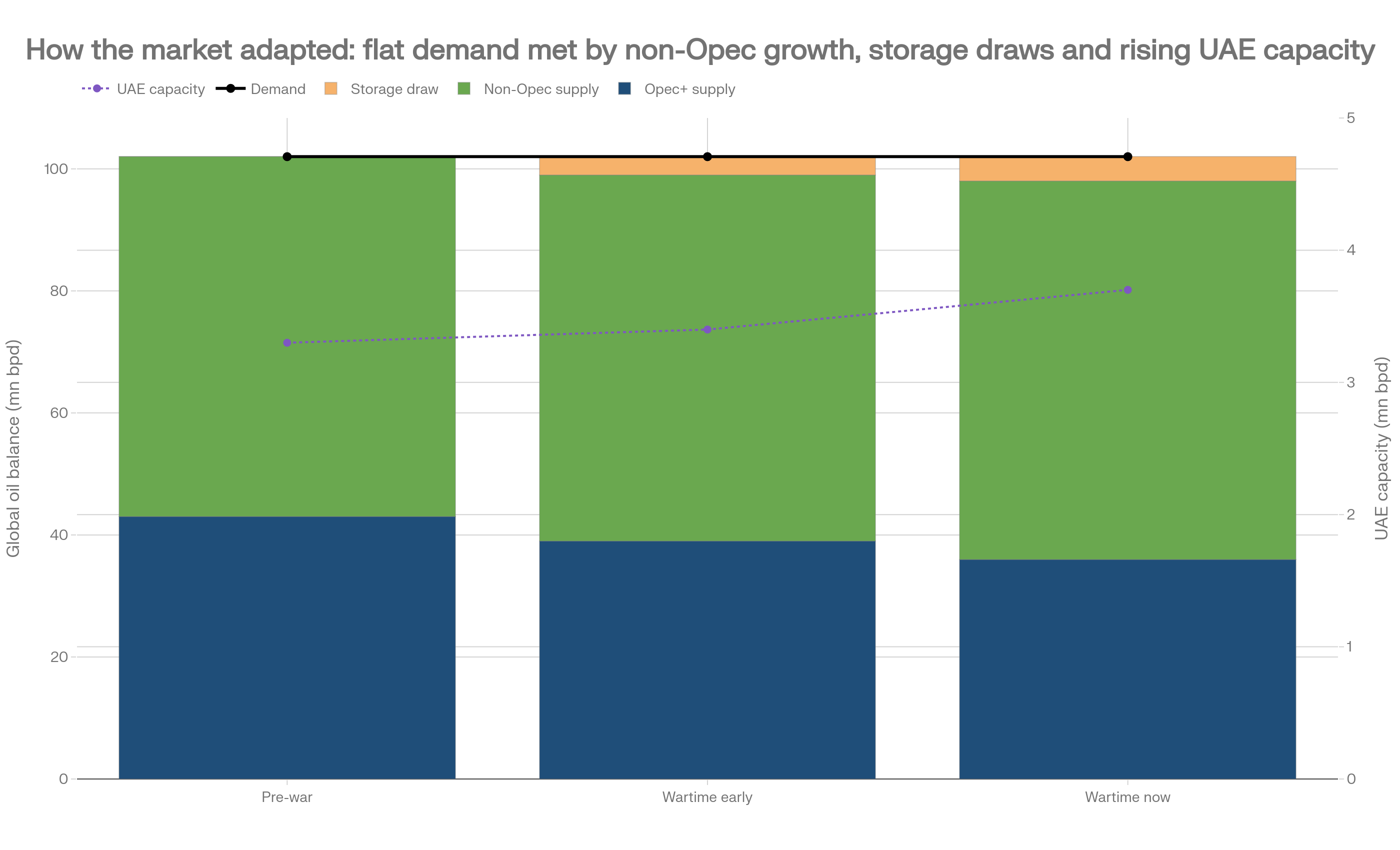
That alone would not be especially dramatic. What gives the move significance is that the increases are being discussed while actual supply remains far below what the group was producing before the Iran war disrupted Gulf exports. OPEC+ output was 36.28mn bpd in June, down from almost 43mn bpd in February before the war began. In effect, the alliance is restoring quota room on paper while several million barrels per day are still unavailable in practice.
The hidden surplus question
This is where the coming glut comes into view. If the market has reached a rough equilibrium while OPEC+ is producing nearly 7mn bpd less than it was in February, then a partial return of those disrupted volumes could change the balance quickly.
Not all of that gap would come back at once, and not all of it is attributable solely to war, but the scale of the difference is still large enough to expose how contingent today’s balance really is.
The wars have effectively delayed a reckoning over spare capacity and market share. They have given OPEC+ cover to talk about gradual restoration while masking the far larger question of what happens when the trapped barrels are no longer trapped. Once that happens, the market will no longer be judging marginal quota adjustments in isolation; it will be weighing them against the physical return of flows from the Gulf, the Red Sea and other conflict-affected supply chains.
More than an Iran story
Iran is central to that risk, but it is not the only moving part. The collapse of a preliminary US-Iran peace understanding helped push prices back towards $100 a barrel because it revived fears over Gulf exports after a brief period in which shipments through Hormuz had improved. That episode underlined how much of the current pricing structure still rests on route risk rather than underlying scarcity.
Ukraine adds a second layer. Russian crude has continued to reach the market, but under altered routes, discounts and political constraints. Any eventual easing of that conflict would not necessarily produce a single dramatic jump in Russian exports, but it could make those barrels more competitive, cheaper to move and harder for others to displace.
The same logic applies, in a smaller but still relevant way, to Yemen-linked Red Sea disruption: the end of route insecurity would not create new reserves, but it would make existing supply easier to place.
UAE on the other side
This looming test is made harder by the fact that one of the Gulf’s most ambitious producers is no longer bound by OPEC discipline.
Reuters reported in May that ADNOC Drilling was ready to support UAE capacity growth beyond 5mn bpd by 2027 if asked, while Suhail al-Mazrouei reiterated that capacity could reach 6mn bpd should market conditions require it. Upstream reported on July 23 that ADNOC is now examining a faster route to 6mn bpd, adding to the commercial optionality Abu Dhabi gained after leaving OPEC.
That shift matters politically as well as commercially. In earlier cycles the UAE’s growth ambitions had to be balanced inside the group, however awkwardly. Now they sit outside it. If a post-war recovery in Iranian and wider regional supply coincides with Abu Dhabi accelerating capacity, the old cartel calculus becomes harder to maintain because one of the region’s most expansion-minded producers is no longer tied to the same discipline.
Defence: price vs market share
There are signs that this change in mindset is already under way. Reuters said the current sequence of quota increases is being pursued partly in the expectation that members will want to recapture market share once the war ends. That is a revealing formulation. It implies that the debate has already started to shift from how to support prices to how to hold customers.
That distinction is critical. Supporting prices requires cohesion and restraint. Defending market share tends to reward speed, spare capacity and tolerance for weaker prices. Those are not evenly distributed across OPEC+. Saudi Arabia can endure a period of softer prices better than many members, but even it faces fiscal strain when crude remains well below its preferred range. Others, especially the more fragile producers, may want price defence but lack the credibility or spare capacity to compel it.
Old tensions returning
The group has seen this tension before. Earlier OPEC+ arrangements repeatedly exposed the difficulty of reconciling quota discipline with national ambitions, especially when members believed they had urgent budgetary or strategic reasons to produce more.
Past disputes involving Saudi Arabia, the UAE and Iraq showed how quickly the language of collective stability can give way to arguments over fairness, compensation and competitive positioning.
The difference this time is that the market backdrop may be even less forgiving. OPEC+ has less unilateral pricing power than it did a decade ago because non-OPEC supply remains substantial and resilient. Official US projections have shown OPEC+’s share of global liquids production falling in 2025 and 2026, while wider datasets continue to point to growth from large non-OPEC producers.
If the group tries to flood the market to discipline competitors, it may inflict more pain on its own members than on the rivals it hopes to pressure.
Risk of racing to the bottom
That is why the phrase “race to the bottom” no longer looks exaggerated. If quota restoration continues into the autumn and wartime disruptions ease at the same time, supply could rise through two channels simultaneously: formal policy changes and the physical return of constrained barrels.
In that setting, members would have to decide whether to pause and defend price, or keep producing and risk a sharper deterioration in the market in order to hold on to customers.
Saudi Arabia may still be the only producer capable of acting as a genuine swing supplier at scale, but even that role looks harder to perform in a more fragmented system.
The UAE is freer than before, Russia remains too important to ignore, Iraq has a long record of difficulty with compliance, and Iran’s own trajectory is tied to war and diplomacy rather than cartel procedure. OPEC+ can still announce a collective position. Whether it can enforce one in a post-war glut is another matter.
The return of withheld barrels
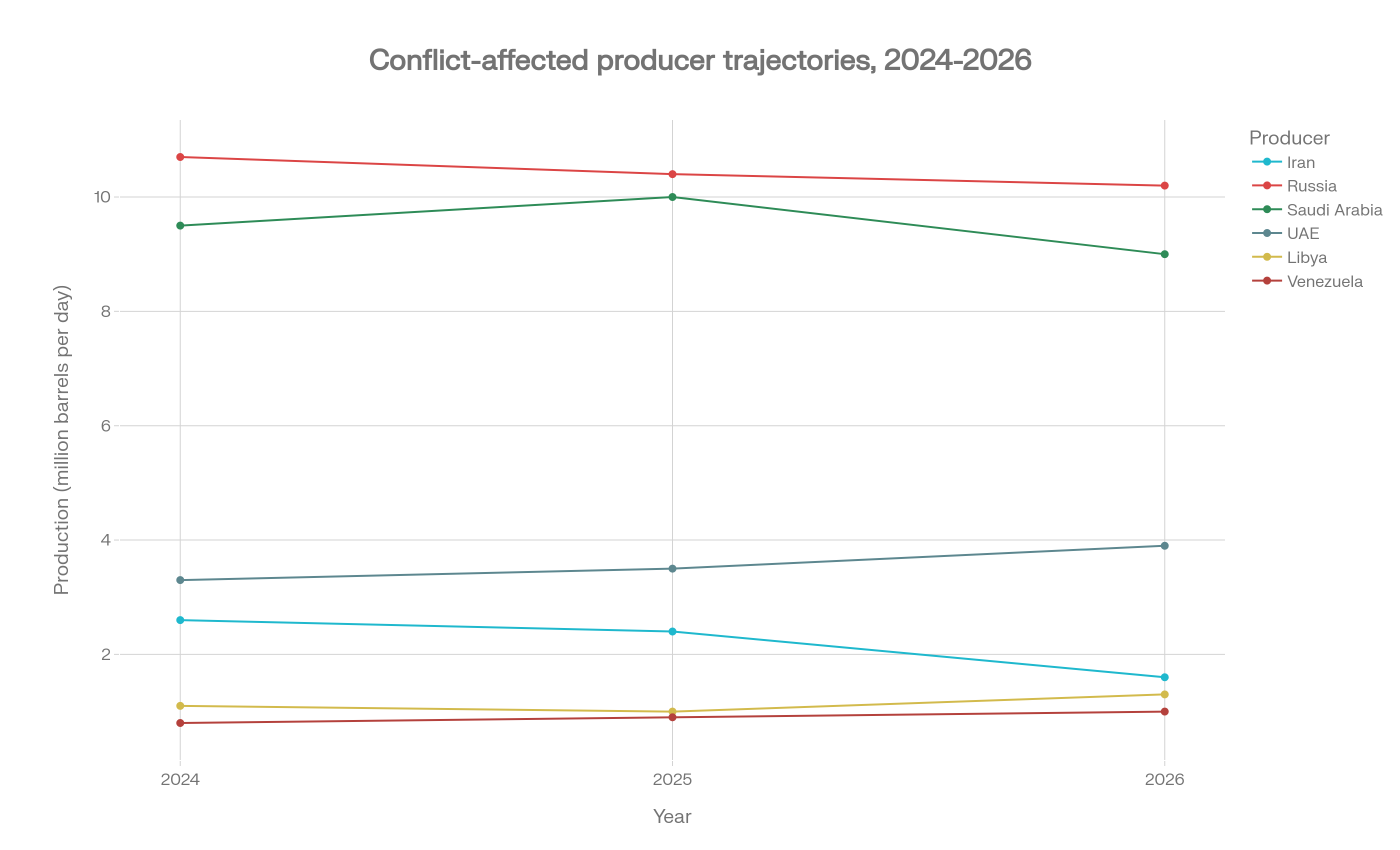
OPEC+ is restoring quota room in small increments even though actual production remains well below pre-war levels because conflict is still suppressing flows from key members.
Iran, Libya, Venezuela, Russia, Saudi Arabia and the UAE are all moving on different trajectories, but together they illustrate how quickly spare or constrained supply could reappear if multiple conflicts eased at once.
None of this guarantees a glut. Peace processes can fail, damaged infrastructure can slow the return of output and demand may absorb part of the rebound. But the more uncomfortable possibility is now plain enough: the market’s apparent balance may owe more to wartime constraint than to underlying tightness. If so, the end of the conflicts around Iran and Ukraine, and perhaps Yemen too, would not restore order so much as expose a surplus the market has temporarily been spared from confronting.
That would leave OPEC and its partners facing a familiar but more difficult choice. They could try to defend price through renewed restraint, at the risk of ceding customers to rivals and to the UAE outside the system. Or they could defend share and accept lower prices in the hope of wearing others down. Either course would amount to an admission that the post-war market may be harder to control than the wartime one.
Don’t just follow the news—understand it.
The IntelliNews PRO service includes access to reports, exclusive market data, and more news that decision-makers care about. Stay ahead of the market with IntelliNews PRO.
Sign Up NowRelated Articles
Riyadh's Red Sea lifeline comes under fire
Confronted with a Houthi naval blockade and burning tankers off Yanbu, Saudi Arabia's carefully engineered workaround to Hormuz is unravelling just as Asian refiners scramble for alternatives. ... more
Houthis strike Saudi tankers as Red Sea route unravels
Yemen's Houthi movement said it struck two Saudi oil tankers in ... more
Iran steps up strikes on Kurdish bases in northern Iraq,Yemenis hit Saudi tankers in Red Sea
Iran has intensified drone and missile attacks on Iranian-Kurdish opposition bases in Iraq's Kurdistan region, with fresh strikes on Erbil and Sulaymaniyah reported on July ... more