


Fedorov's popularity surges after sacking as Ukraine protests continue
6 hours ago
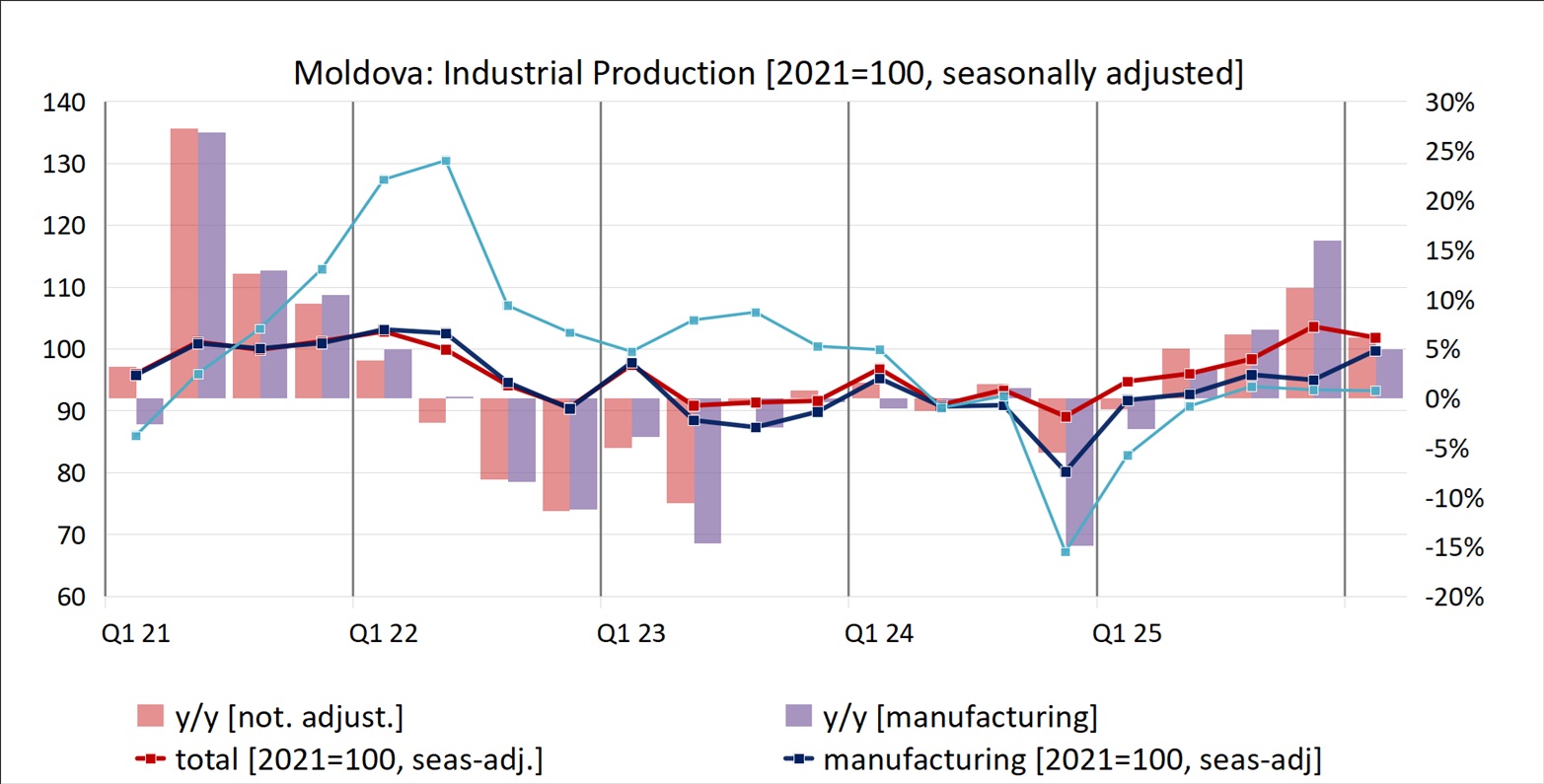
Moldova’s industrial output (chart) increased by 6.1% year on year in the first quarter of 2026, slowing from 11.2% growth in the previous quarter and from the 5%-6% annual expansion rates recorded in the preceding two quarters, according to data published by the National Bureau of Statistics (BNS).
Despite the solid annual growth, the figures continue to reflect a short-term recovery cycle rather than a sustainable medium-term expansion. In absolute terms, industrial production in Q1 was only 1.8% above the average level recorded in 2021.
Moldova’s industry has struggled to generate sustained growth in recent years despite labour costs remaining below those in European Union member states.
The shortage of labour, following large-scale migration of Moldovan workers to EU countries, and the insecurity linked to the country's positioning have constrained the industrial expansion of foreign investors. Investors also cite energy insecurity, worsened by the Middle East crisis and the war in neighbouring Ukraine, as a major obstacle to large-scale manufacturing investment.
Net foreign direct investment (FDI) eased to 1.8% of GDP in 2025 from around 2% in 2023-2024, extending the gradual decline from the 3.8% of GDP peak recorded in 2022 when the war in Ukraine began putting an end to a positive trend. Furthermore, only a small part of FDI was poured into industrial assets, with the banking, retail and real estate prevailing.
The country’s industrial sector remains heavily concentrated in food and beverage production, which accounts for roughly one-third of total industrial output and contributes to elevated volatility linked to agricultural conditions and trade flows.
Food production expanded by 13.3% year on year in Q1 after surging by 40.4% in Q4 2025. However, in seasonally adjusted terms, output in the segment remained 6.8% below the 2021 average in Q1. Even during the previous quarter’s sharp expansion, production was still 6.7% below the 2021 benchmark, highlighting the importance of base effects after a deep contraction a year earlier.
Beverage production declined by 14.7% year on year in Q1, although output remained 3.4% above the 2021 average in seasonally adjusted terms.
Among other key industrial branches, the manufacturing of metallic constructions recorded the strongest performance. Output in the segment surged by 46% year on year in Q1 and stood 69% above the average level recorded in 2021.
Other important sectors include the production of non-metallic minerals such as cement, glass and construction materials, as well as vehicle parts manufacturing.
The IntelliNews PRO service includes access to reports, exclusive market data, and more news that decision-makers care about. Stay ahead of the market with IntelliNews PRO.
Sign Up Now


