


RAGOZIN: Ukraine corruption leaks put ‘control’ of graft at heart of political crisis
2 days ago
Europe's gas traders have spent the summer betting that the Gulf war would end before the heating season starts, giving them time enough to restock Europe’s gas tanks. That bet has gone badly.
European gas storage currently stands at about 63% of capacity against a five-year average of 79%. Macro-Advisory, the Eurasia consultancy, said in EU Gas Dilemma note published in August that governments "may very soon force traders to start buying." And that could be very expensive. Investment banks are starting to warn of a repeat of the 2022 energy crisis with price of gas tripling to over €100/MWh once the weather turns colder, which will "start an LNG price war with Asian buyers".
Gas in Europe and LNG in Asia both cost just over double what they did a year ago.
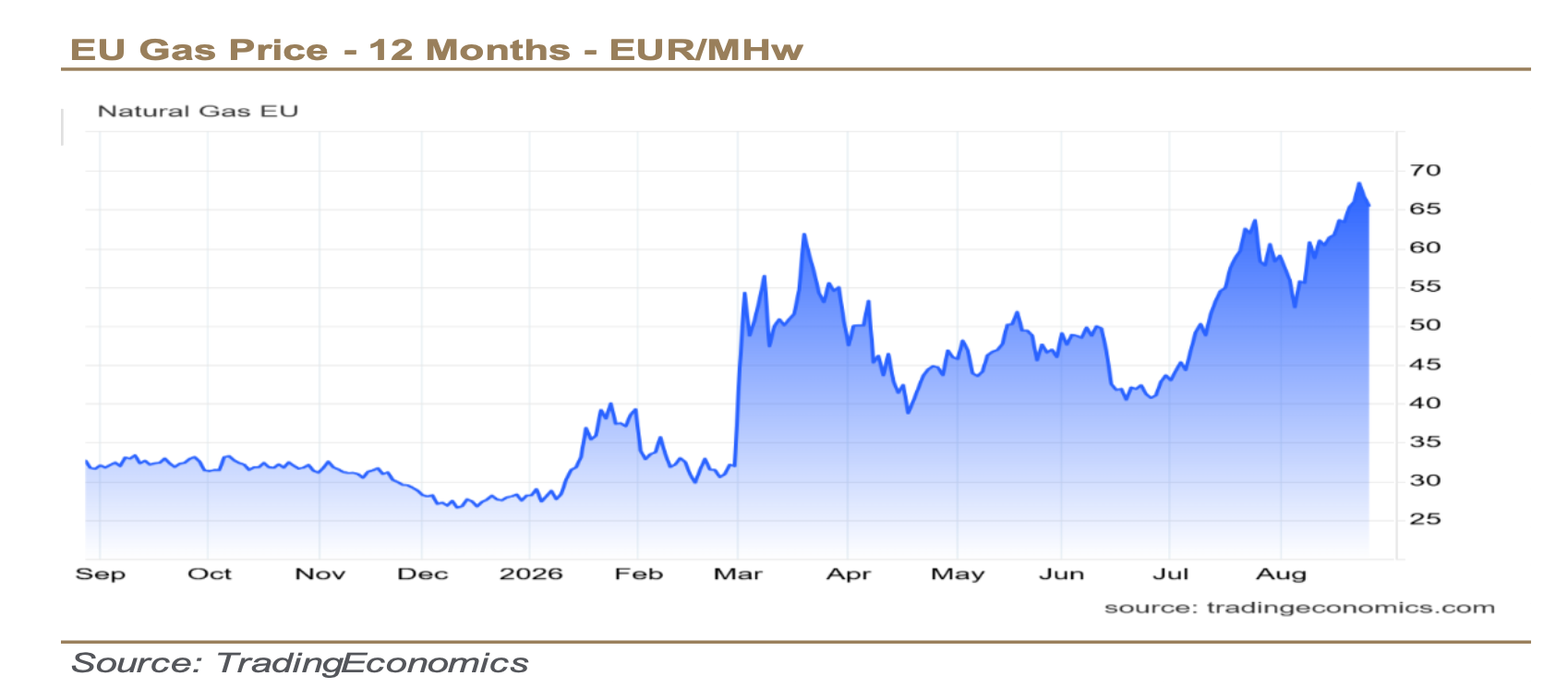
The European benchmark gas price over 12 months, €/MWh. The step change in March is the attacks on Iranian and Qatari infrastructure. Source: TradingEconomics, via Macro-Advisory.
The big change from 2022 is that not only has Europe largely been cut off from Russian gas, but this year the LNG supplies from Qatar have also disappeared thank to the Iran war. Doha says it cannot resume exports because of damage sustained to its Ras Laffan LNG plant, with full repair at 12 to 36 months out. “If that is right, the market has been pricing a supply return that is one to three years away as though it were weeks away,” and the storage deficit is the accumulated cost of the error.
Not all of Europe’s gas tanks are empty. As IntelliNews reported, many countries like Italy and Poland are on track to hit the EU’s mandatory benchmark of 90% full by November 1. Italy was about 82% full and France 67%. The problem children are Germany with 51% and the Netherlands with only 45% of tanks capacity used. Germany is the vulnerable one and also the largest in Europe, but high prices have prevented traders from buying gas during the restocking summer season.
The deficit has raised the risk of power outages in some EU states this winter, according to Macro Advisors, depending on the weather, and "for 100% certain, the price of electricity will be higher".
Then there is the sanctions timetable. The EU has legislated Russian gas out of existence and will ban imports of Russian gas completely by January 1. Short-term LNG contracts have been banned since April 25; all LNG imports go on January 1, 2027; long-term pipeline contracts follow on September 30, 2027, or November 1 if member states face severe storage emergencies.
So, buyers are loading up while it is still legal. The EU bought €809mn ($942mn) of Russian LNG in June, 57% more than a year earlier, giving Russia 24.1% of the bloc's LNG market by value against the US on 54.3%. Belgium - the seat of EU executive and legislative power - was the single biggest buyer at €268mn ($312mn), ahead of France on €258mn ($300mn) and Spain on €201mn ($234mn), and it overtook France and Hungary as the largest buyer of Russian gas of any kind.
Pipeline flows tell the same story in the other direction. The bloc imported a further €542mn ($631mn) of Russian pipeline gas in June, 12.5% of the value of all pipeline gas imports, with Norway leading on 33.3%, Algeria on 23.6% and the UK on 18.8%. TurkStream is the only route still carrying Russian pipeline gas into Europe. Hungary remains the largest buyer at €1.3bn ($1.5bn) in the first half, down 12.5% y/y, then Bulgaria on €704mn ($820mn) and Greece on €539mn ($628mn).
Across the first half Russian LNG purchases came to €4.5bn ($5.24bn) and total EU spending on Russian gas of all kinds fell just 3.4% y/y to €7.4bn ($8.62bn). June volumes of Russian LNG were 2.17 bcm, up 10%, on Bruegel figures. "Volumes rising into those deadlines look less like weaning and more like stocking up while it is still legal," the note says.
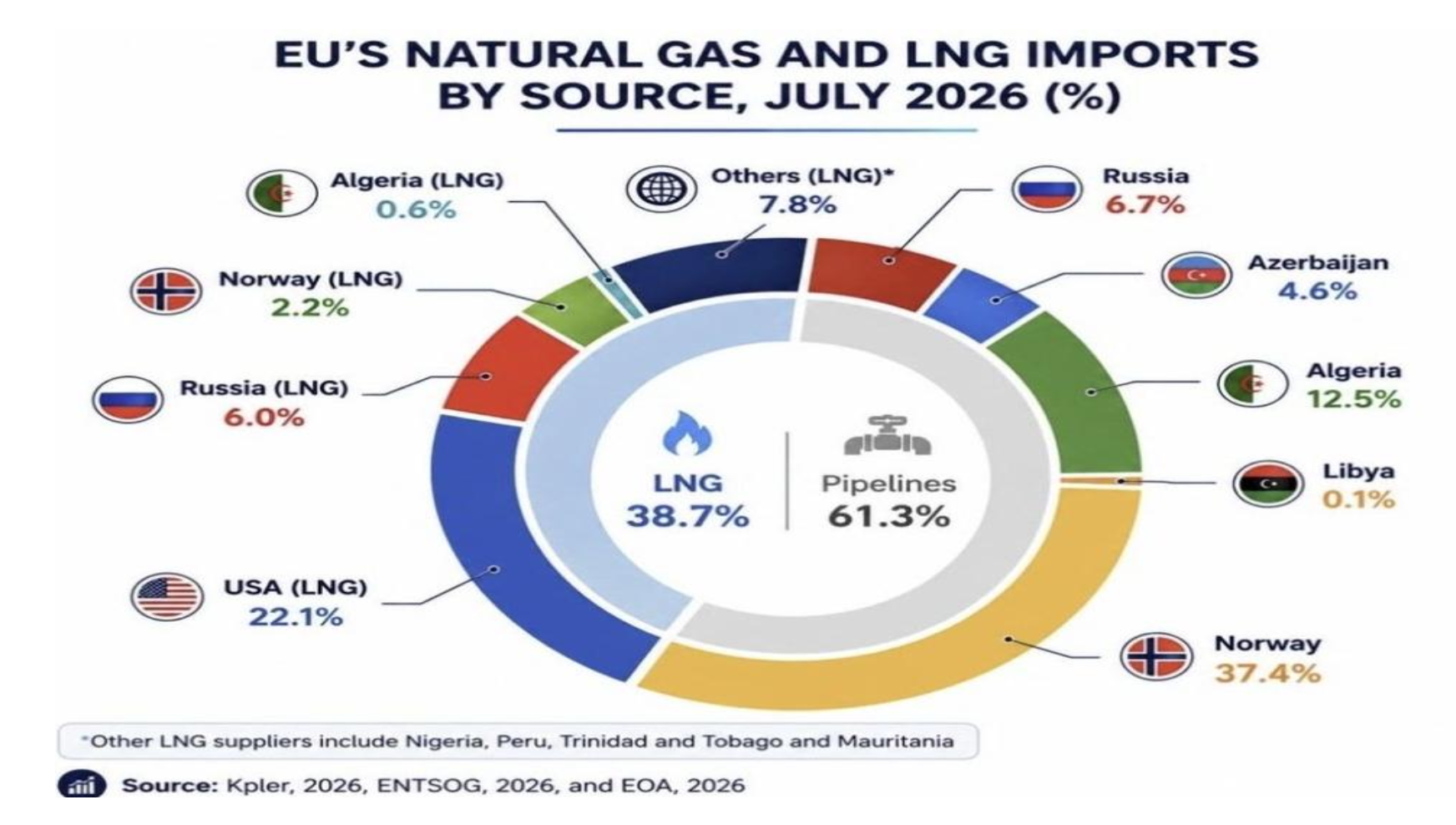
Where the EU's gas came from in July 2026. Pipelines were 61.3% of the total and LNG 38.7%; Russia supplied 6.7% by pipeline and 6.0% as LNG. Source: Kpler, ENTSOG and EOA, 2026, via Macro-Advisory.
With Europe threatening ban Russian gas completely, Putin turned the tables on Europe and threatened to cut Europe off early rather than wait to be pushed. That would exacerbate the potential crisis as Europe remains addicted to Russian gas. Deputy Prime Minister Alexander Novak said Russian companies would redirect LNG to China, India, Thailand and the Philippines. Russia supplied Europe with 38 bcm of gas in 2025, just over 20 bcm of it as LNG.
The alternatives all fail on timing rather than on volume. New US LNG capacity arrives too late for this winter and perhaps for 2027-28, and Washington has warned it may restrict exports as data centres and AI drive domestic power demand. Azerbaijan is promising more piped gas but the TAP and TANAP pipeline projects need significant capacity upgrades first, which takes "several years". Turkmenistan has the reserves and sells over 80% of its gas to China, but it is on the wrong side of the Caspian: a new trans-Caspian pipeline, or an LNG plant in Turkey, is still at the talking stage because nobody will commit until they know when Gulf supply returns.
Every one of those routes is waiting on the same unknowns, which is why none of them is being built.
Macro Advisory has also flagged a competitiveness argument that outlasts the winter. If Russia sells its LNG into Asia at prices below what the US charges Europe, European chemicals and other energy-intensive manufacturers face a permanent cost gap against Asian competitors - a structural transfer rather than a seasonal one.
Weather decides the rest, IntelliNews Lambda recently reported in a deep dive into the gas sector. Inventories are at their lowest in 17 years and available supply is tighter than in 2022, with under three months to the heating season. What a cold winter does is not push up prices per se, but empties the tanks out faster; the danger this year is with low storage the space underneath the gas market was already a lot shallower than normal.
The wider gas crisis now runs through a single chokepoint, and Europe's answer to losing Russian pipeline gas was to buy a seaborne commodity whose route Iran controls. The sanctions deadlines were written when Qatar was the swing producer and will now go into effect when Qatari gas is off the market.
The IntelliNews PRO service includes access to reports, exclusive market data, and more news that decision-makers care about. Stay ahead of the market with IntelliNews PRO.
Sign Up Now


