

Ukraine's prosecution cyber chief is detained over scam call centres
4 hours ago
Steve Witkoff and Jared Kushner met Vladimir Putin at the Kremlin on September 5 before moving on to see Volodymyr Zelenskiy in Kyiv on September 6, restarting talks that have been stalled since the US attack on Iran in February.
The most extensive readout from the meeting was from Putin’s top foreign policy aide Yuri Ushakov who has led the Russian position in talks with the envoys. He called the meeting “very useful” without giving many details.
"The conversation lasted more than three hours, or more precisely, three hours and ten minutes. It was substantive, constructive, extremely frank, and confidential,” Ushakov told the Russian press. “The discussion, covering extremely serious issues, continued both in a working setting and informally over dinner. In terms of the substance of the discussions, the Russian side provided clear and comprehensive assessments of the situation unfolding during the special military operation.”
Doing business
The direction of the trip signalled the White House’s alliances, with the envoys choosing to go to Moscow first for the ninth time before going on to Kyiv, the envoys' first visit to Ukraine. That suggests the envoys will take Putin’s demands to Zelenskiy rather than discussing Bankova’s position and then going to Moscow to presenting that to Putin in the hopes of finding a compromise.
Reading between the lines, based on the few comments released from the talks, it appears that Putin simply reiterated his previous position, calling for Kyiv to give up control of the four occupied regions and quitting the Donbas. In addition, Putin aide Yuri Ushakov said that three-hours of talks covered extensive “economic” questions and previously discussed business deals that were sketched out at the Anchorage summit between Putin and Trump last summer. From Ushakov’s comments, it appears the main topic of discussion was business.
“The talks weren't limited to an exchange of views on resolving the Ukrainian crisis. Economic issues and potential major mutually beneficial Russian-American projects were discussed in considerable detail,” Ushakov said. “Overall, it can be said that the talks were timely and very beneficial for both sides. It was confirmed that the presidents of our two countries will continue to maintain personal contacts, and that work between Steve Witkoff and Jared Kushner will continue.”
In this context, the participation of Kirill Dmitriev, the head of Russia’s sovereign wealth fund, was significant, as Zelenskiy earlier reported that there was a so-called “Dmitriev package” of deals on the table worth a collective $12 trillion dollars – six-times the value of the entire Russian economy – that covers everything from real estate to hydrocarbons and rare earth minerals. Since the beginning of the US-brokered ceasefire talks both Putin and Trump have made it plain that the White House is interested in doing business with Russia. Included in the 27-point peace plan (27PPP) thrashed out at the Moscow meeting on December 3 between Putin and the envoys were plans for a $100bn Russia-US investment fund for joint commercial projects that taps the $300bn of frozen Central Bank of Russia funds, held in Belgium.
Witkoff is a regular visitor to Russia and has maintained contacts with Dmitriev, who studied in the US and shares a professional interest with Witkoff in real estate investments in the Middle East where the US envoy made his money. Kushner joined him for several of his trips to Moscow and has no diplomatic experience at all, acting as Trump’s personal envoys to the talks. The two have never discussed a settlement directly with Kyiv despite repeated Ukrainian invitations.
The bonhomie between Witkoff and Putin was on display with his closing remarks to Putin. Witkoff told Putin: "We were all talking about, when we retire, we'll have all these incredible stories and incredible memories, and yours will be right at the top of it all."
Trip to Kyiv
While the Moscow trip went smoothly, the two envoys have been dithering over the mooted Kyiv trip, with Witkoff reportedly getting " scared" to go. He doesn't like train trips and with the skies over Ukraine open to Russian missiles and drones, all the airports are closed and the only way to reach Kyiv is by train from Rzeszow in Poland.
The envoys have repeatedly promised to travel to Ukraine, but not followed through. Notably, they didn’t attend Ukraine’s recent Independence Day celebrations, and the Trump administration sent no official US government representative to the event at all. The only high-level US politician to attend was former Vice President Mike Pence, who proclaimed “Ukraine is winning this war.” A person familiar with the matter told the Kyiv Independent, and the envoy’s trip has been confirmed and cancelled several times in recent days. "The Russians don't want them to come here to Kyiv, and Witkoff is always sensitive to Russian sentiment," the person said. "They're being told there that it's dangerous."
Separately, Kyrylo Budanov, head of the President's Office, disclosed that Russian negotiators had unexpectedly invited the Ukrainian delegation to continue talks in Moscow as a February round of talks in Geneva closed at the start of the process, with the possibility that Putin would join. The offer had not been reported before, according to the New York Times. Budanov has kept in regular touch with Admiral Igor Kostyukov, head of Russia's GRU, a channel that opened during the Turkish-mediated Black Sea grain talks in 2022 and later widened to prisoner exchanges. Iran was also discussed, but no details were given and Russia remains an increasingly close ally of Tehran as part of the growing CRINK alliance (China, Russia, Iran and North Korea).
Three-day ceasefire
To ensure their safety, the US asked Ukraine for a three-day ceasefire during the diplomatic mission and Putin also unilaterally offered to cease attacks on Kyiv from midnight of September 5, but while the number of attacks fell, they did not stop completely. Putin said no strikes have been carried out on Kyiv since midnight on September 5, but that Russia has never agreed on a broader ceasefire with Ukraine.
“We received this request through official channels – both intelligence channels and Foreign Ministry channels – to stop strikes on Kyiv. I issued the relevant order, and no strikes have been carried out on Kyiv since midnight,” Putin said. “I would like to note that the Ukrainian side has also significantly reduced strikes on Russian territory, including Moscow.”
That ceasefire follows on from Zelenskiy’s threat that the Russian skies are now “dangerous for Russian aviation,” without actually threatening to shoot down Russian civilian aviation. Bankova appears to be taking a leaf out of the Iranian paybook and hoping insurance companies will cancel their policies as a result of the heightened risk, effectively grounding the Russian civil aviation fleet by administrative fiat, rather than military. One airliner from Tanzania has already cut its service to Moscow and hundreds of Russian tourists have been trapped in Turkey after Pegasus cancelled dozens of flights after Zelenskiy's statement.
The envoys planned to fly into Kyiv, but that has become impossible. Washington asked Moscow not to strike Kyiv while its officials were there but "Russia did not commit." Presidential spokesman Dmitry Peskov said the White House had made a matching request to Ukraine not to strike Moscow, as it did during CIA director John Ratcliffe's visit to Russia on August 25, when a short ceasefire more or less held.
Talking points
While the question of control over the Donbas has long been on the agenda, a more recent addition that emerged over the last year is a dispute over control of the Russian-occupied Zaporizhzhia nuclear power plant (ZNPP), the largest in Europe. Russia wants to hang on to it, while Kyiv is insisting on its return. The US has proposed to take management control in a three-way joint venture and use it to sell cheap power to Russia as well as supply Ukraine.
Among the options discussed in an Abu Dhabi round of talks included administration by private military contractors, governance through Donald Trump's Board of Peace, or joint Ukrainian-Russian civilian administrations. Budanov said he had advised Zelenskiy to accept nothing that would let Russia raise its flag over the territory and claim sovereignty.
However, the longer the talks go on, the harder Russia’s position is becoming, say analysts. Moscow's public position going in is that the ground has shifted. Deputy foreign minister Sergei Ryabkov told Tass on September 5 that the question was how far Washington would take account of the “realities on the ground,” which he said were "constantly changing" and not in Ukraine's favour, and that questions raised by the aftermath of the Anchorage summit remained open.
Realities on the ground
The Kremlin’s heels remain dug in over the question of Bankova giving up control of the Donbas and according to Ushakov, continues to make advances against the AFU’s defences.
“In particular, they noted the Russian army's significant successes in advancing in the combat zone. They expressed confidence in achieving the stated goals. And, of course, they emphasized the need to address all the root causes of the conflict,” Ushakov said, commenting on the meeting. “Incidentally, the American representatives prepared seriously for this trip. They not only expressed their traditional interest in a speedy end to the fighting but also formulated a number of ideas regarding possible paths to a settlement.”
As IntelliNews reported in its latest issue of the Missile War Monitor on September 4, Russian forces are making steady, albeit slow and very costly, progress in the Donbas against the three so-called Fortress Cities. Of the three remaining cities, Kostiantynivka fell to Russian forces two months ago. But according to more recent reports by milblogger Clement Molin, Russian troops only control about half the city and fighting remains intense. As IntelliNews reported, drones have made the difference, and the capture of a city is no longer a binary event in a modern drone war. The tactics have evolved from frontal assault to infiltration by small units that use hit and run tactics as holes in the defensive lines of both armies open up due to the lack of men. Even if Armed Forces of Ukraine (AFU) units are pushed out of the city itself, they can continue to harass and kill the occupying forces with drones so that control remains contested.
Part of Putin’s inflexibility appears to come from his belief that it is only a matter of time before the remaining fortress cities will fall and hopes to use his superiority in drones and missiles as well as the winter to take the remaining two cities.
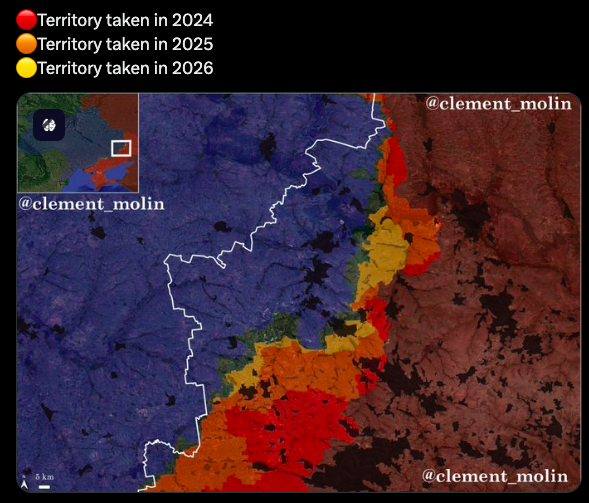
If the key fortified cities of Kramatorsk and Sloviansk fall as well there is little to prevent the Russian forces from taking the farmland of central Ukraine and move into the populous and productive Dnipropetrovsk region. Russia is grinding forward through the industrial base on the ground while hitting the warehouses, refineries and pharmacies of the rest of the country from the air.
One of the more embarrassing points Putin brought up was to highlight Bankova’s ongoing flirtation with Ukraine’s far-right extremists.
“It's worth noting that the Americans took note of one point specifically highlighted by our president: that the Kyiv regime has already stopped hiding its true nature, having reburied some of the most important Nazi criminals,” Ushakov reported.
In a decision that raised eyebrows amongst allies and played into the Kremlin talking point of the need to “denazify” Ukraine, Zelenskiy ordered and attended a ceremony to rebury Andriy Melnyk, a Nazi collaborator but lionized as an anti-Soviet resistance leader, who was given state honours during his reburial in May. The decision sparked outrage in Israel as Melnyk collaborated with the Nazi occupiers of Ukraine in WWII and aided them in various pogroms against the Jews including the Babi Yar massacre outside of Kyiv. He was one of the leaders of the Organization of Ukrainian Nationalists (OUN) and went on to head the faction that bore his name (OUN-M) after the movement split from Stepan Bandera, another controversial Nazi collaborator who is also still held in high regard by the right wing including the Azov brigade that is a key part of the AFU.
Budanov does not expect the conditions for a ceasefire before spring, and expects Russia to run another winter campaign against Ukraine's energy and civilian infrastructure first. "You cannot fight your whole life," he said.
Zelenskiy problems mounting
All eyes will be on Kyiv on September 6 awaiting the outcome of the meeting between Zelenskiy and the two US envoys. And the mood over Kyiv is blackening as the president's problems mount.
Kyiv has been under constant bombardment for well over a week and air raid warnings have become routine. Since Putin said Ukraine’s attack on its largest retail companies had opened “Pandora’s box” the Russian retaliation has been brutal, knocking out some 90% of Ukraine’s own warehousing that has started to cause supermarket shelves to empty.
At the same time three quarters of Ukraine’s generating capacity has been destroyed as the heating season looms already leaving Ukraine with a circa 6GW power deficit. Last week Putin ordered a resumption of “intense” bombing of Ukraine’s surviving power assets.
Solomiia Bobrovska, a member of the Rada Committee on National Security, stated that the authorities must honestly warn the public about potential problems this winter. "Ukrainians need to be told the truth about winter, not fed promises. Get ready, stock up, leave Kyiv, buy firewood," she said during a TV interview on September 5.
And Zelenskiy is trying to cope with a mounting domestic political crisis that has seen the $100mn kickback Energoatom corruption scandal metastasize that has implicated most of his inner circle. In the latest twist a top official from the General Prosecutor’s office, which is under direct presidential control, was arrested for protecting Ukraine’s notorious scam centres that fleece both Russians and European of an estimated $1bn a month. In addition, Ukraine’s two top security services – the SBU and the HUR – got caught up in a shoot-out on the streets of Kyiv. A drone, targeting the temporary head of the SBU, flew through his office window the next day in an apparent assassination attempt on September 5. Russia was blamed for the attack, but no evidence has been presented other than the fact that the missile was launched from inside Ukraine.
The IntelliNews PRO service includes access to reports, exclusive market data, and more news that decision-makers care about. Stay ahead of the market with IntelliNews PRO.
Sign Up Now


