


LONG READ: Zelenskiy sounding increasingly desperate as the hunt for air defence ammo fails
3 hours ago
Ukraine has run out of air defence ammo and has little chance of getting any more before the war is decided. Bankova, Ukraine’s presidential administration, only option now is to do as much damage or more to Russia as Russia is expected to do to Ukraine this winter. That seems like an impossibly tall order, but Kyiv has one big advantage: Russia’s size. It is too big a country to be able to defend effectively, leaving the Kremlin with some difficult choices.
Ukraine has bootstrapped a domestic missile production industry out of next to nothing over the last four years and that industry is starting to produce its first missiles.
The wartime arms maker Fire Point is already producing about 90% of the drones used on the battlefield, but has also developed the Flamingo cruise missile that is increasingly being used on the battlefield to take out high value targets located hundreds of kilometres inside Russia’s territory. And in April, the company unveiled the F-9 project, Ukraine’s first true ballistic missile, that is expected to go into production before the end of this year.
The drones vs missiles arms race, Russia has a huge lead, having produced sophisticated missiles since the start of the Cold War, but now Ukraine is catching up fast having pioneered the use of cheap but plentiful drones to turn the tables on a more powerful invading force. From a standing start in 2022. Ukrainian President Volodymyr Zelenskiy says Ukraine expects to make seven million drones this year.
But Ukraine is lagging far behind in missile production, while Russia has ramped up its missile production capacity – doubling it in just the last year to around 2,500 missiles per year.
Ukraine has run out of air defence ammo
That is a big problem after Ukraine's air defences ran dry over the Kyiv region on the night of August 1-2. Ukraine has just run out of the Patriot interceptor missiles, the only thing that can protect its cities and people from Russia’s large ballistic missile arsenal.
"Only one ballistic missile was intercepted, simply because there are no interceptors for the Patriot systems," Zelenskiy said on August 1 following a heavy attack on Kyiv.
Ukraine's Patriot problem is a straightforward numbers problem. Kyiv consumes an estimated 60-70 interceptors in a normal month and up to 150-180 during intensive Russian missile campaigns, while Lockheed Martin built roughly 620 PAC-3 MSE interceptors in the whole of 2025 - a global total that also has to supply US Army reserves, training stocks and other allies. As reported by IntelliNews, Ukraine intercepted only four of 54 ballistic missiles fired at it during a July 6 attack that killed 28 people; by August 1-2 that ratio had worsened to one in 27.
Zelenskiy has been warning allies for weeks that the shortage is structural, not just a bad night. At a Paris summit of the Coalition of the Willing on July 13, he called ballistic missiles "Russia's last advantage" in the drones-versus-missiles race even as Russian strikes hit Kyiv and a fertiliser ship in Odesa within the same 24 hours. He is now asking Washington for an emergency "winter package" of 300 Patriot interceptors to get through the colder months, when Russia has historically intensified strikes on energy infrastructure and cities alike. But as the US stock of interceptors has fallen to a mere 759, according to Center for Strategic & International Studies (CSIS), the Trump administration has rebuffed Ukraine’s request – more than a third of America’s dwindling supply.
Unable to shoot down inbound missiles, Bankov’s plan now is to target and destroy the launchers inside Russia before the missiles can even get off the ground, as well as continuing to pound military and industrial assets.
Russia's Achilles heel
Ukraine does not need to match Russia's missile production to change Moscow's calculus - it only needs enough ballistic missiles to force a choice, says defence analyst Michael Bohnert.
For most of the war Russia has used its air defence S-300 and S-400 batteries freely as surface-to-surface strike role, stripping itself of its own air defence. That was something the Kremlin could risk only because Ukraine lacked both the fighter jets to contest Russia's own SAM belt and a ballistic threat of its own worth defending against. As a result the Kremlin has left Russia wide open to a sustained missile attack.
Even a modest Ukrainian ballistic arsenal would cause chaos. Russia would have to either keep using its S-400s offensively and accept that Ukraine starts hitting hardened, high-value targets, or pull those systems back into their designed air-defence role - in which case Ukraine's drones and cruise missiles gain a freer run at everything else. Russia's sheer size, the key asset that Russian general Mikhail Kutuzov used to beat the invading Napoleon Bonaparte in 1812, has become a liability now: a country that large cannot blanket its own territory with the same density of SAM coverage Ukraine has had to build over four years of practice defending far less ground.
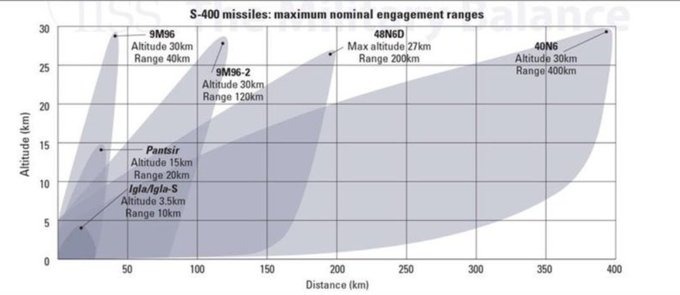
S-400 interceptor engagement ranges by missile type. Source: IISS Military Balance.
Not every analyst is convinced the economics favour a full ballistic build-out over drones. Experts caution that unless Ukraine has found a way to make the missiles unusually cheap - unlikely given how much of the internals will still come from Western suppliers - long-range drones will remain the better cost-per-target option in roughly nine cases out of ten, according to defence analyst Ryan O'Leary.
The key in an asymmetrical war is the cost-to-kill ratio needs to be low enough so a government can afford to build enough drones or missiles to be able to completely overwhelm the enemies defences. Ukraine’s Flamingo costs about $600,000 each to build, a fraction of the US missiles, but on a par with Russian missiles.
The disagreement is really about mix, not direction: both camps agree Russia out-produces Ukraine in raw missile numbers, but Ukraine's opportunity is that building a comprehensive Russian missile defence network to block a determined Ukraine would be prohibitively expensive.
Ukraine's build-out
And Ukraine has already made inroads, closing the gap from several directions at once. Fire Point, the drone-maker behind the long-range Flamingo cruise missile, is developing the FP-7 and FP-9 ballistic projects (ranges of roughly 300 km and 850 km respectively) alongside a defence ministry pledge to have a budget in place for serial procurement in 2027.
Fire Point is also working on the FP-7.X interceptor missile, which is being designed specifically for air defense missions rather than ground strikes.
The UK has separately signed contracts to build its own pared-down ballistic missile for delivery to Ukraine on the same 2027 timeline, its first new ballistic weapon in more than half a century.
On the Russian side of the ledger, Moscow is not standing still either. As reported by IntelliNews, Russia is expanding and modernising its missile programme despite Western sanctions, rolling out the new jet-powered Banderol strike drone in May - a weapon Ukrainian officials say flies faster than the Shahed drones Moscow has relied on until now, evidence Ukraine is trying to close the gap from a lower base.
The already well developed Russia-Ukraine drones arms race has just graduated to a missile arms race.
The IntelliNews PRO service includes access to reports, exclusive market data, and more news that decision-makers care about. Stay ahead of the market with IntelliNews PRO.
Sign Up Now
_1785666405.jpg)

