


MACRO ADVISORY: Best Eurasia books published in 1H26
1 day ago
The Kyrgyz som looks remarkably stable. That is exactly the problem.
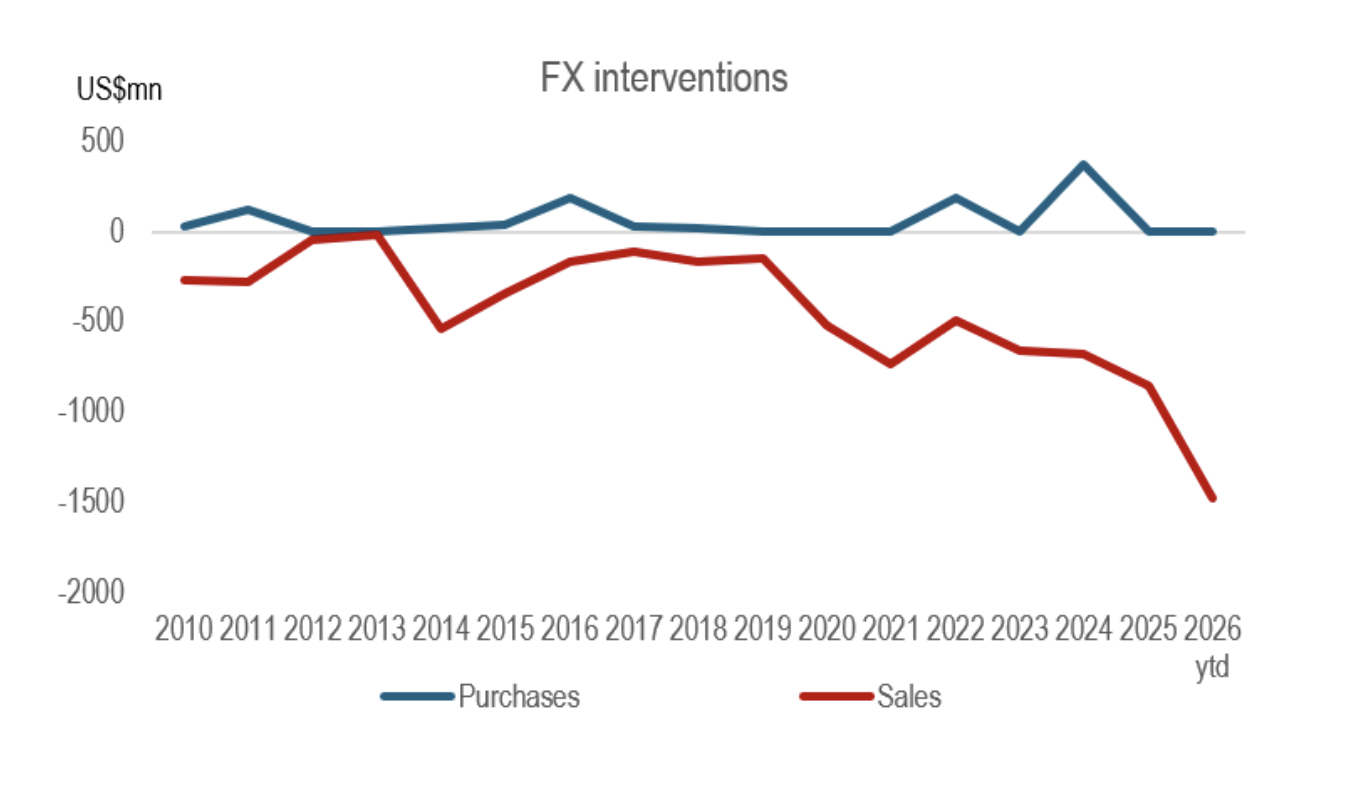
Since the start of 2026, the National Bank of the Kyrgyz Republic has sold almost $1.5bn through nine foreign-exchange interventions, which is now close to a fifth of its FX reserves. That also already exceeds the $853mn sold during all of 2025. Yet the exchange rate has barely moved, remaining close to KGS87.45 per dollar. When a central bank sells record amounts of foreign currency while the exchange rate remains almost perfectly flat, the policy begins to look less like volatility smoothing and more like defence of a particular level (Graph 1).
Graph 1: The NBK has been selling FX in increasing amounts over the past few years
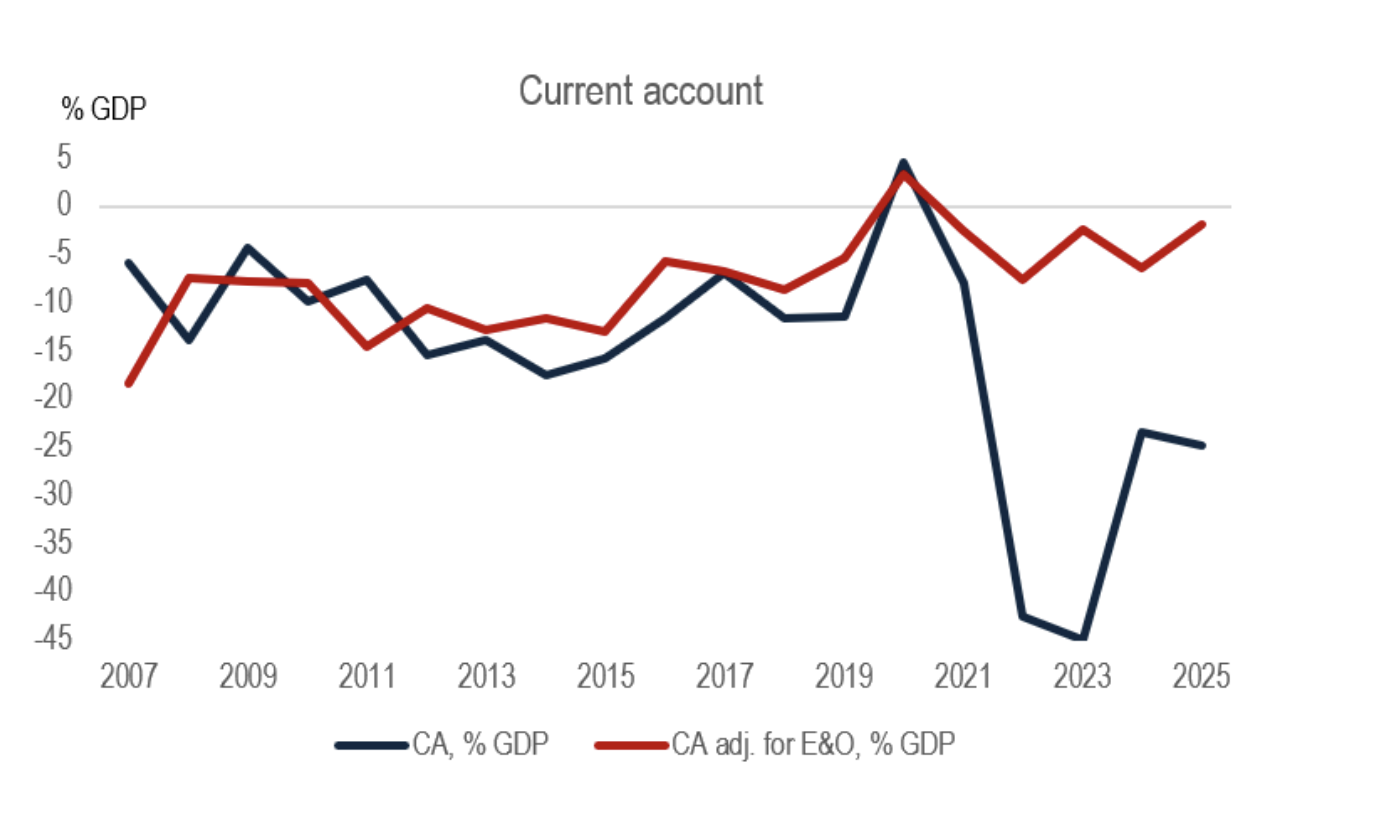
That does not mean a devaluation is imminent. Kyrgyzstan is not currently facing a textbook balance-of-payments or confidence crisis. Foreign-exchange reserves remain comfortable, remittances are still strong, and gold continues to provide substantial support to the external position. The headline current-account deficit also exaggerates the underlying pressure because of the unusually large errors-and-omissions item in the balance of payment (Graph 2). This is, in turn, related to substantial unrecorded export shipments to Russia. Once that distortion is taken into account, the external picture looks significantly less alarming. The overall balance of payments has remained in surplus during the past two years, while reserves are still robust despite some recent gold-related moderation in recent months.
Graph 2: The adjusted CA deficit is not flashing red
The real problem is not a shortage of money. It is too much money chasing imports.
Kyrgyzstan’s economy is probably overheating. Real GDP growth averaged slightly above 10% between 2022 and 2025 and reached 11.9% year on year in the first half of 2026. Expansionary fiscal policy, infrastructure spending, construction and exceptionally rapid credit growth have fueled demand for imported machinery, materials and consumer goods. Private-sector credit expanded by almost 50% last year. Companies need dollars to finance imports and equipment purchases, while public projects and households add to the demand for foreign currency.
This is an important distinction for investors. The intervention surge does not necessarily indicate capital flight, collapsing remittances or a loss of confidence in the banking system. But it does indicate that the market-clearing exchange rate would almost certainly be weaker than KGS87.45 without central-bank support.
The pressure is amplified by the extreme shallowness of Kyrgyzstan’s FX market. On days without central-bank intervention, average interbank turnover is only about $14mn. The average intervention in 2026 has exceeded $160mn — almost twelve times normal daily market volume. In such a thin market, a few large import payments or institutional dollar purchases can create an outsized shortage of foreign currency. The central bank may reasonably fear that allowing an initial 2-3% depreciation would not lead to a smooth adjustment. It might instead generate one-way expectations, overshooting and a rush to buy dollars.
The authorities also have a powerful domestic reason to resist depreciation: the exchange rate has effectively become Kyrgyzstan’s main inflation anchor.
Inflation reached 11% y/y in June, well above the central bank’s 5-7% target range, while the policy rate stands at 12%. In a small and import-dependent economy, depreciation feeds quickly into the prices of fuel, food, medicines, machinery and consumer goods. The authorities therefore face an uncomfortable choice: allow the som to weaken and accept another inflationary shock, or spend reserves to suppress imported inflation and contain expectations.
They have clearly chosen the second option. In effect, Kyrgyzstan is converting part of its inflation problem into a reserve-flow problem. That choice is understandable because reserves have risen sharply in recent years, partly because of gold valuation gains. But it is not costless. The longer the central bank keeps the currency almost perfectly stable, the more businesses and households begin to treat KGS87.45 as a quasi-fixed rate. Any eventual move then risks being interpreted not as a normal market adjustment, but as a policy failure.
Balance-sheet risks reinforce that caution. Foreign-currency loans account for roughly 18% of total lending, while FX deposits represent about 29% of deposits. These levels are not high enough to suggest an immediate banking crisis, but they remain significant enough for abrupt depreciation to affect corporate borrowers, depositors and household confidence.
Valuation also points toward eventual weakening. The som appears to be the most overvalued currency among its regional peers when measured against its longer-term real effective exchange-rate average. The estimated gap is around 17%, compared with roughly 11% for the Armenian dram and Kazakh tenge. This is not extreme overvaluation, but it is difficult to reconcile with an exchange rate that has barely moved for years despite persistently higher inflation.
The contrast with Uzbekistan is revealing. Tashkent has also managed its currency heavily, but since 2025 it has tolerated greater two-way movement and increasingly presented the exchange rate as a shock absorber rather than a separate policy target. Uzbekistan also has a clearer gold-neutrality mechanism: domestic liquidity created through central-bank purchases of locally produced gold is broadly offset by FX sales. That makes it easier to distinguish routine liquidity management from outright defence of an exchange-rate level. Kyrgyzstan’s framework is less transparent, its financial markets are shallower, and its transmission mechanism is weaker. It is therefore less well placed to move abruptly from quasi-fixity to genuine flexibility.
For investors, the direction of travel looks clearer than the timing.
The probability of a depreciation greater than 2-3% by the end of 2026 is probably around 40%. Over the next 12 months, that probability rises to 60-65%. A controlled adjustment of 3-7% is considerably more plausible than a disorderly devaluation. The authorities still possess substantial firepower, while remittances, gold and reserves provide enough support to postpone the adjustment.
The most likely outcome is therefore not a sudden collapse, but a prolonged period in which the central bank continues to substitute reserves for exchange-rate flexibility. A modest depreciation in late 2026 or early 2027 would probably be healthier than maintaining a rigid level until external conditions force a sharper move.
The som looks vulnerable, but the trade remains difficult. The central bank has demonstrated that it is willing to spend heavily to delay the adjustment. A bearish position becomes more compelling only when intervention intensity rises further, liquid reserves begin falling materially, or the authorities permit the first sustained break above roughly USD/KGS88-89.
The direction looks right. The trade still looks early.
Ivan Tchakarov is partner for the Caucasus and Central Asia at GlobalSource Partners.
The IntelliNews PRO service includes access to reports, exclusive market data, and more news that decision-makers care about. Stay ahead of the market with IntelliNews PRO.
Sign Up Now


