


Syria’s central bank opens lira account at Turkey’s central bank
20 hours ago
Russia has sent two Be-200 amphibious firefighting aircraft to Turkey following a request from Turkish authorities, as wildfires burn across the country, the Daily Turkic reported on July 30.
The gesture is only possible because Turkey, a Nato member, has consistently declined to join Western sanctions on Russia over the war in Ukraine - a stance that has repeatedly drawn criticism from allies but has also kept channels open for exactly this kind of practical cooperation as extreme wildfires become a near-annual crisis across the Mediterranean and southern Europe, following Europe's record 2025 wildfire season and Turkey's own 50,000 evacuations in 2025.
Madrid, on the other hand, has joined the EU sanctions regime and is now paying the price. As a direct result, none of its ten contracted Russian-made Kamov Ka-32 firefighting helicopters - among the most capable aircraft of their kind - are currently flying. EU sanctions on manufacturer Kamov have cut off spare parts and barred the Russian technicians required to certify the aircraft airworthy, prompting Europe's aviation regulator EASA to pull the Ka-32's flight certificate, Newsbase reported. Spain's wildfires have already burned around 153,000 hectares this year, concentrated in the Madrid, Avila and Toledo provinces and the fires continue to rage, causing the government to declare a state of emergency.
The episode captures an uncomfortable trade-off for European sanctions policy: the same restrictions designed to squeeze Russia's economy have also stripped a frontline EU state of firefighting capacity precisely when climate-driven wildfires are becoming more frequent and more destructive.
The UK and Spain issued a joint statement on the wildfires this week declaring that "this summer's wildfires demonstrated that climate change was now a national security emergency facing Europe and threatening our way of life," with both governments agreeing that tackling the climate crisis was "an urgent policy priority for all countries" and that climate action was essential "to protect not just current generations, but our children and grandchildren too."
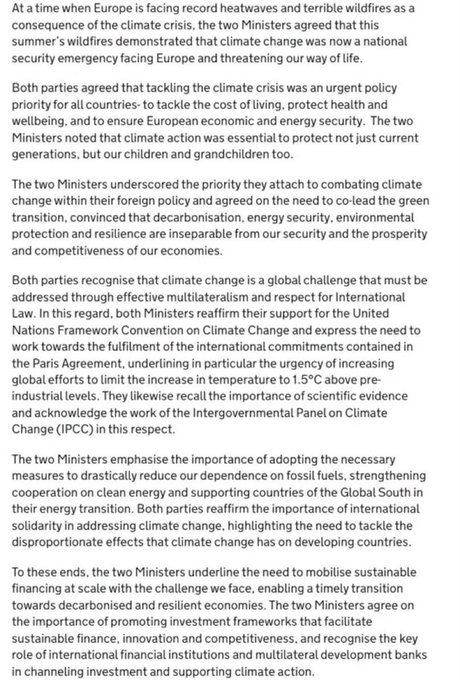
Joint UK-Spain government statement on the 2026 European wildfires.
Wildfires are turning parts of Europe into an insurance nightmare
Beyond the immediate firefighting-capacity problem, Europe's insurers and policymakers are grappling with a harder question: who pays? As IntelliNews reported, one study estimates that extreme weather has already caused around $28 trillion of damage and that bill is getting bigger every year during the annual disaster season.
"What's happening in Europe this summer isn't unique," deputy governor of the Bank of France Agnes Benassy-Quere said, "these heatwaves and forest fires are part of a marked global increase in extreme weather events that imposes real costs on households, businesses, and governments," Politico reported.
Weather-related extremes cost the EU economy more than €200bn ($233bn) in economic losses between 2021 and 2024, according to European Environment Agency data cited in the report, and insurers are responding by raising prices and pulling out of higher-risk areas altogether - shifting the cost onto governments and individuals. Insurance companies are already reassessing the premiums needed for the popular catastrophe bonds and starting to review their risk assessments in general due to the literally off-the-chart weather events. In Europe, 75% of natural-disaster damages are not insured at all, according to NGO Reclaim Finance, citing European Insurance and Occupational Pensions Authority data.
Insured wildfire losses in Europe have grown by an estimated 8-11% a year in real terms since 1970, according to Swiss Re's Nikhil da Victoria Lobo, who called wildfires "the fastest-growing weather peril globally" even though they still account for a relatively small share of Europe's total insured catastrophe losses so far. In France, where a wildfire still burns through Gironde and Landes, at least 240 homes have been lost and around 130,000 workers are currently unable to work because of the fires, with the government promising to cover evacuees' accommodation and rebuilding costs.
The European Central Bank and the EU's insurance regulator have called on Brussels to set up an EU-level reinsurance scheme and a public natural-disaster fund - an acknowledgment that national insurance markets alone may not be able to absorb losses of this scale as extreme weather becomes the norm rather than the exception.
The IntelliNews PRO service includes access to reports, exclusive market data, and more news that decision-makers care about. Stay ahead of the market with IntelliNews PRO.
Sign Up Now
_18_1785491129.jpg)


