Russian life satisfaction slumps to 47% as gloom returns to mobilisation levels
5 hours ago
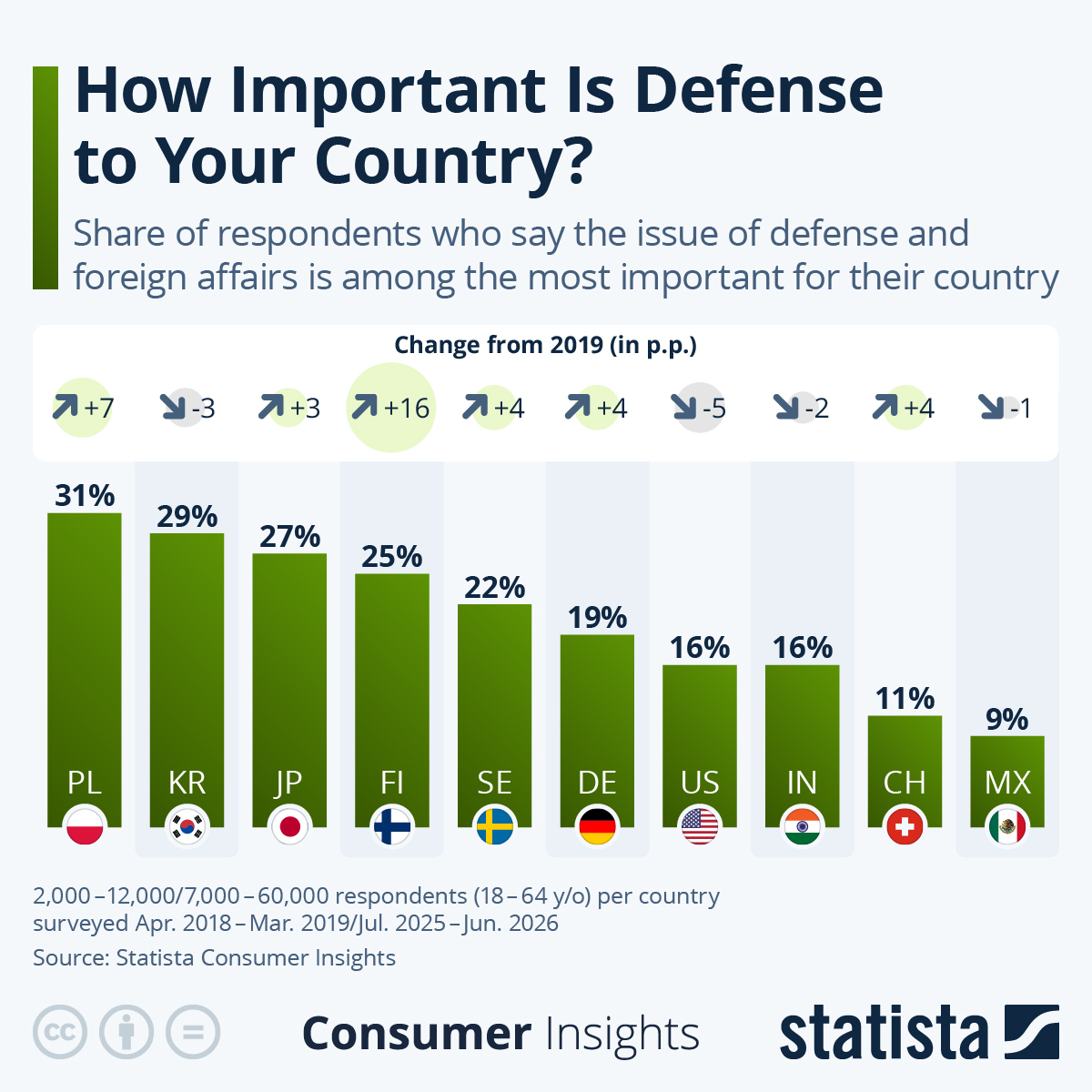
Even in the country most alarmed by it, defence is a top national concern for fewer than one person in three, reports Statista, which asked people in 32 countries whether defence and foreign affairs ranked among the most important issues facing their country. Nowhere did more than about one in three say yes, and in most places the share sat between one in ten and one in five.
Source: Statista Consumer Insights, August 10, 2026
Poland came top at 31%, followed by South Korea on 29%, Japan on 27%, Finland on 25% and Sweden on 22%. Germany reached 19%, the United States and India 16% each. Switzerland, China, Brazil, the United Arab Emirates and Indonesia all sat at 11%. Mexico, on 9%, was among the least worried, alongside Argentina, Saudi Arabia, Colombia, Austria and Singapore.
There is a gap here that every finance ministry in Europe is about to walk into. Nato members have committed to defence budgets heading towards 3.5-5% of GDP, the largest rearmament since the Cold War, and the voters being asked to fund it put the subject behind health, prices and jobs almost everywhere. Rearmament that outruns public conviction is rearmament that gets cut at the first hard budget.
The movement since 2019 tells a sharper story than the levels do. Finland is up 16 percentage points, by far the biggest shift on the board, and Poland up seven. Germany and Sweden each gained four. All four sit close to Russia or to the war it is fighting.
"There have been major changes for some countries in the light of the Russia-Ukraine war, especially in Northern and Eastern Europe," wrote Katharina Buchholz, the data journalist who compiled the chart.
Everywhere else the line went the other way. The United States fell five points, the largest drop recorded, with South Korea down three despite North Korea on its border, Switzerland down two and Mexico down one. More than four years of the biggest land war in Europe since 1945 have changed what people think their country's priorities should be only where the front is close enough to feel.
That pattern matches how the money is actually being spent. Lithuania budgeted the highest share of GDP for defence of any Nato member in 2026, and the Baltic and Nordic states have run consistently ahead of the alliance's larger western economies on spending as a share of output. Public opinion in the region is not lagging the budgets - it is one of the reasons they pass.
The survey covers 2,000-12,000 respondents per country in the 2018/19 wave and 7,000-60,000 in the 2025/26 wave, all aged 18-64, fielded between April 2018 and March 2019 and between July 2025 and June 2026.
Poland spends more on defence as a share of its economy than almost any country in Nato. Fewer than a third of Poles think that is one of the most important things about it.
The IntelliNews PRO service includes access to reports, exclusive market data, and more news that decision-makers care about. Stay ahead of the market with IntelliNews PRO.
Sign Up Now