


Drone that hit Ukraine's SBU headquarters was guided from inside Ukraine, adviser says
1 hour ago
Russian drones hit warehouses belonging to the Nasdaq-listed drugmaker Teva and one of the World Health Organization's main medical supply depots in Ukraine on September 3.
Teva's facilities were targeted twice that day, Kyiv Post reported. "We are assessing the consequences of the attack and doing everything possible to minimise the impact on supplies and ensure that Ukrainian patients continue to have access to the medicines they need," the company said. The WHO confirmed the strike on its warehouse, where humanitarian medical supplies are stored. Neither the oblast nor a damage figure has been disclosed.
The strike expanded the campaign on Ukraine’s retail infrastructure, storage and distribution network into medical supplies for the first time, which is starting to have a major impact on the functioning of Ukraine’s economy.
Taras Vysotsky, the agrarian policy and food minister, says a significant share of the country's modern storage capacity has already been destroyed, reaching up to 90% in some areas. Russia destroyed the central warehouse of Optima-Pharm, one of Ukraine's largest pharmaceutical distributors, in October last year, and hit the Biokon pharmaceutical logistics complex in the Boryspil district two days ago. Teva reported Ukrainian revenue of UAH4.65bn ($103mn) in 2025, up 21% on the year.
Epicentr loses a fourth store
The retail chains are being worked through in the same way. Epicentr's Mykolaiv hypermarket took six direct hits in a single day and was destroyed, the company said, with staff putting out four fires before the last strike brought the building down. Trading halls were wrecked, one floor burned out completely and windows went in across the neighbouring residential blocks. A 72-year-old man was hospitalised and a 17-year-old girl was treated and discharged, Suspilne reported. Firefighters had to withdraw repeatedly as the site was struck again.
The site employed 520 people, and the company says they included staff already relocated from its destroyed stores in Kherson, Zaporizhzhia and Odesa. That makes Mykolaiv at least the fourth Epicentr site lost. No reconstruction plan, reopening date or loss figure has been published. Local reporting says staff had been moving goods out of the store in the preceding days, expecting a strike on the pattern set in the other three cities.
Odesa oblast lost a food warehouse for the second time in a week. Direct hits started a fire in a building storing food products, later extinguished with no casualties, said Oleh Kiper, head of the Odesa Oblast Military Administration. The same facility was struck on August 30, when about 3,000 sq m was destroyed. A Ukrainian aggregator says the warehouses belong to the ATB supermarket chain; no official has named an operator.
Four more storage sites went in the same 24 hours. Warehouse premises at Sviatopetrivske in the Bucha district took four direct hits and burned, LB.ua reported, citing the head of the village council. A warehouse belonging to a private enterprise in the Poltava hromada was hit, with the blast wave damaging nearby homes. A warehouse, specialised equipment and a cargo lorry were damaged in the Kryvoozerska hromada in Mykolaivska oblast. And a warehouse was destroyed at Balakliia in Kharkiv oblast, alongside a hangar, a greenhouse and damaged electricity networks.
The worst of it was at Kamianske, where a strike on an industrial enterprise killed four people and wounded five, three of them hospitalised including a 30-year-old woman in a critical condition, said Oleksandr Hanzha, head of the Dnipropetrovsk Oblast Military Administration, in remarks carried by Ukrinform. The plant has not been named and no description of the physical damage has been issued.
Ukrnafta goes offline
In the second half of the night Russia was targeting oil and gas fields. Several Ukrnafta production facilities came under attack, with numerous hits recorded and fires started, and damaged equipment shut down pending specialist assessment, the Naftogaz Group press service said. Employees sheltered and there were no casualties, Ukrinform reported. The oblast was not disclosed and no production-loss figure was given.
Russia has been targeting energy all year and destroyed 37 Naftogaz Group filling stations and five Ukrgasvydobuvannia production facilities in the first seven months of 2026. A single attack on August 7 damaged seven Ukrnafta production assets in the east along with four filling stations in Zaporizhzhia and Dnipropetrovska oblasts, on the company's own account. The group's Odesa combined heat and power plant was hit on August 31.
The grid held better than the gas fields. Ukrenergo reported new outages in Odesa, Kharkiv, Chernihiv and Sumy oblasts on the morning of September 4 and warned that network restrictions might be needed in Odesa oblast to stop equipment overloading. It forecast no outages at all for September 5 and asked consumers to shift heavy use away from the evening peak. No facility was named on either day and no customer numbers were published.
A quieter night over Russia
Russia had its lightest night in a fortnight. Its defence ministry claimed 53 Ukrainian drones destroyed overnight across Moscow region, six other regions, Krasnodar Krai, Crimea and the Black Sea, Interfax reported, against 490 claimed the night before. One economic target was reported hit: an unnamed energy facility in the Korenevsky district of Kursk region, damaged with supply restored through a backup scheme, according to governor Alexander Khinshtein.
The fall in the attack numbers is almost certainly linked to a three-day ceasefire order from Bankova ahead of the planned visit by the US envoys to Moscow on September 5 and on to Kyiv on September 6. The order went into effect along the line of contact from midnight on September 5 until late on September 8, Ukrainska Pravda reported, citing its own sources. A presidential source said Bankova was awaiting a Russian answer to a proposed truce in the air during the diplomatic meetings. Nothing has been confirmed on the record by either government, and the drone counts above suggest Russia was not observing anything.
The Sochi strike of the night before turned out to be bigger than first reported. Two fuel depots burned, not one, with thermal anomalies logged at 02:20 and 03:39 Moscow time, The Insider reported, identifying them as Lukoil-Yugnefteprodukt at Sirius and Rosneft-Kubannefteprodukt in the Adler district. Queues formed at Sochi filling stations the following morning and the city said its reserves were sufficient and asked residents not to stockpile. At Sterlitamak, satellite imagery reported by Militarnyi showed damage to the Agidol fuel-additive facility, the isoprene plant overpass and isopentane dehydrogenation units in two buildings.
Ukraine's General Staff went further on September 4 and said two Russian refineries had stopped work altogether: Lukoil's plant at Kstovo, which it called Russia's fourth-largest refinery and second-largest gasoline producer at around 15mn to 17mn tonnes of crude a year, halted after the August 26 strike, and the Novatek complex at Ust-Luga after September 1, the Kyiv Independent reported. Neither claim has been confirmed by Lukoil, by Novatek or by any Russian source, no duration was given for either, and both are one side's claims about its own success.
What is not in dispute is the state of the fuel market. AI-92 gasoline set a record on the St Petersburg exchange on September 1 at RUB75,477 a tonne, with AI-95 at RUB75,926 and summer diesel at RUB71,221, Kommersant reported. Only 41% of gasoline supply contracts on that exchange were executed on average between May and early September, with one deal in five ending in default or cancellation, Lukoil accounting for 46% of unfulfilled obligations and Rosneft for 28%, Delovoy Peterburg reported. The ban on exports of gasoline, diesel and other fuels now runs to January 31.
Russian forces progress in Donbas
None of this happens in isolation from the front, and the front is moving. The Russian forces are making steady, albeit slow, progress against the remaining “fortress cities” of the Donbas, the last line of defence before the open wheatfields that run all the way up to the Dnipro River that cuts the country in half.
Russian units have secured enough passages through the Ukrainian defensive line known as the 0.5 to allow deep infiltrations towards two Donbas cities, Dobropillia and Druzhkivka, the analyst Clement Molin wrote on September 3.
The manpower shortage has left gapping holes in the AFU’s defences and Russia has adopted a tactic of infiltrating small groups through the holes who then circle back and attack Ukraine’s defensive positions from the rear which has proven effective and hard to stop.
The line held for more than a year and thousands of Russian soldiers died in front of it after the failed breakthrough attempt by frontal assault in August 2025, with a kill zone opening between the wire and the obstacle belt behind it. But the Russian forces have become more cautious and conscious of its high casualty rate. They have made most progress in the centre if the Donbas front where defences are thinnest, by infiltration rather than assault.
Molin puts urban combat under way at Bilytske with infiltrations to the rear towards Vodyanske, the situation at Dobropillia recently deteriorating with penetrations north of the city and around the first defensive line behind it, and infiltrations west of Druzhkivka reaching between the two lines while others to the north reach Raiske. Further east the battle for Kostiantynivka is still running three months after the city was widely reported to have fallen, with Russia holding about half of it and pushing north, and Chasiv Yar almost entirely taken. He is careful about what he cannot verify, and says he cannot confirm the Russian consolidation east of Dobropillia that many maps show.
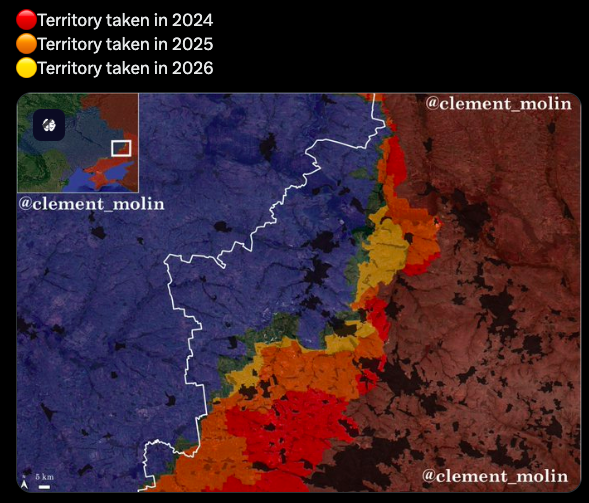
The Donbas offensive is expected to run to the end of autumn, aiming to get a foothold in Druzhkivka and Dobropillia before the winter fighting, and in parallel to breach the first defensive line and push north towards Barvinkove and the logistics routes into the strategically key city of Kramatorsk. That is a supply-line objective. It is the same target set the drones have been working over from the air for a month, at a different speed and a different cost.
It is also why the economic ledger, and the map belong in the same story. Donbas has been Russia's main military objective since May 2022 and the fighting has taken it apart: its mines, its industries and its population, city by city and a year at a time, a year in Toretsk, a year in Pokrovsk, a year in Kostiantynivka.
If the key fortified cities of Kramatorsk and Sloviansk fall there is little to prevent the Russian forces to take the farmland of central Ukraine and move into the populous and productive Dnipropetrovsk region. Russia is grinding forward through the industrial base on the ground while hitting the warehouses, refineries and pharmacies of the rest of the country from the air. Whoever ends up holding Donbas will need water from the Dnipro to rebuild its mines and its industry.
Weapons and technology
Russia sent 167 Shahed-type drones at Ukraine overnight, about half of them jet-powered, alongside Gerbera and Parodiya decoys and Iskander-M or KN-23 ballistic missiles fired from the Rostov and Voronezh regions, Ukraine's Air Force Command said.
Air defence claimed 128 drones shot down or suppressed. Hits were recorded at 23 locations and debris at one more, Ukrinform reported. No missile count was published and no ballistic interception was claimed. The night before, 121 drones produced hits at 15 locations, so the number of places actually struck rose by more than half.
The interception rate is the number to watch, and it is falling. Ukrainian monitoring puts August at 4,288 of 5,155 Geran-type drones brought down, about 83%, against 87% in July, 90% in June and 92% in May. The explanation offered is the jet-powered variants, which presidential adviser Serhii Beskrestnov is reported as putting at 3,000 launches in August against 1,500 in July. On those figures 867 drones got through in a single month, which is what the arithmetic of interception turning against Kyiv actually looks like in practice.
Those figures do not agree with the ones this monitor carried yesterday. The September 4 edition reported total monthly drone launches falling from a peak of 7,500 in May to under 6,000 in June, under 5,000 in July and under 2,500 in August. The monitoring figures above put August at 5,155 Geran-type drones launched, more than twice that. Both sets are Ukrainian in origin and no Russian figure exists to arbitrate, because Russia publishes nothing at all about how many drones it fires. Beskrestnov's own jet-drone count for August has now been reported at 2,500 in one version and 3,000 in another. Drone use numbers are at best an estimate and subject to needs of propaganda so while the absolute numbers cannot be trusted the trends described by the changes is a bit more useful.
The least-counted weapon in the war is also one of the most destructive. Russia dropped more than 8,300 guided glide bombs on Ukraine in July, the highest monthly figure of the full-scale war, after 8,266 in June, on figures published by Ukraine's defence ministry citing the General Staff and reported by the Kyiv Independent.
Glide bombs are WII gravity bombs Russia still holds in stock in large numbers with wings and a rocket engine strapped to their back. And they are powerful: typically carrying 1,500kg of explosive but the largest have 3,000kg. And as they are gravity bombs – they fall more than fly – Ukraine has no effective defence against them. A drone can kill a sniper on the roof; the glide bombs destroy the entire house.
No August glide bomb use has been published by anyone. A claim circulating this week that use is approaching 9,000 a month, and has held above 8,000 for three consecutive months, cannot be stood up: there are two documented months above 8,000, not three, and nothing published points at 9,000. However, it is clear, based just on anecdotal reports, that Russia has upped it use of glide bombs, especially against the port of Odesa, where they are doing major damage.
These reports in occasional monthly summaries rather than in the air force report that carries drone and missile numbers every morning. Ukraine's only answer to glide bombs is to shoot the aircraft that release them, or hitting the airfields they fly from, rather than stopping the bombs themselves.
Russia beefing up drone production
The Kremlin has poured resources into missile and drone production: missile production is reportedly up 40% this year and ahead of plan. Drone production has also accelerated.
Satellite imagery reviewed by Bild shows drone factory in the Alabuga Special Economic Zone in Tatarstan, which builds the Geran drones, now spread across more than 1,000 hectares of new halls, warehouses and transport routes. The Center for Strategic and International Studies put output at more than 5,500 drones a month in a March study, which also measured the drone-related part of the site at over 2,820,000 sq m across 17 facilities and noted housing for about 20,000 workers. Ukrainian military intelligence says Russia is aiming at up to 11,000 strike drones of various models a month.
Alabuga is also being wrapped against the drones now reaching it. The Institute for Science and International Security, reading Vantor and Airbus imagery from July and August, found two perimeter rings of dozens of large lattice towers going up around the production halls and the Alabuga-Fiber carbon-fibre plant, possibly to carry a mesh of cables against cruise missiles and drones. Construction began after May 18, the inner ring was complete by early July and the outer ring largely so by late July. That is a plant expecting to be hit, and the production race it sits inside is the one that decides how many drones arrive each night.
Ukrainian munitions supplies
On Ukraine's side, the 1020th Anti-Aircraft Missile and Artillery Regiment revealed a Rheinmetall Skyranger 35 delivered without announcement, a 35mm gun firing up to 1,000 rounds a minute out to 4 km with programmable ammunition that scatters sub-projectiles ahead of the target, on a Leopard 1 chassis. Quantities were not disclosed.
Spain will increase supplies of Patriot interceptors to Ukraine, foreign minister Jose Manuel Albares said at an EU meeting. And Russia's embassy in Berlin said deployment sites of Germany's planned long-range systems "will inevitably become Russia's legitimate military targets" if aimed at Russia.
Nothing else moved. There was no record salvo, no first combat use of a new weapon type, no Kinzhal, Zircon, Oreshnik, Banderol, Flamingo, Neptune, Palianytsia or Ruta, and no new fibre-optic or autonomous-targeting reporting, on either September 4 or September 5.
Arson and sabotage in the EU
The most important development in the European sabotage and hybrid attacks on defence sector assets this week is a correction. The two German substation attacks of September 1, at Turnow-Preilack in Brandenburg and Bergheim near Cologne, were widely read as hybrid warfare. On September 4 federal interior minister Alexander Dobrindt described the substation attacks as climate extremism and very probably the work of a lone German radical actor, Tagesspiegel reported.
A handwritten claim of responsibility was posted to the Berlin daily taz, postmarked in North Rhine-Westphalia, which names its sender, says he acted alone, gives an anti-fossil-fuel motive and names the other substation sites. North Rhine-Westphalia interior minister Herbert Reul says the letters are authentic, while cautioning that "if someone signs their name, they are not necessarily responsible". A 48-year-old German national from Gevelsberg is being sought and remains at large; potassium nitrate and potassium perchlorate were found at his home. A third substation, at Dormagen, produced a suspected launching device found in a field by a passer-by, with no damage and no outage.
This monitor carried both substation attacks as open questions this week and several outlets did not, quickly blaming Russia on little to no evidence. The hybrid reading of those two attacks is now the minority position, and the ledger has been annotated accordingly.
The Munich case moved the other way, but only procedurally. The two Bulgarian nationals arrested after the September 3 fire at the Rohde and Schwarz headquarters, named in German reporting as Dimitar T., 38, and Gabriela M., 28, were placed in pre-trial detention on September 4. A third man detained is not treated as a suspect. The Munich prosecutor's office says only that the extent to which the two are connected to the incident is under investigation. No authority has named a state, and Bavaria's interior minister Joachim Herrmann went no further than saying there is now an increased risk of attacks on infrastructure and on defence companies.
The scale of the German caseload was published on September 4. The Federal Criminal Police Office has recorded 165 suspected sabotage cases since the start of 2026, against 320 in the whole of 2025, covering manipulated power lines and railway infrastructure and planned arson. Security agencies logged 747 incidents involving 1,068 suspicious drones between January and the end of August near critical infrastructure, military facilities and defence companies, and 112 espionage offences, of which more than 60 involved unauthorised filming of military sites and 26 are suspected of preparing sabotage. The assessment was obtained by Sueddeutsche Zeitung, NDR and WDR. German agencies suspect Russia behind many of the incidents.
In Poland nothing has moved. There are still no charges over the WB Electronics fire at Skarzysko-Kamienna or the JFG Composites fire at Lublin, no suspect has been named and no Polish authority has attributed either to Russia, whatever prime minister Donald Tusk's language about sabotage implies. The two fires together account for more than €8.5mn of damage on the figures published so far. Warsaw summoned Russia's ambassador on September 3 over what it called escalating aggressive actions.
Nothing new surfaced anywhere in the EU, the UK, Norway or Switzerland on September 4 or 5: no undersea cable or pipeline incident, no shadow-fleet detention, no railway sabotage, no parcel incendiary device, no airport closed by a drone and no new satellite-navigation jamming event.
Major strikes and targets
| Date | Target | Weapon | Region | Damage |
| 3 Jun | St Petersburg oil terminal | Drones | Leningrad region | Hit on the opening day of Russia's SPIEF investment forum |
| 7 Jul | Omsk refinery | Drones | Omsk | Largest refinery hit to that point and the deepest strike into Russia |
| 16 Jul | Salavat refinery | Drones | Bashkortostan | Key units hit; about 3% of national refining capacity |
| 18 Jul | Wildberries warehouse | Drones | Tambov region | Seven killed; opens the campaign against retail and logistics |
| 4 Aug | Wildberries hubs near Moscow and St Petersburg; a refinery | Drones | Russia | Warehouses hit; refinery ablaze |
| 7 Aug | Wildberries warehouse, Yekaterinburg | Drones | Sverdlovsk region | 2,000 km from the border |
| 12 Aug | Novorossiysk Grain Plant terminal | Drones | Krasnodar Krai | Loading equipment damaged; company puts repairs at one to four months |
| 14 Aug | Last working Novorossiysk grain terminal | Drones | Krasnodar Krai | All three of the port's grain terminals out of service |
| 17-18 Aug | Five bulk carriers | Sea and aerial drones | Novorossiysk and Tuapse | First large-scale strikes on ships carrying grain |
| 19-25 Aug | Refineries at Ufa, Nizhnekamsk, Perm, Novokuybyshevsk, Afipsky and Novoshakhtinsk | Drones | Russia | Perm and Novoshakhtinsk suspended processing |
| 22-24 Aug | Ozon warehouses at Chapayevsk (Samara), Orenburg, Makhachkala (Dagestan), Enem and Adygeysk (Adygea), Nevinnomyssk (Stavropol) | Drones | Samara, Orenburg, Dagestan, Adygea, Stavropol | Four warehouses hit and set ablaze, with injuries at Chapayevsk and Makhachkala; operations suspended. Adygeysk and Nevinnomyssk evacuated on a drone threat but undamaged. Ozon shares fell 28% |
| 24 Aug | Astrakhan gas processing plant; Kamensky Combine | Drones | Astrakhan and Rostov regions | Two gas separation units hit |
| 25-26 Aug | Lukoil-Nizhegorodnefteorgsintez, Kstovo | Drones | Nizhny Novgorod region | Crude processing suspended; every major Lukoil refinery in Russia now offline |
| 26 Aug | Wildberries logistics centre, Kotovsk | Drones | Tambov region | Three of 19 drones got through; more than 100,000 sq m burned, complex destroyed, two injured |
| 27 Aug | Ozon logistics centres at Ufa (Bashkortostan) and Orenburg | Drones | Bashkortostan and Orenburg region | Ufa warehouse suffered minor damage and closed for inspection; Orenburg facility evacuated on a drone threat and resumed work soon after |
| 27 Aug | Bashkir Soda Company, Sterlitamak | Drones | Bashkortostan | Smoke over the industrial zone; target identified by open-source analysts, not confirmed officially |
| 27-28 Aug | Shchastia thermal power station | Drones | Occupied Luhansk | Fire at the plant; blackout across occupied Luhansk and Donetsk, restoration time not given |
| 28 Aug | Slavneft-YANOS refinery, Yaroslavl | FP-1 drones | Yaroslavl region | Three quarters of capacity halted: the AVT-3 and AVT-4 primary units, 40% and 33% of the plant, stopped and only AT-4 still running. Eighth strike on the plant this year |
| 28 Aug | Magnit hypermarket, Pavlovsky Posad | Drone | Moscow region | Store hit; 46 windows shattered in the adjacent clinic; no casualties; first reported strike on one of the chain's hypermarkets |
| 28 Aug | Power transmission line | Drones | Voronezh region | Two villages and a farmstead cut off |
| 26-28 Aug | 21 substations and gas distribution stations in occupied territory | Drones | Occupied Luhansk, Donetsk, Kherson, Zaporizhzhia and Crimea | Ukrainian Unmanned Systems Forces claim; no damage detail and no Russian confirmation |
| 29 Aug | Ozon logistics facility | Drones | Rostov region | Small fire extinguished; operations suspended for inspection, per the company; site placed at Aksay by some accounts and Rostov-on-Don by others |
| 29 Aug | DNS warehouse, Aksay | Drones | Rostov region | Reported ablaze by open-source channels; the governor confirmed only drone debris on the site |
| 29 Aug | Chizhik supermarket warehouse, Leninskoye | Drones | Rostov region | Reported struck by a single Telegram channel; no official confirmation |
| 29-30 Aug | Kirishinefteorgsintez refinery, Kirishi | Drones | Leningrad region | Disputed. Ukraine's General Staff says the plant was struck and damage is being assessed; the governor says a downed drone fell near it and started a fire that was extinguished. No independent assessment; about 790 km from the border |
| 30 Aug | Belgorod combined heat and power plant | Not established | Belgorod region | Fires on eyewitness footage circulated by a local Telegram channel; TV broadcast disruption reported; no Russian official confirmation of damage and no outage figures |
| 30 Aug | Estate Logistics warehouse used by Ozon, Belgorod | Not established | Belgorod region | Warehouse hit and burning; Ozon confirmed the strike and halted deliveries in the city; acting governor reported two killed and 16 injured at commercial facilities |
| 30 Aug | PEK transport company facility and an industrial-zone site, Belgorod | Not established | Belgorod region | Fires reported from eyewitness footage circulated by one Telegram channel; no damage assessment and no official confirmation |
| 31 Aug | Logistics centre identified by monitoring channels as a Wildberries hub, Yekaterinburg | Drones | Sverdlovsk region | Operator says the facility was not damaged and staff were evacuated; debris damaged three apartment blocks and four were injured; over 1,600 km from the border |
| 1 Sep | Novatek-Ust-Luga complex, Ust-Luga port | Drones | Leningrad region | Ukraine's Defence Intelligence says key components of an oil-processing unit and other technological equipment were damaged and a large fire broke out; governor Alexander Drozdenko confirmed damage at the port and a fire, since extinguished, with no casualties, and did not name Novatek. Drone counts over the region differ between accounts |
| 2-3 Sep | Factory, operator and sector not identified, Bolshoye Bunkovo | Drone | Moscow region | Governor Andrei Vorobyov says a drone strike started a fire at a factory and did not name it; TASS describes a drone crashing on factory grounds rather than a direct hit. No damage assessment |
| 3 Sep | Sochi sea port | Drones | Krasnodar Krai | Fire in footage published by monitoring channels; damage, consequences and casualties still being clarified. Neither the Krasnodar governor nor the mayor of Sochi has commented. Rosaviatsiya restricted arrivals and departures at Sochi and Gelendzhik airports |
| 3-4 Sep | Two fuel depots, one at Sirius and one in the Adler district of Sochi | Drones | Krasnodar Krai | Fires at both, with thermal anomalies logged at 02:20 and 03:39 Moscow time. Sochi mayor Andrey Proshunin confirmed a fire and no casualties and set up a round-the-clock crisis centre; the Krasnodar Krai operational headquarters said drone debris was found at various addresses. The Insider identifies the two as Lukoil-Yugnefteprodukt at Sirius and Rosneft-Kubannefteprodukt at Adler; a Ukrainian monitoring account calls the Adler site an aviation fuel complex near the airport. No Russian official has named either operator and no capacity or throughput figure has been published. Queues formed at Sochi filling stations on 4 September and the city said reserves were sufficient |
| 3-4 Sep | Vessel Nefrit, Sochi sea port | Naval drone | Krasnodar Krai | Ukraine's Navy published video it says shows the aftermath of a strike on the vessel, which it describes as servicing offshore oil and gas facilities and carrying cargo and personnel. No Russian acknowledgement and no damage assessment. May be the same event as the 3 Sep Sochi sea port row |
| 3-4 Sep | Sterlitamak Petrochemical Plant | Drones | Bashkortostan | Radiy Khabirov, head of Bashkortostan, confirmed a drone attack and said debris started a fire on the enterprise's premises, without naming the facility. Satellite imagery reported by Militarnyi shows damage to the Agidol fuel-additive facility, the isoprene plant overpass and isopentane dehydrogenation units in two buildings. The plant makes ionol, an additive for aviation fuel and for lubricants used in military equipment. About 1,300 km from Ukraine. No output-loss or downtime figure published |
| 4-5 Sep | Energy infrastructure facility, Korenevsky district | Drone | Kursk region | The facility was damaged and supply was restored through a backup scheme, per governor Alexander Khinshtein. The facility was not named, no consumer-outage figure was given and no damage assessment was published |
Strikes on economic infrastructure in Russia and Russian-occupied territory since 1 June 2026. Compiled from publicly available sources, including our own reporting and the Centre for Eastern Studies' war reports. Dates are of the strike where known and of first report otherwise; the list is of significant strikes on economic targets and is not exhaustive.
| Date | Target | Weapon | Region | Damage |
| 15 Jun | Odesa ports | Missiles and drones | Odesa | Export infrastructure damaged; first sustained pressure on the sea corridor |
| 6 Jul | Crimean power grid | Drones | Occupied Crimea | Peninsula-wide blackout |
| 14 Jul | Togo-flagged merchant ship, Odesa port | Missile | Odesa | Three crew killed |
| 19 Jul | Kyiv and other cities | Missiles and drones | Ukraine | Largest bombardment of the war to that date, in response to the Tambov strike |
| 27 Jul | Drone-industry exhibition | Missiles | Kyiv region | At least 10 killed |
| 31 Jul | US-owned drone factory | Missile | Ukraine | Plant destroyed |
| 5 Aug | Kyiv | 24 ballistic missiles | Kyiv | Air defences unable to respond; interceptor stocks reported near exhaustion |
| 18 Aug | Kryvyi Rih thermal power station | Drones | Dnipropetrovska oblast | Damaged beyond the ability to generate |
| 20 Aug | Antonov aircraft plants; drone and cruise missile component sites; three retail chains' warehouses | About 75 missiles, 23 ballistic or hypersonic | Kyiv | 18 killed, 42 injured, 90,000 customers cut off; no ballistic missile intercepted |
| 21 Aug | Largest shopping centre in Kryvyi Rih | Drone | Dnipropetrovska oblast | 16 killed, 140 injured, three missing |
| 22 Aug | Ukrzaliznytsia rail depots and repair works, Darnytskyi district | 11-13 ballistic missiles | Kyiv | Extensive fires; air defences inactive |
| 22-25 Aug | DTEK energy assets; Odesa and Chornomorsk ports; Rozdilna rail junction; two Epicentr stores; fuel depots | Missiles and drones | Odesa region | Six ships damaged in Greater Odesa between 18 and 24 August |
| 25-26 Aug | Power distribution across five regions | 162 Shahed-type drones, some jet-powered | Kharkiv, Sumy, Chernihiv, Donetsk, Zaporizhzhia | Consumers cut off in five regions; Ukrenergo published no numbers |
| 26-27 Aug | Kherson combined heat and power plant | Five guided bombs over two nights | Kherson | All remaining heat and power generating equipment destroyed weeks before the heating season |
| 27 Aug | Odesa port infrastructure and a grain elevator | Missiles and drones | Odesa | Seven-hour attack; elevator and port damaged, three injured; trains delayed more than 17 hours |
| 27 Aug | Warehouses and distribution centres of Roshen, Comfy, Avrora, Budynok Ihrashok, Fora, KOLO and Epicentr | 258 drones, two Oniks and Iskander-M/KN-23 ballistic missiles | Kyiv region | Roshen, Avrora and Budynok Ihrashok centres destroyed; third strike on Fora logistics in August |
| 27 Aug | Industrial plants and an energy facility, Kremenchuk and Myrhorod districts | Drones | Poltava | Seven settlements cut off |
| 28 Aug | Nova Poshta warehouse at Sviatopetrivske and terminal in Sumy | Drones; four guided bombs at Sumy | Kyiv region and Sumy | Warehouse struck twice more while crews fought the fire; Sumy terminal hit and three lorries damaged; a Kyiv region sorting centre destroyed |
| 27 Aug | Zaporizhstal steelworks | Five ballistic missiles | Zaporizhzhia | Blast furnace shop, power and transport infrastructure hit; plant already halted since the 11 August strike that killed eight |
| 27 Aug | Cargo ship Progress IV, out of Reni with sugar and peas | Reported drone strike, unattributed | Black Sea, Romania's economic zone | Caught fire and sank; all 12 crew rescued; Romania has opened a criminal investigation and named nobody |
| 28 Aug | Fozzy hypermarket and production facilities, Vyshneve | Drones | Kyiv region | Operations halted, scale of damage being assessed; no casualties |
| 28 Aug | Epicentr hypermarket, Zaporizhzhia | Drone | Zaporizhzhia | Fire over about 2,000 sq m; four injured; the chain's last operating store in the city |
| 28 Aug | Hypermarket, Pavlohrad | Not stated | Dnipropetrovsk | Store burned; a 17-year-old killed and seven injured; the chain was not named by officials |
| 28 Aug | Petrol station, Kharkiv | Geran-4 drone | Kharkiv | Fuel dispensers and operator's building burned; one woman killed and four men injured |
| 28 Aug | 14 warehouse premises across five districts, including a book warehouse at Sviatopetrivske | Shahed-type drones | Kyiv region | Publishing stock destroyed; Readeat suspended shipments |
| 28 Aug | Warehouses of a private company, Myla | Drones | Kyiv region | Prolonged detonations; M-06 highway closed over 17 km; more than 200 evacuated; prosecutors opened an inquiry into the storage of explosive materials |
| 28 Aug | Cargo lorries | Drones | Zhytomyr | Four lorries and three semi-trailers burned |
| 28 Aug | Power facilities in four regions | Not stated | Odesa, Mykolaiv, Kharkiv and Kyiv | Consumers cut off; Ukrenergo published no numbers |
| 29 Aug | Lorries carrying grain, Safianivka | Shahed drones | Odesa, Izmail district | Five lorries destroyed and three damaged; about 125 tonnes of grain damaged; one killed and three injured |
| 29 Aug | Energy infrastructure, Mykolaiv city and two districts | Shahed-136 drones, Banderol cruise missiles, one Iskander-M | Mykolaiv | More than 300,000 consumers cut off; trams and trolleybuses suspended |
| 29 Aug | Supermarket and a warehouse, Mykolaiv | Drones | Mykolaiv | Both caught fire; no casualties reported |
| 29 Aug | Warehouse at Zolochiv, enterprises at Chuhuiv and Liubotyn, power lines at Chervona Poliana and Cherkaska Lozova, a shopping centre and two petrol stations | Four missiles, guided bombs, 11 Molniya drones, one FPV and 83 unidentified drones | Kharkiv | Cherkaska Lozova cut off; two killed and 11 injured across the region |
| 29 Aug | A shop, a gas pipeline and a mobile phone tower | Not stated | Kherson | 34 settlements struck; one killed and 26 wounded |
| 29 Aug | Logistics company building, Pavlohrad | Not stated | Dnipropetrovsk | Building destroyed; two wounded |
| 28-29 Aug | Ukrposhta delivery lorry, near Kramatorsk | Drone | Donetsk oblast | Vehicle destroyed with about 500 parcels aboard; date placed by ISW and not independently confirmed |
| 29-30 Aug | Black Sea port infrastructure | Banderol S8000 jet loitering munitions | Odesa | Cargo operations prevented; vessel calls down from seven or eight ships a day to one, per the Ukrainian Ports Association |
| 30 Aug | Food storage warehouses, operator not named | Not stated | Odesa | Damaged; fire covering roughly 3,000 sq m |
| 30 Aug | Food-processing facility, a warehouse, port infrastructure and energy sites, operators not named | Not stated | Mykolaiv | Struck; single-sourced and no damage detail given |
| 30-31 Aug | Nova Poshta terminal | One Kh-59 and 121 Shahed-type drones across the attack | Odesa | Terminal building partially destroyed; fire later extinguished; no casualties |
| 31 Aug | Warehouse holding goods of the Varus supermarket chain, Boryspil | Not stated | Kyiv region | A large amount of goods damaged and destroyed, per the company; all 119 stores stayed open; deliveries may be delayed and some items temporarily unavailable |
| 31 Aug | Distribution centre of the Avrora chain | Not stated | Kyiv region | Completely destroyed, per the co-owner; no employees injured; second Avrora centre lost in five days |
| 31 Aug | Unspecified infrastructure, Odesa city | Shahed and Banderol drones and guided aerial bombs | Odesa | Infrastructure damaged, details being clarified by the regional administration; electricity supply disrupted across the city |
| 1 Sep | Ukrzaliznytsia depot and railway facilities, Kyiv | Ballistic missiles | Kyiv | Six Ukrainian Railways employees killed and one hospitalised; a workshop destroyed and multiple fires; train traffic halted on two sections and later reopened. 12 killed and 21 injured across Kyiv and the oblast overnight |
| 1 Sep | Port export infrastructure at Odesa and Chornomorsk, the Orlivka ferry crossing on the Romanian border, energy infrastructure and a sewing workshop | At least ten Banderol S8000, plus Shahed drones and guided aerial bombs | Odesa | Orlivka took direct hits and operations are fully suspended; it handles up to 1,200 vehicles a day. Temporary blackouts in some areas; major fire at the workshop; two residential buildings damaged and one injured |
| 31 Aug | DTEK Energy coal mine | Drone | Dnipropetrovsk | A worker injured, per the company; no damage figures given |
| 1 Sep | Nova Poshta terminal, Odesa | Not stated | Odesa | Fire inside the building, extinguished by the State Emergency Service; no casualties at the site; the terminal had been damaged in earlier strikes |
| 1 Sep | Three warehouse facilities, Bucha district | Not stated | Kyiv region | Fires and structural damage at all three, all extinguished; the State Emergency Service says two further strikes were made on the warehouses while crews worked; owners and contents not identified |
| 1 Sep | A supermarket and stores across the Nikopol, Pavlohrad and Synelnykivsky districts | Aerial bombs and drones | Dnipropetrovsk | Supermarket destroyed and stores damaged in more than 20 attacks from the evening, per the regional military administration; no chain named |
| 1-2 Sep | Port infrastructure, energy infrastructure, the Orlivka ferry crossing and a Nova Poshta terminal, Odesa | Ballistic weapons, guided aerial bombs and Banderol munitions | Odesa | Infrastructure damaged and electricity disrupted; eight injured including one child and two hospitalised; a 24-storey residential building, office buildings and two educational institutions also hit |
| 2 Sep | Industrial facility, operator not named | Jet-powered drones | Poltava | Damage not specified; no casualties; emergency service units deployed |
| 2 Sep | Backbone energy facilities, Odesa region | Massed missile and drone attack | Odesa | More than 350,000 families cut off, of which 177,000 restored at the time of reporting, per DTEK Odesa Grids. Electric public transport stopped and water supply failed in the Peresyp district. Ukrenergo says supply was restored to all Odesa region consumers by the morning of 3 September, with grid restrictions still applied to avoid overloading damaged equipment |
| 2 Sep | DTEK industrial site and a Ukrnafta filling station | Massed missile and drone attack | Odesa | Transport vehicles and office buildings damaged at the DTEK site; structures destroyed and equipment significantly damaged at the filling station |
| 2 Sep | Energy facilities, operators not named | Not stated | Sumy, Kharkiv, Chernihiv and Kherson | Consumers cut off in the four regions, per the energy ministry; no figures published |
| 3 Sep | Biokon pharmaceutical logistics complex, Boryspil district | Drones | Kyiv region | Warehouse premises, an administrative building and a shop damaged, with a large fire; one man hospitalised with shrapnel wounds. Described by nv.ua as one of the largest specialised pharmaceutical warehouses in the country |
| 3 Sep | Two enterprises, operators not named, Khmelnytskyi district | Drone debris | Khmelnytskyi | A cargo lorry burned over roughly 40 sq m and its driver was injured; a separate warehouse fire covered roughly 200 sq m |
| 3 Sep | Coca-Cola Beverages Ukraine plant, Velyka Dymerka, Brovary district | One drone | Kyiv region | One drone struck the finished-goods warehouses, per Ekonomichna Pravda citing Ukrainska Pravda; local Telegram channels showed significant smoke over the industrial area; preliminary information indicates no casualties. No official confirmation and no company statement at the time of writing |
| 3 Sep | Nova Poshta branch and depot, Dnipro | Banderol S8000 | Dnipropetrovska oblast | Branch and depot destroyed; a 27-year-old driver employed by the company killed and five employees wounded by shrapnel of varying severity. The company says it is still establishing the exact number of damaged shipments, will compensate the declared value of destroyed parcels and has switched to a backup logistics scheme |
| 3-4 Sep | Warehouse premises, Sofiivska Borshchahivka | Drones | Kyiv region | Warehouse premises damaged, per Oleksandr Medvid, acting head of the Borshchahivka village council; no casualties reported and no floor area, stock or value figure given |
| 3-4 Sep | Industrial enterprise and warehouses, Brovary | Drones and drone debris | Kyiv region | Fire at an unnamed industrial enterprise with smoke over the city and residents told to close their windows; a separate warehouse fire started by debris from destroyed drones was quickly contained. Brovary mayor Ihor Sapozhko says there is no information on casualties |
| 4 Sep | An enterprise and a supermarket, Nikopol district; a logistics company building and vehicles, Dnipro | Drones and artillery | Dnipropetrovska oblast | Damage confirmed by Oleksandr Hanzha, head of the oblast military administration, who says two districts were attacked more than 10 times. Two police officers were killed and one hospitalised in a critical condition at the Bohdanivka hromada in Pavlohrad district. A gymnasium, apartment blocks and private homes were also damaged. Neither the supermarket chain nor the enterprise was named |
| 3 Sep | Warehouses of Teva Pharmaceuticals and a World Health Organization warehouse | Drones | Not established | Teva facilities were targeted twice on 3 September and one of the WHO's main warehouses for humanitarian medical supplies was hit, per Kyiv Post. Teva says it is assessing the consequences and doing everything possible to minimise the impact on supplies. The oblast was not disclosed and no damage figure was given. Teva is listed on Nasdaq and reported Ukrainian revenue of UAH4.65bn ($103mn) in 2025 |
| 3 Sep | Ukrnafta production facilities | Not stated | Not established | Several Ukrnafta production facilities came under attack overnight, with numerous hits recorded and fires, and damaged equipment shut down pending specialist assessment, per the Naftogaz Group press service. Employees sheltered and there were no casualties. The oblast was not disclosed and no production-loss figure was given |
| 3-4 Sep | Warehouse at Balakliia, a hangar at Yavenske, a greenhouse at Zolochiv and electricity networks at Pechenihy | MLRS, four missiles, two guided bombs, four Molniya drones, seven FPV drones and 83 further drones across 12 settlements | Kharkiv | Warehouse destroyed at Balakliia; hangar and greenhouse damaged; electricity networks damaged at Pechenihy and power lines in the Chuhuiv district; 12 wounded across the oblast including two children, per Oleh Synehubov. A 24-hour tally, so individual strikes are not separately timed |
| 4 Sep | Warehouse premises, Sviatopetrivske, Bucha district | Drones | Kyiv region | Four direct drone hits on the storage premises, a large fire and heavy smoke, no casualties, per Anton Ovsienko, head of the village council. Local channels say the warehouses held food products; that is not officially confirmed and no operator has been named |
| 4-5 Sep | Epicentr hypermarket, Mykolaiv | Shahed-type drones, described as jet-powered | Mykolaivska oblast | Six direct hits on the site in one day, per the company; staff put out four fires and the last hit destroyed the building. Trading halls damaged, one floor burned out completely, windows blown out in the neighbouring residential blocks; a 72-year-old man hospitalised and a 17-year-old girl treated and discharged. Firefighters repeatedly withdrew because of repeat strikes. The site employed 520 people, including staff relocated from the chain's destroyed stores in Kherson, Zaporizhzhia and Odesa |
| 4-5 Sep | Warehouse holding food products, operator not named | Drones | Odesa | Direct hits started a fire in the warehouse building, later extinguished, with no dead or injured, per Oleh Kiper, head of the Odesa Oblast Military Administration, and the State Emergency Service. The same facility was struck on 30 August, when about 3,000 sq m was destroyed. A Ukrainian aggregator says the warehouses belong to the ATB supermarket chain; no official has named an operator |
| 4-5 Sep | A warehouse, specialised equipment and a cargo lorry, Kryvoozerska hromada | Shahed-type drones | Mykolaivska oblast | Warehouse, specialised equipment and a cargo lorry damaged, per Heorhii Reshetillov, first deputy head of the oblast military administration; no casualties. Whether the warehouse is a commercial facility is not stated |
| 5 Sep | Industrial enterprise, Kamianske | Not stated | Dnipropetrovska oblast | Four people killed and five wounded, three of them hospitalised including a 30-year-old woman in a critical condition, per Oleksandr Hanzha, head of the oblast military administration. The enterprise was not named and no description of physical damage to the plant was issued |
| 5 Sep | Warehouse of a private enterprise, Poltava hromada | Attack drone | Poltava | Direct hit on the warehouse; adjacent residential buildings damaged by the blast wave; munition debris, some with warheads, found across the district; no injuries reported at the time of publication, per Vitalii Diakivnych, head of the oblast military administration. The enterprise was not named |
Strikes on economic infrastructure in Ukraine since 1 June 2026. Compiled from publicly available sources, including our own reporting and the Centre for Eastern Studies' war reports. Dates are of the strike where known and of first report otherwise; the list is of significant strikes on economic targets and is not exhaustive.
| Date | Target | Method | Country | Damage and attribution |
| 4-5 Aug | Ukrainian Antonov Airlines cargo aircraft, Leipzig/Halle airport | Drone carrying explosives | Germany | Detonator failed; device defused by a robot; airport briefly closed. Two further drones found near the airport on 14 and 25 August. Germany's interior minister Alexander Dobrindt formally attributed the attack to Russia on 1 September: "The Federal Government therefore concludes that Russia is responsible for the hybrid attack in Leipzig on August 4." Putin calls the findings a grave mistake and says Germany falsified evidence |
| 10 Aug | EMCO ammunition plant, Belitsa | Fire and explosions, cause not established | Bulgaria | Ammunition storage building hit; workers evacuated, no casualties; partial state of disaster declared within 500 m. Nobody blamed; all possible causes under investigation and the company rules out human error |
| 13 Aug | KNDS Ammo Italy plant, Colleferro | Fire in the powder-pressing area followed by an explosion | Italy | All 24 workers accounted for. Defence minister Guido Crosetto says the government has seen nothing to suggest Russian involvement |
| 16-17 Aug | Building used by Milrem Robotics, Tallinn | Arson | Estonia | Deliberate and premeditated, per the state prosecutor; three Latvian citizens detained in Latvia. The company says deliveries to Ukraine were not disrupted |
| 21 Aug | Concealed weapons cache, Brandenburg forest near Berlin | Prepared arms depot | Germany | Two live firearms found. The domestic intelligence service assesses it a Russian dead letterbox left for agents tasked with kinetic operations. No arrests |
| 30 Aug | JFG Composites, Lublin | Fire, cause not established | Poland | A 2,000 sq m facility destroyed; more than 40 firefighters over seven hours; no injuries; damage put at about PLN21mn. The subcontractor makes composite aviation parts for PZL-Swidnik. Prosecutors are examining arson, technical fault and spontaneous ignition. Nobody blamed and no suspects identified |
| 31 Aug | WB Electronics drone-components plant, Skarzysko-Kamienna | Suspected arson | Poland | Storage rooms holding drone components burned; CCTV recorded a masked person climbing the perimeter fence, and a backpack and sweatshirt were recovered; damage put at at least PLN15mn; no injuries and no arrests. The National Prosecutor's Office opened proceedings on foreign-intelligence activity and a terrorist offence. Prime minister Donald Tusk says there is no doubt it was deliberate arson and an act of sabotage; deputy interior ministry head Czeslaw Mroczek says a Russian trail is the obvious inference. No charges and no formal attribution |
| 1 Sep | Turnow-Preilack substation linking the Jaenschwalde power plant to the 50Hertz grid | Purpose-built rockets carrying conductive material | Germany | Two short circuits; a double-digit number of devices found, several unfired; one 500 MW block at Jaenschwalde shut down automatically and was due back the same evening; general supply never affected. Nobody blamed; the interior minister rules out neither foreign powers nor left-wing militants. Brandenburg police have opened a terrorism investigation. On 4 September federal interior minister Alexander Dobrindt described the substation attacks as climate extremism and very probably the work of a lone actor, after a claim of responsibility naming its sender reached the Berlin daily taz |
| 1 Sep | Bergheim substation on the Amprion grid, near Cologne | Not established | Germany | Short circuit took several lines out; RWE says five blocks totalling 4,200 MW came off the grid, of which about 3,000 MW was being fed in at the time; no power cuts. Police say they are not assuming a technical failure. North Rhine-Westphalia police are investigating whether the attack was directed by a foreign state or by left-wing extremists. Nobody blamed. The taz claim of responsibility also names Bergheim, and Dobrindt's 4 September attribution to climate extremism covers it |
| 3 Sep | Rohde and Schwarz headquarters, Munich | Suspected arson at a construction site | Germany | Fire caused no significant damage before it was extinguished and nobody was injured; the company confirmed only a police and fire brigade operation near its premises. A 28-year-old woman and a 38-year-old man, both Bulgarian nationals, were arrested at a nearby filling station. Police are investigating suspected arson. No attribution to any state, and German authorities rule out neither foreign involvement nor left-wing extremists. The company makes radar systems for detecting and jamming drones. On 4 September the two, named in German reporting as Dimitar T., 38, and Gabriela M., 28, were placed in pre-trial detention. A third man detained is not treated as a suspect. No authority has named a state |
| 3-4 Sep | Dormagen substation, and searches at substations near Weisweiler | Suspected launching device found in a field | Germany | Cologne police say someone apparently tried deliberately to cause a short circuit. No damage and no outage at Dormagen. A handwritten claim of responsibility sent to the Berlin daily taz, postmarked in North Rhine-Westphalia, names its sender, says he acted alone and gives an anti-fossil-fuel motive, and names the other substation sites. NRW interior minister Herbert Reul says the letters are authentic while cautioning that a signature does not prove responsibility. A 48-year-old German national from Gevelsberg is being sought and remains at large; potassium nitrate and potassium perchlorate were found at his home |
Arson, sabotage and drone incidents in the EU connected to the war in Ukraine since 1 August 2026. Attribution is given only where a named official or agency has made one, and in most of these cases nobody has. Compiled from publicly available sources; the list is not exhaustive.
Tit for tat
The asymmetry is now stark. Ukraine spent the night barely striking at all, whether because of the reported ceasefire order or not, and its recent work is showing up in Russian price data rather than in fresh fires. Russia spent the same night hitting a drugmaker's warehouses, a hypermarket, four more storage sites and a set of gas wells. One side is attacking the machinery that makes fuel; the other is attacking the machinery that moves goods to people.
The medicine strikes are the ones to watch, because they change what the campaign is for. A warehouse holding drugs is not a dual-use target in any useful sense, and hitting one has no effect on the front. What it does is degrade a health system already running on imports and humanitarian supply, in a country whose modern storage capacity is, on its own agriculture minister's account, up to 90% gone in some categories. Ukraine can rebuild a hypermarket. It cannot quickly rebuild a distribution network for medicines.
In Europe the week ran the other way, and it is a useful corrective. A fortnight of substation attacks, defence-plant fires and airport drones had settled into a single story about Russian hybrid warfare. Then a German climate activist posted a signed confession to a newspaper, and the interior minister agreed with him. Both things are happening at once, the ledger holds them both, and telling them apart is most of the work.
The IntelliNews PRO service includes access to reports, exclusive market data, and more news that decision-makers care about. Stay ahead of the market with IntelliNews PRO.
Sign Up Now


_1788576897.jpg)