Poland leads the world on defence worry, Finland climbs fastest since 2019
1 day ago
The tariff for transporting Iraqi crude oil through the Iraq-Turkey Pipeline (ITP, also known as the Kirkuk-Ceyhan Oil Pipeline) under a recently signed one-year agreement stands at $1.62 per barrel, the director general of Iraq's state oil marketer SOMO told Dijlah TV on August 4.
Iraq sold around 42mn barrels of oil in July, including 35.5mn barrels from southern ports and 7mn barrels via Turkey's Ceyhan terminal, Zawya quoted the director-general, Ali Nizar Al-Shatari, as saying.
The tariff covers the operation and maintenance of the ITP by Turkey's government-run Botas. According to Botas data, 33mn barrels of oil were transported via the pipeline in 1H.
Data provided by Shatari and Botas suggest that Botas officially carries around zero barrels of Iraqi-Kurdish oil and simply works for the central government in Baghdad.
Upped to 0.75mn barrels per day
The initial agreement between Ankara and Baghdad covering piped crude oil volumes for a period of 50 years expired in June. On July 9, the governments of Turkey and Iraq signed a one-year extension deal to keep the ITP operational until a final agreement is hammered out and secured.
On July 28, Iraqi PM Ali Faleh al-Zaidi was in Ankara.
“The terms of this new agreement such as oil transit fees, payment methods and dispute resolution mechanisms are once again being kept hidden from the public,” Deniz Yavuzyilmaz ((@yavuzyilmazd), an MP of Turkey’s New Party (YP), complained on X.
On August 1, Turkey and Iraq signed an additional agreement that upped the oil flow volume to 750,000 barrels per day from an initial 170,000. Iraqi government-run suppliers SOMO and NOC provide the oil.
Half a century old
On Iraqi territory, the 600-mile (970-kilometre) Kirkuk-Ceyhan (Kirkuk-Yumurtalik) pipeline branches off into many different lines. A fact often missed is that the Kurdistan Regional Government’s (KRG’s) branch connection remained active when the branches under the full sway of Baghdad were damaged by Islamic State attacks.
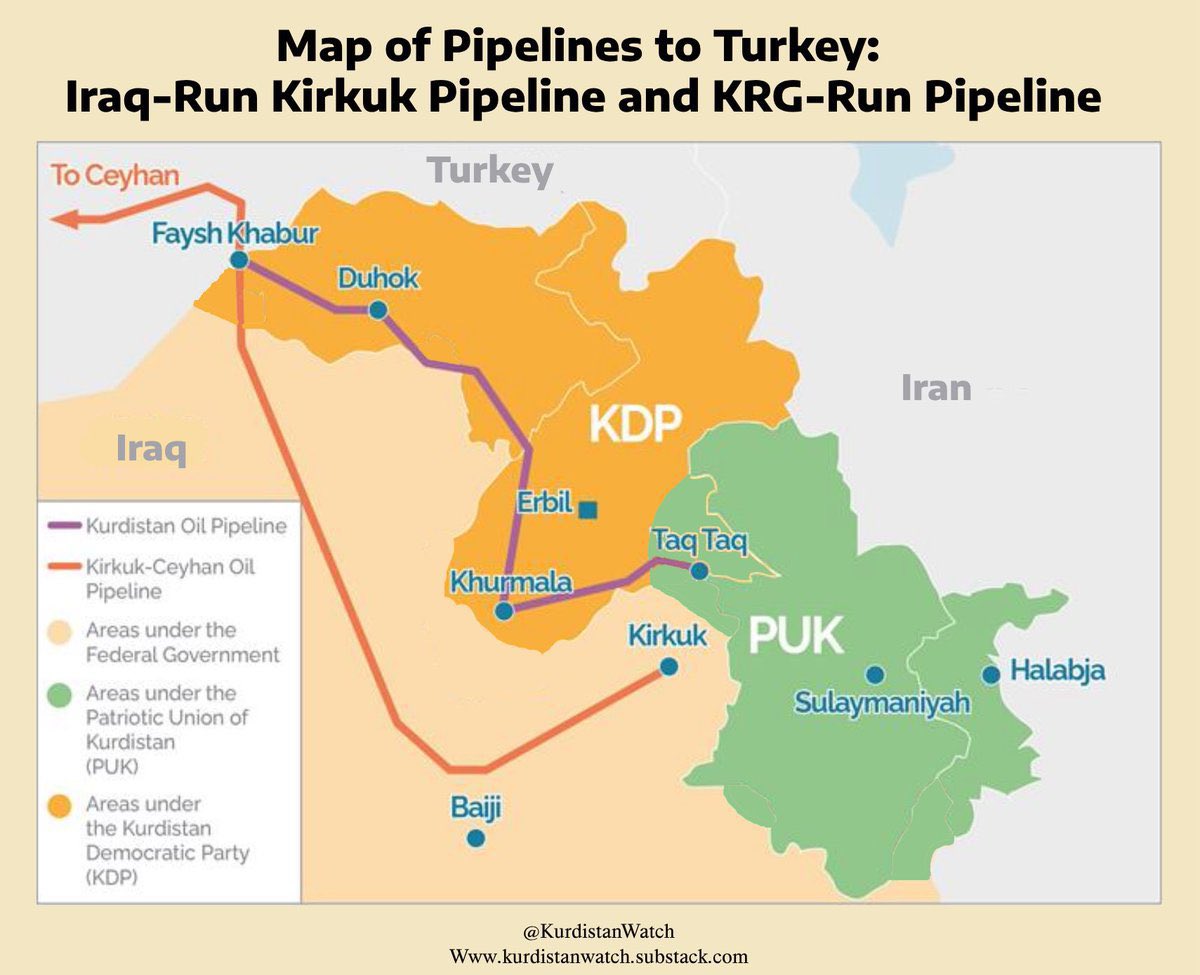
Map: A simplified diagram of the pipeline situation in Iraq as regards branches and territories (Credit: @KurdistanWatch).
In 2023, the International Chamber of Commerce (ICC) ruled in favour of the Iraqi federal government in a landmark arbitration case, finding that Turkey breached a 1973 pipeline agreement by allowing KRG crude exports without Baghdad’s consent.
The ICC ordered Turkey to pay approximately $1.5bn in damages to Baghdad. This sparked a complete shutdown of the northern export route, paralysing roughly 450,000 barrels per day of crude that should have flowed on to global markets via Turkey.
The KRG later relaunched the pipeline, and with the reigniting of the US/Israeli conflict with Iran that has led to the blockading of the Strait of Hormuz, an energy transit corridor chokepoint for Gulf energy exports, Iraq’s central government has also swung behind the operation of the pipeline.
The IntelliNews PRO service includes access to reports, exclusive market data, and more news that decision-makers care about. Stay ahead of the market with IntelliNews PRO.
Sign Up Now