


Missile War Monitor: Putin orders massive strikes on Ukraine's energy grid
5 hours ago

European gas storage is emptier heading into September than it was during the 2022 crisis, and prices have doubled, but at about €74/MWh they are still a fifth of the last crisis year's peak.
The shortages are pushing prices up but apart from the weather, another big unknown is the impact of the closure of the Strait of Hormuz and the impact of the removals of Qatari LNG from the market. During most of the summer this has not affected prices, but as the cold weather approaches Asia is starting to compete with Europe for what little LNG is still on the market.
Storage at decade-long lows
EU storage stood at 65.39% of capacity, or 71.5 bcm, at the end of August, 16.76 percentage points below the five-year average and the lowest level for the date since records began in 2011, TASS calculated from Gas Infrastructure Europe data.
IntelliNews’ own series, built from GIE daily data since 2011, puts the September 1 reading at 80.73% in 2022, 77.65% in 2025, 92.40% in 2024 and 93.02% in 2023. The fifteen-year Fourier baseline for the date, fitted on 2011 to 2025 with the crisis years stripped out, is 81.31%. Europe is therefore entering the last two months of the restocking season roughly 16 points under its own long-run normal and about 15 points under where it sat at the same point in the year Russian pipeline gas was cut off four years ago. It is below even 2021, the pre-crisis squeeze year, when the date read 68.04%.
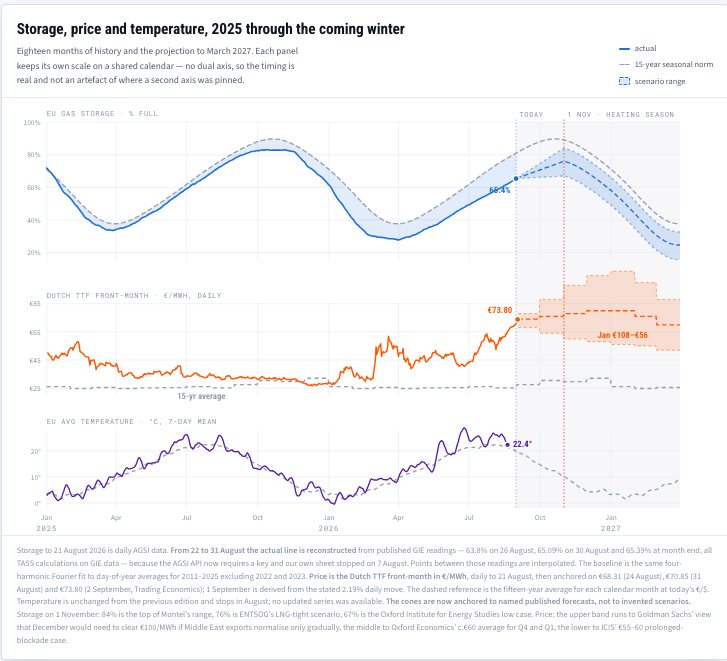
IntelliNews Lambda forecasts of storage volumes and price set against the weather. Find an intereactive version of these charts here.
The refill is not closing the gap
Only 41 bcm has been injected since April, 60% of the 68 bcm needed, based on GIE figures. August net injections came in at 9.2 bcm, 9% lower than a year earlier and among the lowest in twelve years, while thanks to the hottest summer on record, August withdrawals hit 771 mcm, the highest in five years and up 11%. Gas was coming out of the tanks during the restocking season when it was supposed to be going in.
The national picture is more uneven than the aggregate. Germany’s tanks are still way behind its baseline levels and was 53.28% full on August 31. The Netherlands, the other problem child, has 47.29%, against Italy on 83.10% and France on 71.31%, per the AGSI+ feed. The two biggest buffers in northwest Europe are the two emptiest.
Getting to 80% by November 1 would need more than 140 LNG cargoes a month through October, against the 105 a month that actually arrived from May to July – a shortfall of 72 cargoes according to experts. The range set for actual storage for November 1 is now somewhere between 69% to 84% full. The Oxford Institute for Energy Studies is lower: their analysts calculate that if injections match 2024's pace, Europe starts winter at 72 bcm, or 67% full, which would be the lowest opening stock since 2012.
That is a material downgrade on the 77% by November 1 this column modelled in the last edition. The deviation from the long term norms is getting worse by the month as Europe fails to find alternatives.
The price has doubled and is still nowhere near 2022
The growing shortages are now being reflected in the prices, but traders are not yet panicking. Front-month TTF was €73.80/MWh on September 2, up 28.34% on the month and 129.83% on the year, Trading Economics data show.
It topped €70 on August 31 for the first time since January 2023. Bloomberg reported prices at their highest since January 2023 after an escalation in the US-Iran war, with the front-month contract rising as much as 6.5% and now more than 70% above where it sat at the start of July, when a temporary ceasefire lifted hopes of a settlement.
Set against 2022, when TTF peaked at about €350/MWh, today's price is roughly a fifth of the crisis high. The monitoring account Russian Oil & Gas Monitor puts the current level at about $900 per thousand cubic metres, double the average of the last three or four years and more than four times the pre-2021 level, and argues that while the run-up may prove temporary, pre-2021 pricing is unlikely to return.
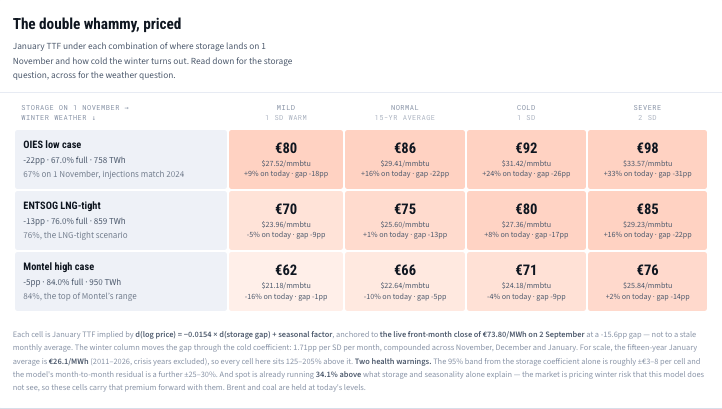
Why this is not 2022
Three things separate this year from 2022.
The shock is a different shape. In 2022 the supply loss was pipeline gas withdrawn by a supplier who was also the counterparty. In 2026 it is liquefied gas trapped behind a closed Persian Gulf waterway that is the swing factor.
The International Energy Agency's Gas Market Report puts the Gulf supply loss at 54 bcm for the year, with Qatar and the UAE down 35 bcm between March and June, partly offset by non-Gulf supply up almost 18%. A physical blockage can clear; a severed commercial relationship does not.
Demand is structurally smaller now than then, partly due to the widespread deindustrialisation, especially in Germany. EU gas consumption runs roughly 15% to 20% below 2021, though last winter that saving narrowed to between 5% and 10% when temperatures fell below average, Oxford Economics says.
And the strict rules that turned 2022 into a buying panic have been dismantled. The 90% storage target survives but no longer has to be met on November 1: it can be hit any time between October 1 and December 1, with 10 percentage points of flexibility and a further five available by delegated act. Previously, government had no choice but to buy at any price, but this year there is more wiggle room that will keep prices down.
Energy Commissioner Dan Jorgensen invited member states in March to cut their filling target to 80%. Europe has, in effect, pre-committed to arriving at winter less full, which removes the forced bid that did most of the damage four years ago.
Where it could still go wrong
The competition for cargoes has moved and Asian demand is back in play, outbidding their European peers. US LNG deliveries to China, Japan, South Korea, Taiwan and India tripled between March and July, and July was the first month American shipments to those five markets exceeded deliveries to Europe, with Asian netbacks offering a €5/MWh premium. Experts say the level at which Europe pulls cargoes back at €60/MWh or higher, which the market has now cleared.
The nuance matters, though: this is not an Asian demand boom. The IEA has regional Asian LNG demand down 0.5% and Chinese LNG imports down 12% year on year. Asia is outbidding Europe for a pool that has shrunk, not for one it wants more of.
Weather cuts both ways. Seasonal forecasts built on the Copernicus service point to above-normal autumn temperatures across nearly all of Europe, which suppresses heating demand and leaves more gas for injection. But August’s sweltering summer worked in the other direction, driving the highest storage withdrawals in five years as cooling load pulled gas into more power generation.
If the Middle East does not normalise, Goldman Sachs analysts Samantha Dart and Laura Cyr estimate December TTF would likely need to move above €100/MWh. Oxford Economics is less pessimistic, seeing TTF near €60/MWh across the fourth and first quarters, and warns eurozone inflation could reach 3.5% in the second half on current wholesale pricing.
The fear is directionally right but the magnitude is wrong, according to IntelliNews Lambda’s model. Storage is genuinely worse than 2022 and reaching the mandatory 90% by November 1 is no longer possible. But the shock is reversible, demand is smaller, the regulatory straitjacket is gone, and the price is a fifth of the peak. What Europe is buying this winter is not a repeat of 2022. It is a much thinner margin for a cold January, and the chokepoint staying shut.
This article was produced with the assistance of IntelliNews Lambda, an AI-assisted analytical tool.
The IntelliNews PRO service includes access to reports, exclusive market data, and more news that decision-makers care about. Stay ahead of the market with IntelliNews PRO.
Sign Up Now_1788348967.jpg)


_Cropped_1788258984.jpg)
