


North Macedonia’s gasification push enters new phase as Greece interconnector nears completion
3 hours ago
Stock markets across much of Central and Southeast Europe delivered strong performances in 2025, buoyed by rising investor participation, strong capital raising and renewed interest in equities and bonds, according to information from regional exchanges and market officials.
Across the region, market officials said falling inflation, easing monetary policy and strong domestic growth have supported the rally, while valuations in several CEE markets remain below Western European levels, suggesting further upside for investors.
The biggest exchange in the region, Poland’s Warsaw Stock Exchange, had one of its best years on record, with the broad WIG index surging by 47.3% during 2025, according to a press release issued by the exchange on January 9.
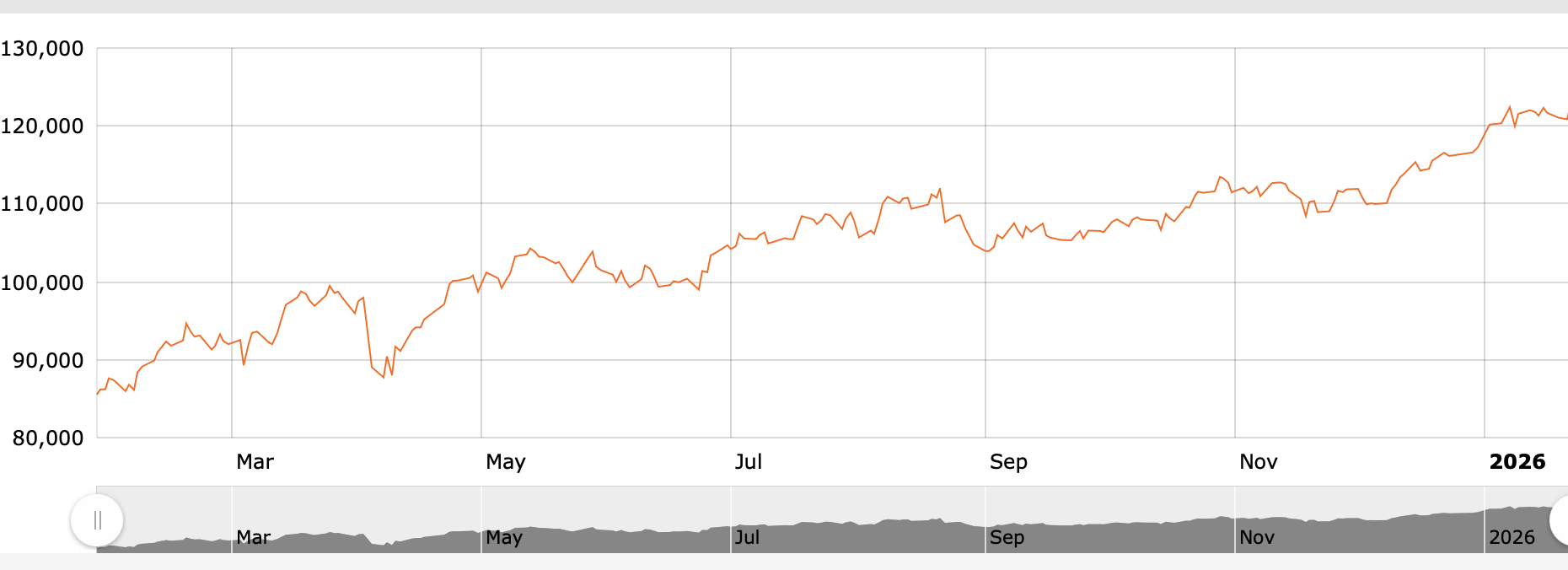
Warsaw's WIG index. Source: WSE.
“[E]verything indicates that [2025] will be remembered as one of the best periods in the history of the Warsaw Stock Exchange,” financial portal Analizy.pl said in December, noting that the WIG has risen by more than 100% over the past three years.
The prevailing opinion among Polish investment fund companies (TFI) experts is that the upcoming year will bring a continuation of the bull market on the WSE, albeit at a slower pace and with a clear change in its structure, betting heavily on small and medium-sized companies, Analizy.pl said.
The consensus forecast is for around 15% profit growth in 2026. “The market consensus predicts a 10% decline in banking sector profits, but the results of other sectors are expected to increase by nearly 25%,” said Jakub Liebhart of Eques Investment TFI, as quoted by Analizy.pl.
While the majority of analysts quoted by individual investors-focused portal Strefainwestorow said they believe the raging bull market is here to stay, they noted that rates of return could be lower in 2026 than in 2025. However, the situation remains attractive for companies in need of capital.
Moreover, as reported by Strefainwestorow on January 19, positive sentiment on the WSE will likely attract fresh initial public offerings (IPOs) that may trigger a wave of newcomers this year, with nearly 20 companies potentially lining up to list.
Successful debuts in 2025 by Arlen Textile Group (WSE: ARL) and medical lab services company Diagnostyka (WSE: DIA) demonstrated that even after a prolonged period of stagnation on the IPO market, investors were willing to welcome offers from companies with a clear business model and credible track record.
Possible debutants listed by the portal include Poland’s biggest private military equipment producer WB Electronics, PV-oriented company Nasz Prad, retailer Empik and children’s goods retailer Smyk.
Strong year on Nasdaq Baltic
In the Baltic States, the regional Nasdaq Baltic exchange reported its strongest year on record. Companies raised a total of €2.1bn through equity and debt, up 160% from 2024 and three times more than in 2023, reflecting a rapid deepening of capital markets in Estonia, Latvia and Lithuania.
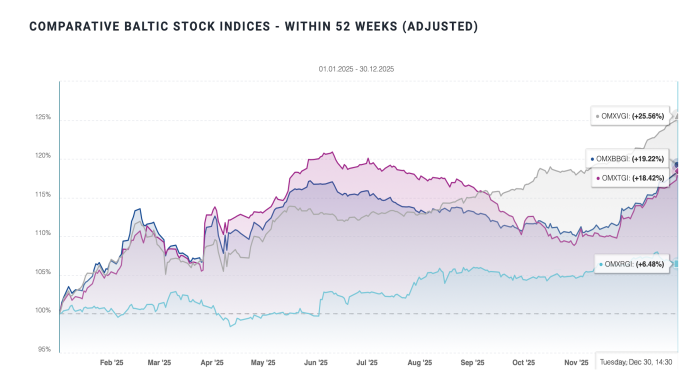
Performance of the main Nasdaq Baltic indexes in 2025. Source: Nasdaq Baltic.
Total equity trading turnover reached €556mn, representing a 41% increase year over year, while bond trading turnover rose by 52% to €152mn, the exchange said in a press release earlier in January. Market indices closed the year firmly in positive territory, with the Vilnius index leading gains, followed by Tallinn and Riga, and the Baltic Benchmark Index advancing 19% overall, Nasdaq Baltic said.
There were 60 new bond listings and nearly €2bn raised, driven mainly by financial institutions, real estate firms and utilities. Equity markets also performed strongly, with 30 of 33 companies on the Main List ending the year higher, the exchange said in a press release. The Baltic Benchmark Index rose 19%.
Commenting on the results, Kaarel Ots, head of Nasdaq Baltic Exchanges, said the surge in listings and capital raised demonstrates that capital markets are becoming an increasingly vital component of corporate financing in the Baltics, supported by rising confidence among both issuers and investors.
Hungary’s BUX soars
Hungary was among the global top performers, as bne IntelliNews reported recently. The Budapest Stock Exchange’s (BSE’s) BUX index climbed 40% in 2025, while the small- and mid-cap BUMIX gained 44%.

The Budapest Stock Exchange’s (BSE’s) BUX index. Source: BSE.
Central bank governor Mihaly Varga told a press conference, quoted by financial website Portfolio.hu, that the rally reflected underlying economic strength, while BSE CEO Tibor Toth highlighted surging trading volumes and record gains in blue-chip lender OTP (BUD: OTP).
Last year OTP shares surged more than 60% and is now trading at an all-time high, while among mid-caps, 4iG, which aspires to be the fifth blue chip, besides OTP, Richter (BUD: RICHTER), MTelekom (BUD: MTEL) and MOL (BUD: MOL), shares jumped more than 4.5-fold.
Major transactions included MBH's share issue, the largest retail share subscription in 25 years. He also highlighted the first euro-denominated share issue by Shopper Park Plus, which owns and operates shopping malls in the CEE region. The company raised €100mn in November to acquire eight retail parks in Poland.
Toth underlined that the growth reflects company performance rather than market revaluation and noted that current valuations on the BSE still contain a significant discount compared with Western European and US markets. He also stressed the need to increase the proportion of household savings invested in equities to converge with Western levels.
Record high for Prague’s PX index
In Czechia, the Prague Stock Exchange’s PX index hit a record high of 2,714.06 points on January 5, after previously breaking records in December. The index surpassed levels last seen before the global financial crisis, supported by gains in financial stocks including Vienna Insurance Group and Erste Bank.
Meanwhile the Bucharest Stock Exchange’s (BVB’s) main index Bucharest Exchange Trading (BET) also rose strongly during the year, reaching a new historic high of 20,000 points in 2025. The BET closed 2025 at a historic high of 24,439 points, up by 46% since the start of the year, the strongest growth since 2009.
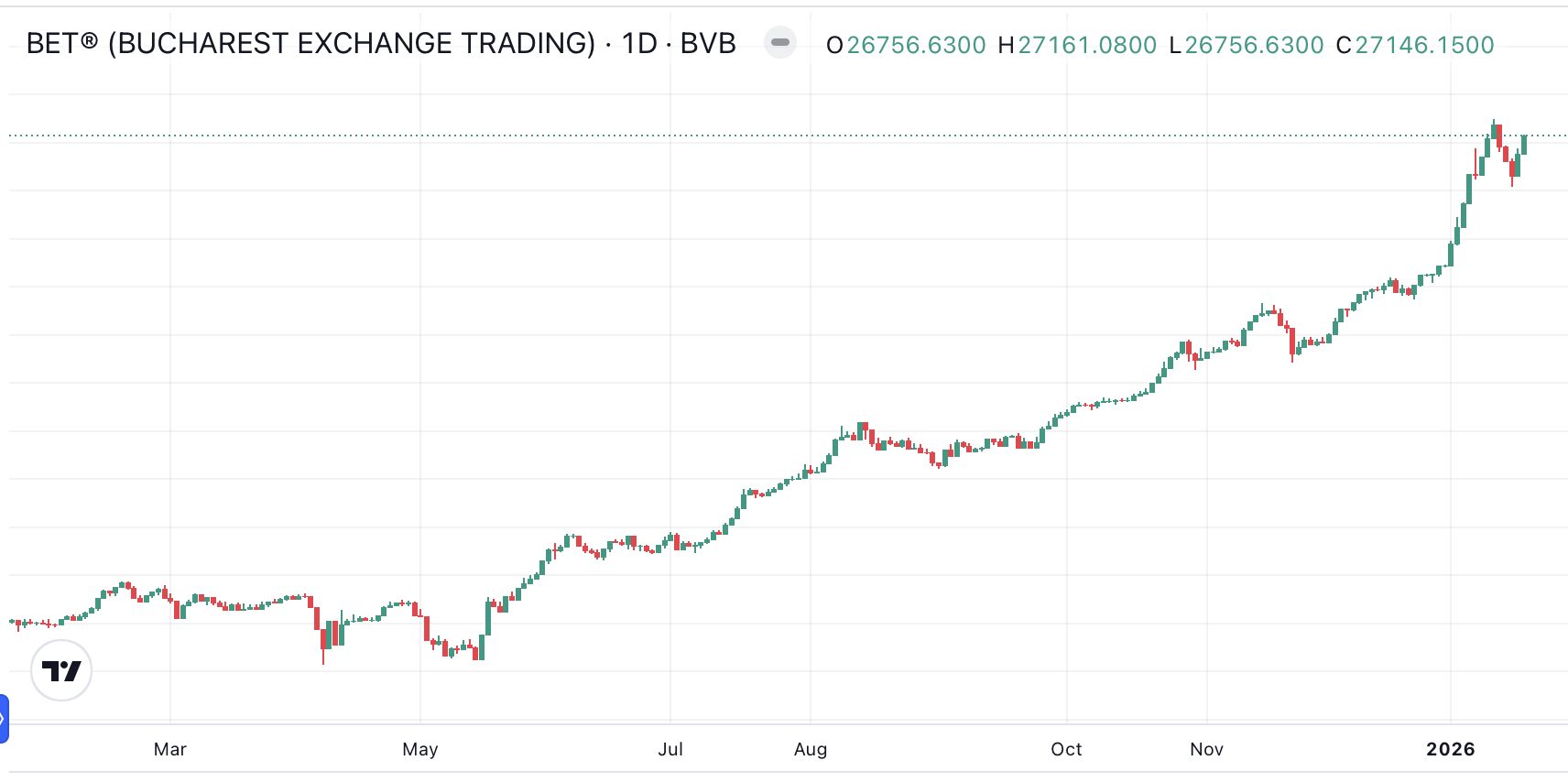
The Bucharest Stock Exchange’s (BVB’s) main index Bucharest Exchange Trading (BET). Source: BVB.
The BET-TR, the version of the BET index that also includes dividend reinvestment, exceeded the threshold of 50,000 points, and was up 55% on the year.
Late 2025 saw the IPO of Romanian entrepreneurial group Cris-Tim Family Holding (BVB: CFH), a producer of cold cuts and ready meals. The opening price gave the company a market capitalisation of RON1.41bn (€277mn).
Croatia’s Zagreb Stock Exchange also posted robust growth, with equity turnover rising nearly 76% and the benchmark CROBEX index gaining 21%. Construction sector stocks led gains, while three new listings helped drive market activity. ZSE management said investor confidence and market maturity had improved markedly.
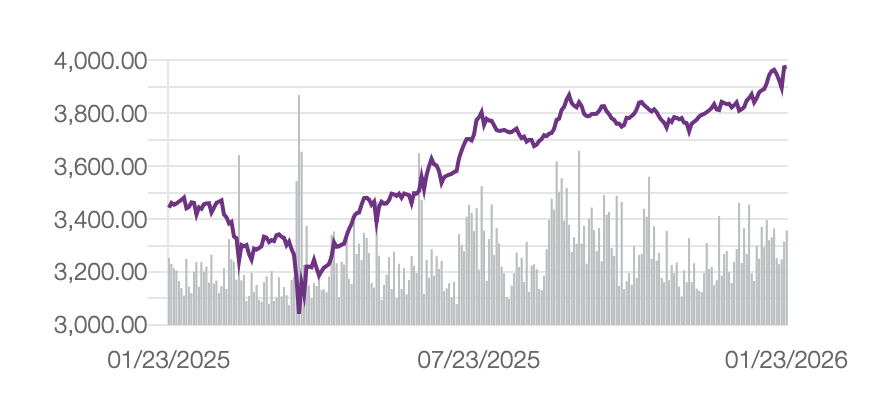
The Zagreb Stock Exchange's CROBEX index. Source: ZSE.
There were a series of IPOs in Zagreb in 2025, including Žito Group (ZSE: ZITO), one of Croatia’s largest agri-food companies which raised €130mn in the exchange’s biggest private sector IPO to date, as well as auto-parts distributor Tokic (ZSE: TOK) and construction company ING-GRAD (ZSE: IG).
The IntelliNews PRO service includes access to reports, exclusive market data, and more news that decision-makers care about. Stay ahead of the market with IntelliNews PRO.
Sign Up Now


