

_Cropped_1786430662.jpg)

Russia's economy rebounds 1.3% in the second quarter but budget strains deepen
58 seconds ago
A gold ring set with 321 diamonds, handed to Donald Trump by Antwerp's diamond traders, has drawn accusations of a “cartoonish bribe” weeks after their gems slipped free of his tariffs.
Senators Elizabeth Warren and Richard Blumenthal have written to the Antwerp World Diamond Centre (AWDC), whose president presented the ring to the president during America's 250th-anniversary celebrations in Brussels on June 28. The 18-karat piece, engraved “Crafted in Antwerp for Donald John Trump”, also carries 56 sapphires, 13 emeralds and six rubies, and has been valued by independent jewellers at up to $35,000. Washington restored a zero tariff on European natural diamonds, a trade worth $2.1bn a year to Belgium, on July 24.
“June 28: Belgium's diamond industry gifted Trump an 18-karat gold ring. July 24: European diamonds got their exemption from Trump's tariffs. I'm investigating what looks like cartoonish corruption,” Warren wrote.
The ring lands amid wider questions over the president's financial dealings. Trump and administration officials placed hundreds of stock trades around market-moving policy calls, most conspicuously a wave of buying before he paused his sweeping tariffs on April 9 2025, hours after he told followers “this is a great time to buy”, a sequence Democratic lawmakers have branded possible insider trading.
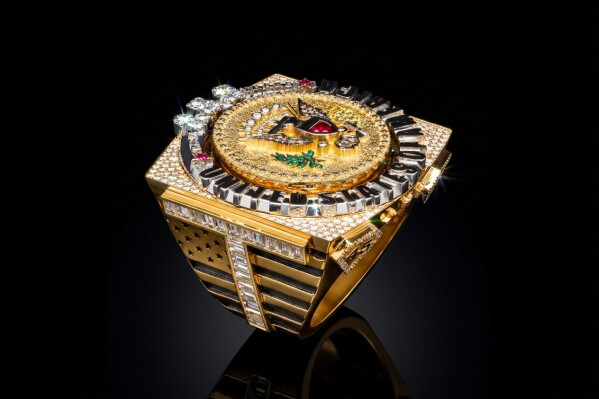
The 18-karat gold ring set with 321 diamonds and dozens of other gems that Antwerp's diamond centre gifted to US President Donald Trump. Credit: Antwerp World Diamond Centre
Antwerp's Russian habit
Belgium's grip on the rough-diamond trade explains the reflex to protect it. Antwerp handles the bulk of the world's rough stones and earns billions of euros a year, and for two decades it leaned heavily on Russian supply. That dependence kept Russian gems out of the first 11 rounds of EU sanctions after the 2022 invasion, even as banks, oil and coal were hit; in 2021 Belgium alone bought roughly $1.4bn of Russia's diamonds.
Russia is the world's largest producer of rough diamonds, and state-controlled Alrosa digs more than 90% of it. Even after a deliberate squeeze on output, Russia mined 31.5mn carats in 2025 and shipped gems worth $2.5bn, close to a third of world production by volume.
The ban held off until the 12th package, agreed in December 2023 and in force from January 1 2024, the first EU embargo on Russian diamonds, widened in stages to stones cut in third countries such as India in step with the G7.
It proved as leaky as the oil measures beside it. Within months dealers were quitting Antwerp for Dubai, protesting that it was “impossible” to prove a stone's origin, while Russian exports found new homes: shipments to Hong Kong jumped 18-fold in early 2024. Washington, which banned Russian stones earlier, has quietly kept a licence open for select diamonds until September 2026.
None of the newer rounds revisits the gems. The embargo already amounts to a full import ban, and the 20th package in April 2026 went after circumvention routes rather than stones. Brussels has floated no fresh total ban; the harder task is enforcing the one it has.
Exemptions all round
The same logic runs through oil. The bloc's 21st sanctions package, drawn up in July 2026, was watered down after Greece, Cyprus and Malta pushed back on tightening the Russian oil price cap, keen to shield the shipping industries that dominate global tanker markets. Left untouched, the floating cap would have loosened automatically from about $44 to $58 a barrel.
Greek owners have reason to fight. Their tankers have earned at least $3.8bn hauling Russian crude since mid-2023, a fifth of the shadow fleet, according to the Financial Times. Russia took in some $160bn from oil exports last year, largely unbothered by the cap.
From Antwerp's gem dealers to Athens's shipowners, the pattern keeps surfacing: the pressure on Russia holds until a member state's own business is threatened, and an exemption appears. The ring on Trump's finger is only the most glittering version of it.
The IntelliNews PRO service includes access to reports, exclusive market data, and more news that decision-makers care about. Stay ahead of the market with IntelliNews PRO.
Sign Up Now


