


Russia-China trade turnover rises 26.3% in seven months
13 minutes ago
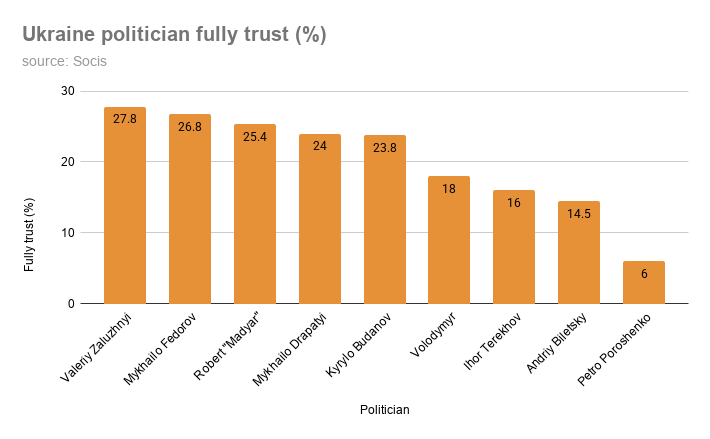
Ukrainian President Volodymyr Zelenskiy has slipped to sixth place in a new public trust ranking of the country's political and military leaders, behind four military figures and his own former defence minister, according to a poll published on August 6 by the Center for Social Research Socis.
This is not a one-off wobble: Zelenskiy's own approval rating has been sliding through the summer as war fatigue deepens, and the new poll is the clearest evidence yet that public confidence has shifted decisively toward the military figures who have led the war rather than the politicians managing it - a dynamic with real consequences whenever wartime martial law eventually lifts and elections become possible.
A crowded field ahead of the president
Socis surveyed 2,000 people face-to-face between July 28 and August 2, with a margin of error of 2.6%; the poll excluded occupied territory and active combat zones. Former commander-in-chief Valeriy Zaluzhnyi, now Ukraine's ambassador to the UK, topped the ranking with 27.8% saying they fully trust him (37.1% more said they somewhat trust him). Mykhailo Fedorov, who resigned as defence minister on July 15 after a tenure marked by open conflict with the military over procurement reform, was second on 26.8%.
Robert "Madyar" Brovdi, commander of the Unmanned Systems Forces, placed third (25.4%), followed by AFU commander-in-chief Mykhailo Drapatyi (24%) and Kyrylo Budanov, head of the Office of the President and former military intelligence chief (23.8%). Zelenskiy came sixth: 18% of respondents said they fully trust him, 24.5% somewhat trust him, 17% somewhat distrust him and 37% do not trust him at all - a net-negative balance no other figure in the top six shares.
Kharkiv mayor Ihor Terekhov (16%) and Third Army Corps commander Andriy Biletsky (14.5%) rounded out the next tier, ahead of ex-parliament speaker Dmytro Razumkov, boxer Oleksandr Usyk, Veterans Minister Vitaliy Klym, and, well down the list on 6%, former president Petro Poroshenko.
Zelenskiy leads the first round but loses almost every run-off
Socis also simulated a hypothetical presidential election. In a first-round vote among all declared and undeclared contenders, Zelenskiy would in fact lead the field - 17.8% to Zaluzhnyi's 17.1%, with Fedorov on 10.5% and Budanov on 6.7%, according to Interfax-Ukraine's report of the same survey; 15% of respondents were undecided and 5.4% said they would not vote.
The picture flips in a run-off. Zaluzhnyi would beat Zelenskiy 47.4% to 24.2%; Fedorov would win 43.4% to 24.7%; and Budanov would take 39.5% to Zelenskiy's 26%, with 14-17% of respondents opposed to both candidates in each scenario. Zelenskiy's only clear win among the tested pairings is against Poroshenko, 38.1% to 20.7%, and a narrower one against Biletsky, 32.8% to 24.9%.
No presidential election can legally take place while martial law remains in force, and IntelliNews has reported that Zelenskiy has himself sought to dissuade Zaluzhnyi from running should the option arise - a sign the numbers behind this poll are already shaping political calculations at Bankova, even with no vote scheduled.
A presidency squeezed from the flanks
The erosion in trust tracks a wider domestic squeeze on Zelenskiy's presidency this summer: IntelliNews reported in March that support was already melting within his own Servant of the People party over the handling of martial-law renewals, and in July a sweeping government reshuffle followed weeks of friction between Fedorov and the military over defence procurement - Fedorov was accused by his critics of obstructing graft, and by the military of obstructing operations, before he was pushed out and, per Financial Times reporting cited by Russian outlet Vedomosti, replaced in a reshuffle that also installed Drapatyi as AFU commander.
That reshuffle appears to have backfired in reputational terms: the two men most associated with the shake-up, Fedorov and Drapatyi, now rank second and fourth in public trust, both comfortably ahead of the president who promoted them. A separate Socis finding underlines the stakes - a third of Ukrainians say democracy is already lacking under wartime rule, a sentiment that a trust ranking topped by soldiers rather than politicians will do little to dispel.
The IntelliNews PRO service includes access to reports, exclusive market data, and more news that decision-makers care about. Stay ahead of the market with IntelliNews PRO.
Sign Up Now


_1_1785989653.png)
