


MACRO ADVISORY: Russia’s August Angst - 2026
16 hours ago
Economic activity data for June confirmed what we saw in the second quarter GDP data: as summer arrived, the Hungarian economy went on holiday. Both industry and retail sector growth rates came in lower than expected, but we are still optimistic about the future.
The Hungarian Central Statistical Office has released data for June on retail sales and industrial production. We have already got the second quarter GDP data, so the negative shift came only as a moderate surprise. Monthly volatility in industry persisted, with June revealing its weaker side. Retail sales slowed at the start of the summer, but elevated consumer confidence and rising real disposable incomes are expected to restore momentum in the coming months. Against this backdrop, we may see a positive overall contribution from both sectors in 2026.
Industry disappointed (again), but there is still room for growth
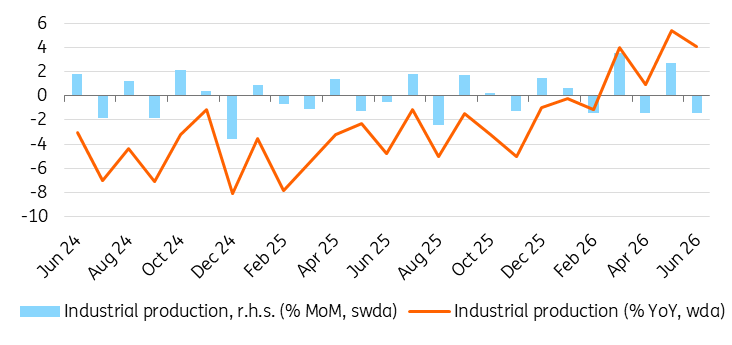
Following the somewhat disappointing second-quarter GDP data, it was clear that the monthly statistics for June would not be strong. It seems that Hungarian industry cannot escape its usual pattern of one good month followed by one bad month. We had hoped this trend might be broken this time, but that did not happen. In June, production fell by 1.4% month-on-month, which was a negative surprise even given the wide range of forecasts. The year-on-year index, adjusted for working days, was also significantly lower than the previous month's figure. However, the growth rate of 4.1% is not bad in itself. This is not least because the negative correction in June was smaller than the surge in the previous month. Based on all this, it can still be said that a positive trend has been in place since the end of 2025.
Volume of industrial production
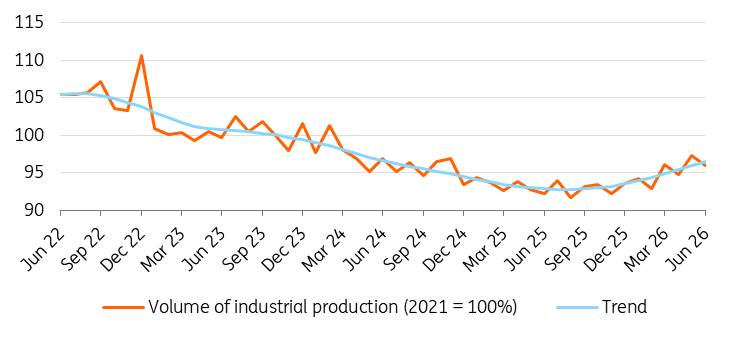
Thanks to this positive trend, the sector’s production volume in June was just 4% below the 2021 average. This is in line with the average performance of 2024, suggesting that a degree of optimism may be justified.
As this is preliminary data, the HCSO has not yet released many details. Yet even based on the brief commentary, a generally positive picture emerges, particularly with regard to the year-on-year indices. Production volume increased in the majority of manufacturing subsectors. The HCSO specifically highlighted the three most significant sectors by name. It is perhaps no longer surprising that production expanded in the electronic and optical products and manufacture of transport equipment. This reflects the surge in production linked to the AI boom and the increase in vehicle manufacturing capacity. Battery production also appears to have passed its low point, having shown growth too.
Current level of capacity utilisation (%)
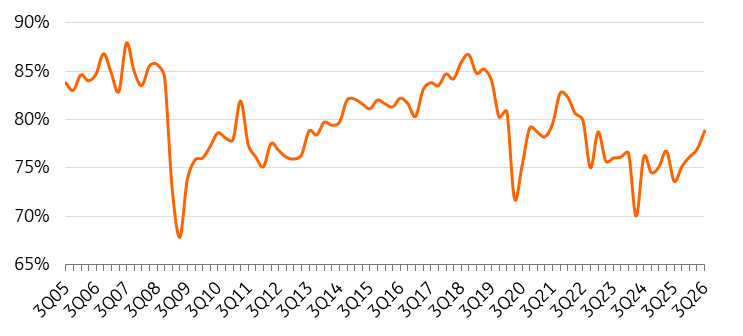
Soft indicators also point to the continuation of this sustained positive trend. For the first time in three months, a slight majority of manufacturing companies intend to hire new staff in the coming months. Furthermore, there are signs of improvement regarding the expected development of order books. Expected capacity utilisation for the third quarter has also risen significantly, approaching a rate of 79%. Given these developments, it is perhaps not surprising that the aggregate industrial confidence index value for July stands at a peak not seen since summer 2022.
Performance of Hungarian industry
Looking ahead, we expect industrial activity to be significantly affected by production cuts stemming from the energy crisis caused by low Danube water levels, which are reducing the electricity generation capacity of the Paks Nuclear Power Plant. Accordingly, we expect to see negative figures as early as late July, but even more so in the August data. However, if a complete shutdown at Paks can be avoided, there is a chance that recovery could begin as early as autumn. As there is still scope for manufacturers to increase capacity utilisation, it may be possible to make up for lost production in the remainder of the year once the energy crisis ends. For this reason, despite the current crisis, we believe that the fixed-base index could reach, and even exceed, the monthly average for 2021 by the end of this year. Therefore, the full-year performance for Hungary's industry could average growth of around 3–4% in 2026. In other words, after three years of industrial recession, the manufacturing sector could once again contribute positively to the overall performance of the economy, despite the Paks crisis.
Retail sales lost some momentum, but this is expected to be only temporary
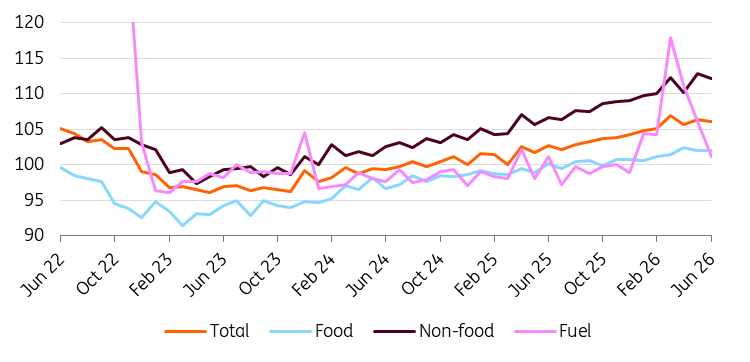
Looking at the details of the monthly decline in sales, grocery store sales remained stable. In contrast, a significant decline was observed at non-grocery stores. There are large variations within this segment. Following the sharp surge in the previous month, sales at mail-order and internet sales declined, supporting our earlier hypothesis that efforts to avoid new EU tariffs may have triggered the significant surge prior to their implementation and now we are seeing a correction. Sales at stores selling textiles, clothing and footwear also fell significantly. Surprisingly, sales at furniture and hardware stores barely increased, despite major promotions timed for the FIFA World Cup, which would typically boost sales. However, sales at book and newspaper stores increased following the negative surprise in May.
Overall, significant volatility continues to characterise individual retail sectors. Fuel sales plunged by 4.7% compared to the previous month, marking a fairly sharp correction for the third consecutive month.
Breakdown of retail sales (% YoY, wda)
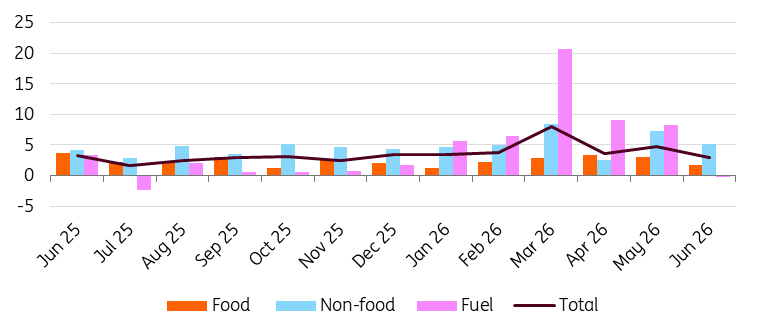
Looking ahead, the foundations for sustained growth in retail sales and, by extension, consumer spending remain firmly in place, supported by soaring consumer confidence, persistently low inflation and strong wage growth. However, this contrasts with the slowdown in growth seen in recent months. It is still too early to determine whether this was simply due to various one-off factors or whether a genuine shift has occurred.
Historical data shows that when growth in disposable income meets strong consumer confidence, this always results in significant consumption growth. It is possible that retail sales have reached a natural limit: consumers are shifting towards higher-quality purchases rather than greater quantity, and the emphasis is shifting from buying goods to purchasing experiences. The latter trend would be indicated by sustained higher growth in the service sector compared to retail sales. Overall, we expect retail growth of around 5% this year, which leads us to conclude that consumption will remain the main driver of the Hungarian economy in 2026 as well.
The IntelliNews PRO service includes access to reports, exclusive market data, and more news that decision-makers care about. Stay ahead of the market with IntelliNews PRO.
Sign Up Now


