_050326.jpg)


Putin’s winter campagin to freeze Ukraine into submission is already underway
15 hours ago
Turkey said on March 5 that its state institutions are keeping a close eye on the actions of the Iranian Kurdish Kurdistan Free Life Party (PJAK) militant group. Ankara’s terse words come at a time when reports suggest PJAK and other Kurdish groups could be armed by the US for an attack launched from Iraq on Iranian security forces that could help bring down Iran’s government.
"The activities of groups that fuel ethnic separatism, such as the terrorist organisation PJAK, negatively affect not only Iran's security but also the overall peace and stability of the region," Turkey's defence ministry told a weekly press briefing in Ankara, Reuters reported on March 5.
On March 4, CNN reported that the CIA has been working to arm Kurdish forces with the aim of fomenting a popular uprising in Iran. US President Donald Trump was said by a senior Kurdish official to have on March 3 spoken by phone with the president of the Democratic Party of Iranian Kurdistan (PDKI), Mustafa Hijri. Israeli Prime Minister Benjamin Netanyahu has for months lobbied Trump to engage the Kurds, Axios has lately reported.
Concerns about what could be in prospect were addressed by Barbara Leaf, the former US assistant secretary of state for near eastern affairs until 2025 and a distinguished diplomatic fellow at the Middle East Institute based in Washington DC. She was reported by the Guardian as saying on March 4: “If the [US] administration is seriously mucking about or contemplating mucking about with the Kurds in Iran, they’re opening up a hornet’s nest. I think that Recep [Tayyip] Erdogan [Turkey’s president] will have a lot to say about it and so will others – count on strong reactions from Iraqi PM [Mohammed Shia al-] Sudani and Syrian president [Ahmed al-] Sharaa.”
“Gulf leaders are likely to be very queasy about the prospect of such a US move,” added Leaf.
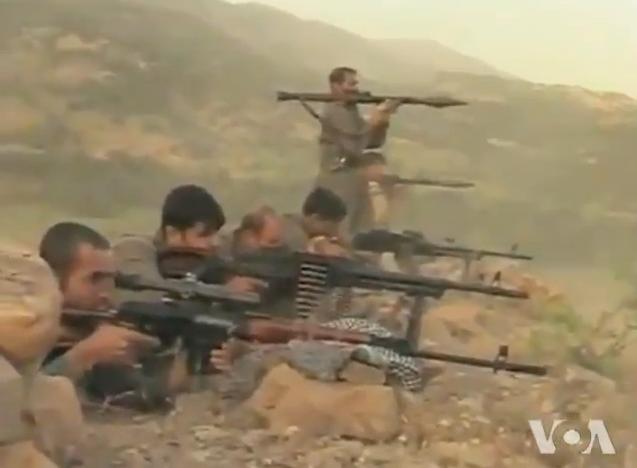
PJAK fighters pictured in 2012 (Credit: VoA, public domain).
PJAK is aligned with the Kurdistan Workers’ Party (PKK), through the Kurdistan Communirties Union (KCK), an umbrella group of Kurdish political and insurgent groups in Turkey, Iran, Syria and Iraq. The PKK, based in mountainous northern Iraq, fought a four-decade-long armed insurgency against Turkish forces, prior to the declaration of a ceasefire and a peace negotiation, which remains fragile, a year ago. Both the PKK and PJAK are designated as terrorist groups by Turkey.
On March 3, as the US-Israeli bombing blitz of the Iranian regime continued, sources told Reuters that Iranian Kurdish groups had consulted with the US on whether, and how, to attack Iranian security forces in western Iran, where most of Iran’s Kurdish population of around 10mn live in provinces bordering Iraq and Turkey.
The goal of such an attack would be to create room for Iranians opposed to Iran’s Islamic regime to rise up now that Supreme Leader Ali Khamenei and other top officials have been killed in the US-Israeli attack that began on February 28, the sources were cited as saying.
However, reportedly, no decision on such an operation, backed by US arms and intelligence, has been made.
Such US support for a Kurdish armed offensive would no doubt infuriate Turkey, which during the conflict that split Syria among warring parties from 2011 to December 2024 frequently complained to Washington over its backing of the Kurdish-dominated Syrian Democratic Forces (SDF), who served as the main ground force in the US fight to crush Islamic State in Syria. Turkey argues the SDF and the PKK are essentially one and the same.

Kurdish-inhabited cities (Credit: thekurdishproject.org).
Michael Horowitz, an independent defence expert based in Israel, was on March 4 quoted as saying by RFE/RL: "The main goal [of the potential backing of the Kurds for an Iran operation] is to make sure the Islamic republic starts losing control of some areas of the country.
"The assessment may be that by doing so, other minorities as well as the broader opposition may be inspired. Some elements within the regime who may be tempted to defect or flee may also see this as a sign that they should do so now, before the situation spins fully out of control."
In anticipation of a US-Israeli attack on Iran, PJAK and four other Iranian opposition Kurdish groups based in Iraqi Kurdistan in February formed a new political coalition aimed at overthrowing the Islamic regime and ultimately achieving Kurdish autonomy.
The four other coalition members are the PDKI, Kurdistan Freedom Party (PAK), the Organization of Iranian Kurdistan Struggle (Khabat) and the Komala of the Toilers of Kurdistan. Some Kurdish political heavyweights including the Komala Party of Iranian Kurdistan are not part of the coalition.
In further comments on the potential US-backed operation, which would likely involve the US and Israel offering Kurdish fighters air support, Horowitz said: "Washington could trigger a civil war and the fragmentation of the country, which could have lasting consequences.”
He added: "If they [the Kurdish groups] engage in a long-term war against Iran, and the US support disappears, this will prove very dangerous for them."
The US lately withdrew from its military alliance with Syria’s SDF after deciding to throw in its lot with the post-Assad interim government that has taken root in Damascus.
With speculation over the likelihood of a Kurdish operation supported by the US and Israel growing, Iran on March 4 warned “separatist groups” against joining the widening conflict.
Tehran added on March 5 that it has launched strikes against Iraq-based Kurdish groups “opposed to the revolution”, including a bombing of the headquarters of the Iranian Kurdish forces in northern Iraq.
“Separatist groups should not think that a breeze has blown and try to take action,” said the secretary of Iran’s Supreme National Security Council, Ali Larijani.
Meanwhile, there are growing reports of Baloch militant groups opposed to the Tehran regime as having shifted from remote mountain bases in Pakistan across the border into Iran.
The IntelliNews PRO service includes access to reports, exclusive market data, and more news that decision-makers care about. Stay ahead of the market with IntelliNews PRO.
Sign Up Now


