


Albania beats EU on renewable electricity but hydropower reliance brings risks
3 hours ago
Solar panels generated more electricity in the European Union than dams did in 2025, the first time that has happened, according to the latest data from Eurostat.
The margin was almost nothing - 346,819 GWh of solar against 346,244 GWh of hydro, a gap of 575 GWh, or about four hours of French demand. Both came to 13.0% of EU generation.
The difference in output is still small, but the pace of the change is not: EU solar output has more than tripled since 2017, when it was 104,317 GWh, while hydro fluctuates with rainfall and has no trend at all.
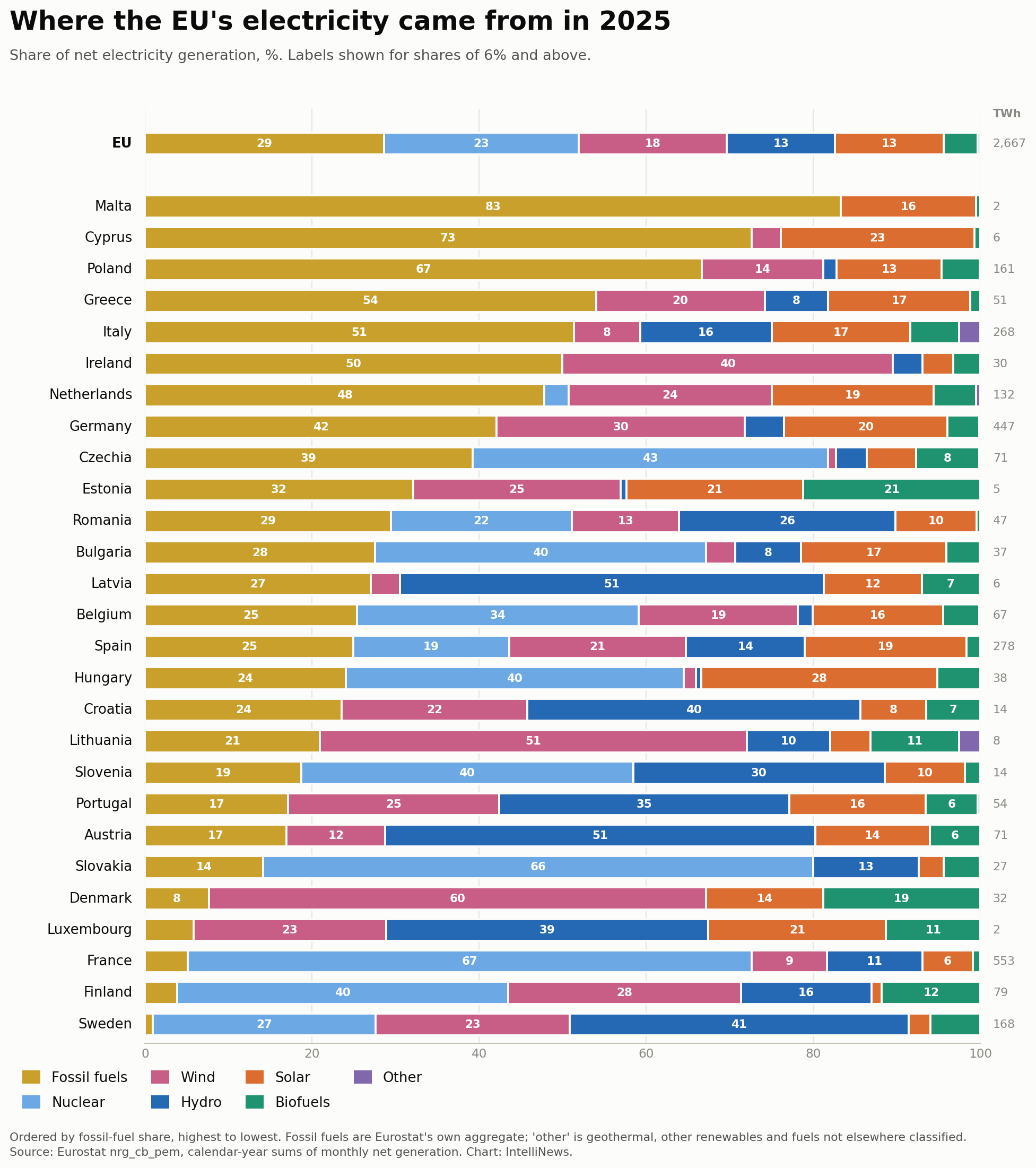
Share of net electricity generation by fuel, 2025. Source: Eurostat nrg_cb_pem.
Fossil fuels supplied 28.6% of the EU's 2,667 TWh, nuclear 23.3%, wind 17.7%, then solar and hydro tied at 13.0% and biofuels 4.0%. Taken together renewables reached 48.1%, and wind and solar alone made 30.7% - more than fossil fuels.
Coal is the source doing the disappearing. EU coal-fired generation fell from 574,375 GWh in 2017 to 245,053 GWh in 2025, a drop of 57% in eight years. Gas has not filled the gap so much as held station, at 449,213 GWh against 360,046 GWh in 2017.
Nuclear is the quieter story. At 620,874 GWh it is down 17% on 2015, but it has recovered from the 2022 trough of 577,593 GWh, when France's corrosion-related outages coincided with Germany's final shutdowns. It remains the single largest low-carbon source in the bloc, ahead of wind.
What the chart shows better than the aggregate is that there is no European electricity system, only 27 national ones that happen to be wired together.
The spread runs from Malta at 83% fossil-fired to Sweden at 1%. Between them sit two different kinds of country. Poland, at 67% fossil, is the largest economy still built on coal. Cyprus and Malta are small island systems with no interconnection to speak of and nowhere to put a dam. Greece at 54% and Italy at 51% still lean on gas.
At the other end the low-fossil countries got there by three different routes, and none of them is the one Brussels talks about most. France is at 67% nuclear. Slovakia is at 66%. Austria is at 51% hydro, Latvia 51%, Sweden 41%. Only Denmark, at 60% wind, is a case of a country building its way to a clean grid rather than inheriting one.
Sixteen of the 27 are below the EU average for fossil fuels, which means the average is being dragged up by a handful of large, carbon-heavy systems rather than reflecting a typical member state.
Germany is the interesting middle case: 42% fossil, but also 30% wind and 20% solar, and zero nuclear since the last three reactors closed in April 2023. It generates more wind power than any other member state by a wide margin and still burns more fossil fuel than any of them too, because it is simply very large - 447 TWh, second only to France's 553 TWh.
Fifteen of the 27 member states now generate no nuclear power at all. That list includes Germany, Italy, Poland, Denmark, Austria, Ireland and Portugal, and it is the reason the nuclear share of the EU mix keeps slipping even as French output recovers.
Hungary, at 28% solar, has the highest solar share in the bloc - a fact that surprises people who assume the answer is Spain, which is at 19%. Estonia gets 21% of its electricity from biofuels, mostly wood, the highest in the EU and a reminder that the country's oil shale industry is being replaced by something that is renewable on paper but still involves burning things.
The IntelliNews PRO service includes access to reports, exclusive market data, and more news that decision-makers care about. Stay ahead of the market with IntelliNews PRO.
Sign Up Now


