

Nato has no plan for a joint Russia-China attack, its own strategists say
4 hours ago

This week The Telegraph reported that “Russians withdraw billions from banks amid fears Putin could seize deposits.” What actually happened is Russian bank deposits have doubled since the start of the war in Ukraine and are still rising. Russians are not taking money out of banks; they are putting more money than ever into their deposit accounts. What has changed is the pace those deposits are growing.
It is true that the demand for cash has increased, as IntelliNews reported. But that is partly due to internet outages forcing to people to pay with cash not contactless, amongst other reasons. Russian household bank deposits hit a record RUB70.5 trillion ($827.8bn) in June, more than double their level when the war began.
And it is true that confidence in the economy has tumbled thanks to an economic slowdown that is hurting consumers and small- and medium-sized enterprises (SMEs) especially hard where the situation has deteriorated rapidly this year. That has curbed the rapid growth in real personal disposable incomes of the last two years, rising on the back of a chronic labour shortage and a military Keynesianism boost that has now petered out.
But as IntelliNews reported, the banking sector remains fundamentally healthy and there is little chance of banking crisis. Nevertheless, the sector is under strain and non-performing loans (NPLs) have been rising from around 4% of loan book in December to RUB11.2 trillion ($131.5bn) in problematic corporate loans at the beginning of May, according to the CBR, or 11.6% of the total corporate loan stock held by banks. And the problem is almost certainly bigger than that as banks simply restructure smelly loans, giving them longer maturities to keep them off the NPL register where they have to be provisioned for. But even so, the sector remains far from a crisis. Since Nabiullina started a comprehensive clean-up of the sector in 2013, bad loans are routinely fully provisioned for.
That doesn’t change the fact that the state is short of cash to fund a ballooning federal budget deficit. The Ministry of Finance (MinFin) is casting about for alternative sources of funding, but grabbing regular Russian’s savings is not a solution. It would be an extreme measure and could spark a systemic meltdown of the financial sector. The famously ultra-conservative CBR governor Elvia Nabiullina, a veteran of half a dozen crises, is highly unlikely to pursue this policy, before exhausting all other alternatives, like raiding the illiquid part of the National Welfare Fund (NWF), selling off some of Russia’s $700bn-plus yuan and gold reserves or prodding Russian Finance Minister Anton Siluanov into raise taxes.
Slowing savings
Digging into the numbers and what is falling is not the amount of money going into banks. It is the rate at which it accumulates.
The Bank of Russia's monetary aggregates, published to June 2026, show household deposits at RUB70,500bn ($827.8bn) - RUB21,179bn ($248.7bn) in instant-access ruble accounts, RUB46,297bn ($543.6bn) in ruble term deposits and RUB3,024bn ($35.5bn) in foreign currency. That is up 10.3% on a year earlier, and up 106.7% on the RUB34,114bn ($400.6bn) held in June 2022.
This matters because the numbers are being read the other way round. The Telegraph reports that Russians were pulling billions out of the banking system on fears that Vladimir Putin could seize their deposits. The published data does not support that reading, and the confiscation rumour it rests on is neither new nor unattributed: it’s has been a social media meme for at least a year, but the authorities have repeatedly denied they have any plans to confiscate the population’s savings.
Changing banking landscape
Nevertheless, the banking landscape has changed but it is simply not a bank run.
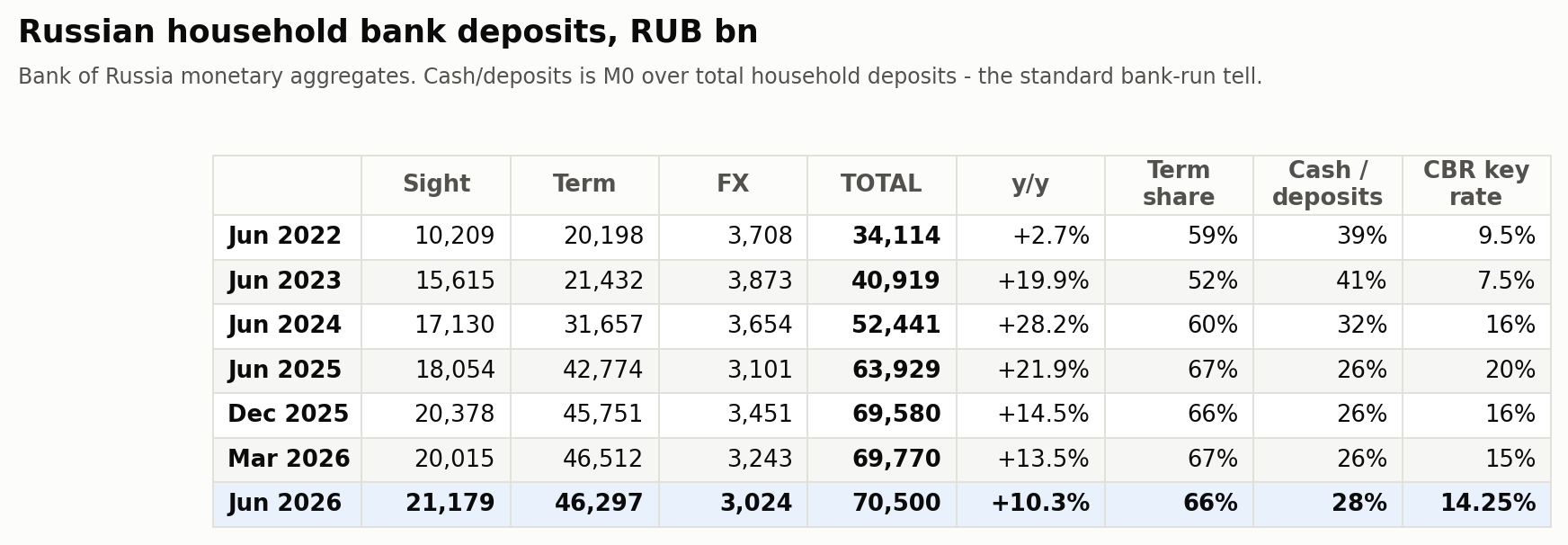
Household deposits by type, with the two ratios that would move first in a genuine confiscation scare. Source: Bank of Russia.
A deposit panic has a signature, and Russia has a control case for it: February and March 2022, following the invasion of Ukraine, the freezing of the central bank's reserves and the collapse of the ruble produced a genuine run.
In that episode two things happened at once. Households moved out of term deposits into instant-access accounts, so they could get at the money - the term share of household deposits fell from 59% to 52% over the following year. And cash flooded out of the banking system leaving banks for the banka, a glass jar used to make pickles where people traditionally keep money stashed under the mattress: the ratio of cash in circulation to household deposits stood at 40.4% in February and March 2022, and 41% a year later.
Neither is happening now. The cash-to-deposits ratio in June 2026 was 28.1%, close to the lowest reading in the series and 12 points below the panic level. The term share was 66%, against 52% in mid-2023 - Russian households have their money locked up for longer than at any point since the war began, which is the precise opposite of positioning to run.
Nor do the monthly movements show an exit. In the 24 months to June 2026 household deposits fell in four: January 2025 (-0.9%), November 2025 (-0.1%), January 2026 (-1.7%) and May 2026 (-0.9%). Three of the four are January or the month after a December spike, and December is reliably the biggest inflow of the year - up 5.7% in December 2025 and 6.7% in December 2024 - as annual bonuses land. January's fall ranks eighth among monthly declines since 2015, and six of the ten largest falls in that period are Januaries.
De-dollarisation
One number in the release does fall, and it is the likeliest source of the confusion. Foreign-currency deposits dropped from RUB3,451bn ($40.5bn) in December to RUB3,024bn ($35.5bn) in June, down 12.4% in six months. That is a real trend, but it is a de-dollarisation, not a bank run, which has been running since 2022: FX now accounts for 4.3% of household deposits. Ruble deposits absorbed the shift several times over.
On what that foreign currency situation is now, we don’t know as the CBR has stopped reporting those numbers. Its deposit statistics are published for rubles, US dollars and euros only. There is no yuan line for household deposits which is significant following the yuanization of the Russian economy after the US weaponised the dollar in 2022; the CBR publishes a yuan breakdown for corporate lending but not for what households hold. The household balance sheet carries a single “Currency” asset line, RUB24.7 trillion ($290.0bn) as of 1 April 2026, with no split by currency at all.
What can be seen is that both published foreign currencies are being run down, and that the remaining dollar and euro balances are now unusually short-dated - by June only 39.9% of new dollar deposits and 26.5% of new euro deposits were being placed for a year or less, against 96.2% for rubles. The ruble book is the short-dated one because savers are chasing the rate and rolling over; what is left in hard currency is a residue, not an active market. The yuan shift that Russian banks have been marketing since 2022 is real, but it is not measurable from the official household series.
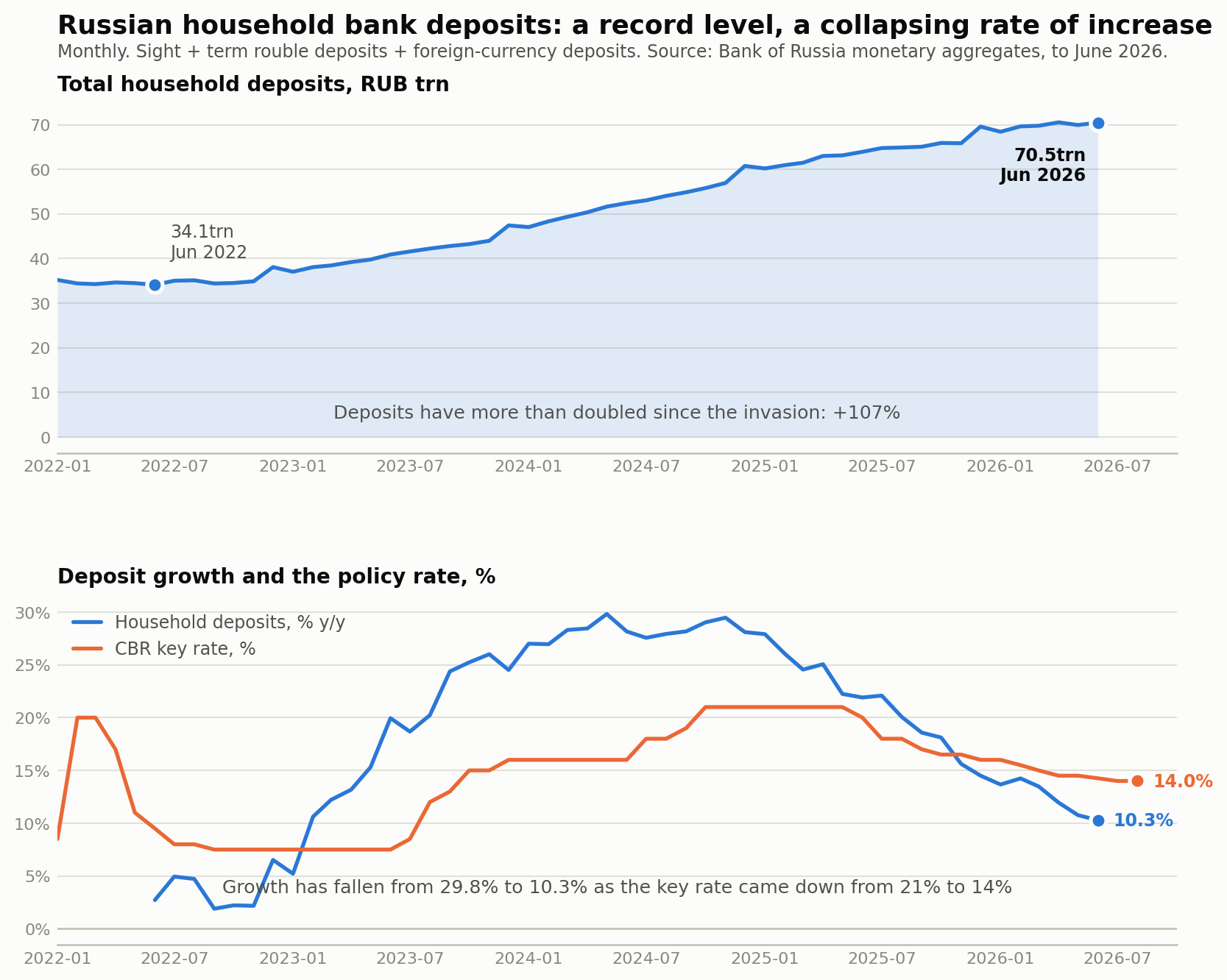
The level is at a record; the growth rate has fallen by two thirds and tracks the policy rate down. Source: Bank of Russia.
The confiscation rumour has been around for a while. It first surfaced in late 2024, when talk spread online that the central bank might mobilise retail deposits into bonds to finance the budget deficit. The CBR called the idea of freezing deposits “absurd”. In August 2025 deputy governor Alexei Zabotkin ruled out any restriction on withdrawals, warning such a step would have “destructive consequences” for the financial system. In May 2026 Finance Minister Anton Siluanov called the reports “fake leaks” and said flatly that “such proposals are not being considered”.
Sovcombank (MOEX: SVCB) first deputy chairman Sergei Khotimsky offered the most interesting explanation of where it came from: he claimed the rumours were pushed by property developers and estate agents trying to drive household savings out of deposits and into flats. Whether or not that is right, the rumour is at least two years old, has been denied at ministerial level, and has left no trace in the deposit data across either denial.
There is also a real story from early August that reads like the one being described, if you do not look closely. Russian retail mutual funds recorded a net outflow of about RUB4.5bn ($55.2mn) in July, their first monthly outflow since February 2025, and bond funds saw a record RUB88bn ($1.0bn) withdrawal. But most of that money went into money market funds, whose net inflows nearly doubled to RUB83bn ($975mn). It was a rotation between fund types after the CBR cut rates more cautiously than the market expected, not money leaving the system - and retail funds still took in RUB770bn ($9.0bn) over the first half of the year.
The one genuinely awkward fact for a straightforward debunk is demand for cash it is at a record high – which is where the Telegraph’s over simplified headlines comes from. Cash in circulation rose by RUB643.4bn ($7.6bn) in July, 43% more than in June, and by RUB2.16 trillion ($25.4bn) over January to July - against a fall of RUB603.9bn ($7.1bn) in the same period of 2025. Russians now hold roughly RUB21.9 trillion ($257.1bn) in cash, and by the end of July the increase had already reached the top of the CBR's own RUB1.5-2.1 trillion ($17.6bn-24.7bn) forecast range for the whole year.
If deposits were flat and cash were surging, that would be a story about fear. Deposits are not flat. And the central bank has given specific, checkable reasons for the cash: VAT rose from 20% to 22% at the start of the year and a 22% VAT was applied to bank acquiring, pushing businesses towards cash; mobile internet disruptions in the spring broke card payments, which is why April's increase was the largest since December 2025.
Sberbank (MOEX: SBER) chief financial officer Taras Skvortsov put the rest of it plainly: envelope wages are growing with it. The share of cash-in-hand payments at small businesses has risen to roughly 20-25% of total volumes from 10-15%, and among sole traders from 10-15% to 40%, as struggling small businesses try and reduce their tax bill – a reaction to the VAT hike in January.
Skvortsov said the bank had seen demand for cash this high only during the acute phase of the pandemic in March 2020. Zabotkin's view is that the rise is not unprecedented and matches the pattern of early 2023. It is a story about tax, the shadow economy and payment infrastructure - not about people emptying accounts.
Why are deposit rates slowing?
Which leaves the question the deposit data actually raises. If nobody is fleeing the banking sector, why has growth fallen from 29.8% a year to 10.3% in two years?
Two things are happening, and the second is bigger than the first.
The first is that the wartime income surge is fading. Russian real disposable incomes spent a decade going nowhere - by early 2024 they were only 7.6% above 2018 and still below their 2013 peak - and fell 1.0% in 2022 after the invasion. Then the war economy inverted it. Labour shortages from mobilisation, recruitment and emigration, plus a flood of military procurement into the regions, pushed wages up hard. As IntelliNews reported, Russia’s poorest regions have been the biggest winners from the war.
That impulse is now decelerating. Nominal wage growth ran at 13.3% y/y across the first five months of 2026 and real wage growth at 7.2%, according to Rosstat; by May nominal growth had slowed to 10.1% and real growth to 4.5%. Unemployment has ticked up from 2.1% to 2.2%. The wider economy has stalled: GDP grew 4.1% in 2023 and 4.3% in 2024, then 1% in 2025, and just 0.3% in the first half of 2026, with a quarterly contraction in the first quarter in real terms. Incomes are still growing, but the extraordinary war-windfalls that people were banking are gone.
The second reason is arithmetic, and it is the one that does most of the work. Deposit balances grow when households add money and when banks credit interest. For two years the interest was enormous. The CBR's key rate went from 7.5% in mid-2023 to a peak of 21% held from October 2024 to May 2025. At those rates, a term deposit book grows sharply without a single ruble of new saving.
Strip the interest out and the picture changes completely. And in the last year, Nabiullina has put through 700bp of rate cuts. As for most of the last three decades, high interest rates paid on bank deposits has been the go-to store of wealth for the bulk of the population and confidence in the banking sector is very high thanks to an efficient deposit insurance system that has been tested many times: regular Russians are extremely sensitive to interest rate changes.
Take the term deposit balance at the start of each year to June and credit it at a conservative three points below the average key rate over that year. On that basis the money households added beyond their own interest was about RUB5.9 trillion ($69.3bn) in the year to June 2023, RUB9.0 trillion ($105.7bn) to June 2024 and RUB6.0 trillion ($70.5bn) to June 2025 - and roughly RUB1.0 trillion ($11.7bn) in the year to June 2026.
New saving has fallen close to 90% from its peak. Almost all of this year's RUB6.6 trillion ($77.5bn) increase in deposits is the banking system paying interest to itself.
The key rate is now 14%, cut seven points from the peak, and both the interest credited and the incentive to park money fall with it.
CBR governor Elvira Nabiullina has described the same shift in the central bank's own terms, saying saving activity had weakened but that its structure had also changed, with households reducing the share held in bank deposits and putting more into financial market instruments and property. That is rotation, and it fits the mutual fund flows exactly.
Households are also simply spending more of it. Retail trade rose 7.3% y/y in June and 5.4% across the first half, and consumption has been the main thing holding the economy up – and why GDP growth went back into the black in 2Q26 – while construction and extraction contract. The clearest single indicator is the share of Russians who say they would rather save spare money than spend it on a major purchase: it fell 6.5 percentage points in a month to 47.9% in July, the lowest reading since March 2015, according to the inFOM survey.
The mood behind that is not comfortable. Consumer sentiment dropped 8.3 points to 89.5 in July on the inFOM survey the CBR uses, one-year inflation expectations rose to 14.7% and observed inflation to 15.1%. People spending rather than saving at 15% expected inflation are not making a confident bet on the future; they are buying now because they expect prices to be higher later. That is a real vulnerability in the Russian economy, and it has nothing to do with confiscation.
The useful version of this story is therefore neither the alarming one nor the reassuring one. Russian households have accumulated RUB70.5 trillion ($827.8bn), the largest domestic savings pool in the country's history and one the state has good reason to keep untouched. But the engine that built it - punitive interest rates on top of a war-driven jump in incomes - has been switched off at both ends. The level will keep setting records for a while on interest alone. The flow has already stopped.
What to watch is not the queue outside the bank. It is what happens to bank funding costs and to consumption when a savings pool this size stops growing in real terms, in an economy running at 0.3%.
The IntelliNews PRO service includes access to reports, exclusive market data, and more news that decision-makers care about. Stay ahead of the market with IntelliNews PRO.
Sign Up Now


