


Kremlin think tank warns Putin Russia faces 1.6% growth without reform
3 hours ago
Central bankers do not usually forecast the weather. The European Central Bank's chief economist has just put one into his. The Climate Crisis has gone beyond a fringe obsession of hippie tree-hugers and entered the studies of central bankers, who have been forced to sit up and take notice of the unfolding disater.
Philip Lane said euro-area inflation would sit near 3% for the rest of 2026, well above the 2% target, for as long as the Iran war lasts. "Hovering around this 3% level is probably what people are looking at for the rest of this year," he told RTE's Morning Ireland on August 18. "But that very much depends on whether there is a resolution to the crisis. So it's really an uncertain situation." He put the number in perspective himself: "It is not like the 10% we had in 2022, but 3% is still well above the 2% target that we have."
Then he named next year's driver, and dated it. "Food inflation is going to be one of the drivers of inflation over next year," Lane said. "These weather events, like El Nino, predictably will lead to more pressure on inflation... this is something that in summer 2027 will be most visible."
Two shocks, arriving in sequence, with almost nothing in common except that neither responds to interest rates. The first is a war in the Gulf that Europe imports through its energy bill. The second is the super El Niño, a Pacific sea-surface anomaly, that Europe will import through its food bill. A central bank can lean against the second-round effects of either; it cannot do anything about the cause of either, and it is being asked to hold a credible 2% target through both.
The war in the price index
Euro-area inflation picked up to 2.9% in July from 2.8% in June, moving away from the target rather than towards it, on Eurostat's flash estimate. Energy ran at 10.0% year on year in July, up from 8.5% in June. Services were at 3.3%, non-energy industrial goods 0.9%, and food, alcohol and tobacco just 1.2% - down from 1.5%. Core inflation, stripping out energy and food, edged up to 2.5% from 2.4%.
So, the food component is currently the quiet one, but it the variable that is going to do the most damage going forward. And that is the part Lane expects to change the most.
Renewed US-Iran hostilities have kept oil and gas costs elevated, and the mechanism by which a Gulf conflict becomes a European price problem runs through the chokepoints. IntelliNews argued in March that an Iran war inflation shock was coming. As long as the chokepoints stay contested the shock is a level rather than a spike, which is exactly the shape of shock that seeps into wage bargaining and becomes a last inflationary pressure.
So far the economy has taken it better than expected. Euro-area GDP grew 0.4% in the second quarter, faster than forecast, which Lane described as "not too bad".
Dry ground
The food shock does not need to wait for El Nino to reach Europe. It is already visible in the soil.
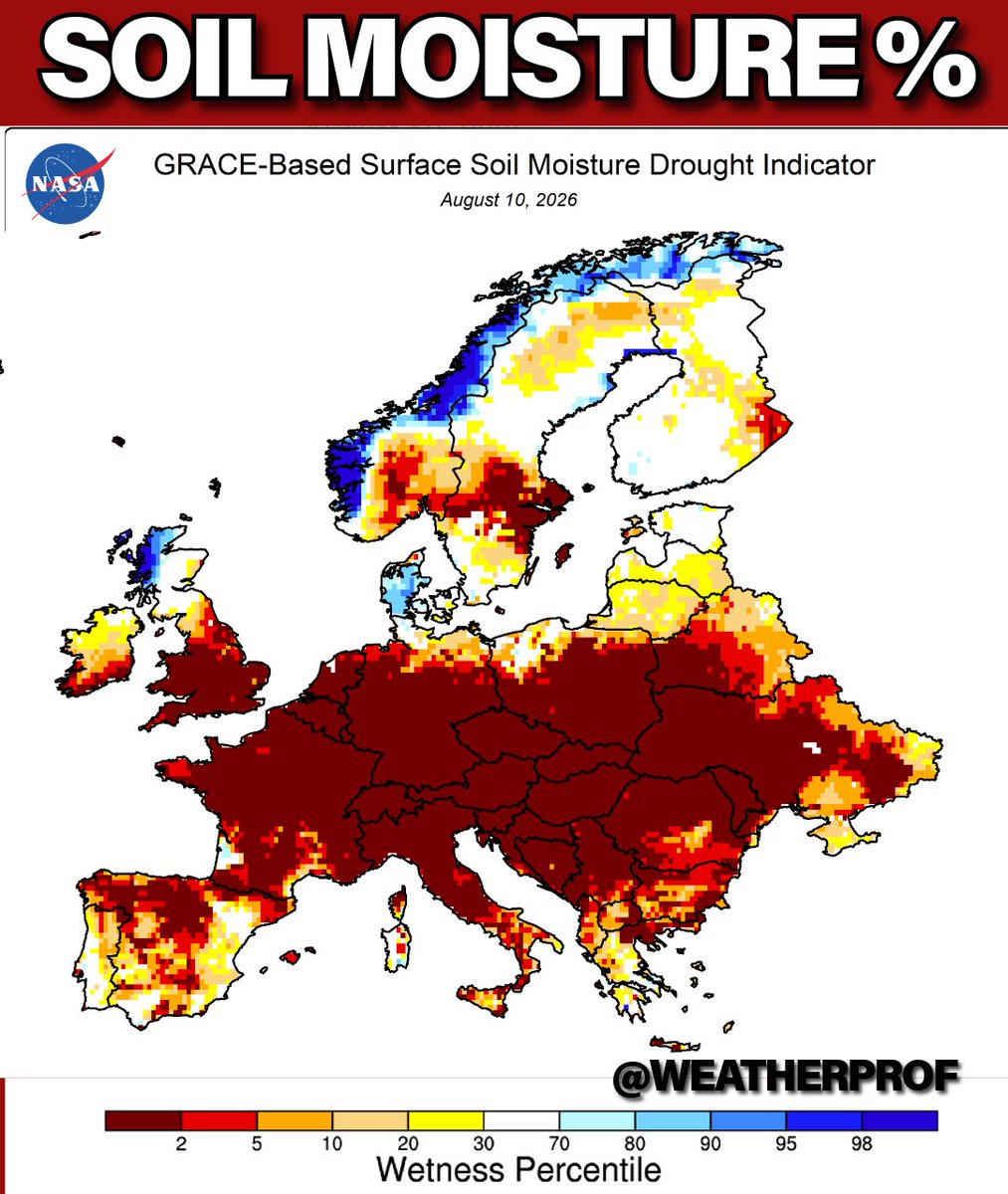
NASA's GRACE-based surface soil moisture drought indicator for Europe, August 10, 2026. Dark red marks the driest 2% of the historical record. Source: NASA GRACE, via @WeatherProf.
NASA's GRACE satellites measure the mass of water held in the ground. Their reading for August 10 puts almost all of continental Europe - France, Germany, Poland, the Low Countries, Italy, the Balkans, Ukraine's south and most of Iberia - in the bottom decile of the historical record, and a large share of it in the driest 2%. Only Norway, Finland and pockets of the Baltic and Ireland sit on the wet side of the scale.
A dry August damages this year's maize and sunflower and drains the reservoirs and rivers that irrigation, hydropower and barge freight depend on. That is already happening with the Danube and Rhine at historically low levels, following the most historically sever heatwave ever recorded in June. The consequences show up in food prices with a lag of two or three quarters, which is roughly the window Lane is talking about.
El Niño then lands on top of a system that has already used up its slack. And the input costs are exposed from the other direction too: the war's fertiliser shock has been feeding into the cost of growing anything since the spring, because gas is the feedstock for nitrogen fertiliser and the Gulf is where a great deal of it is made. Sanctions on Russia, also a major producer of Europe’s fertilizer supply, have only made things worse.
What the Pacific is doing
The event Lane is pricing in is real and it is unusually well forecast. The US National Oceanic and Atmospheric Administration has an El Niño Advisory in effect, with the Nino3.4 region running 1.4°C above average in July and a greater than 90% chance of a very strong event through the northern hemisphere autumn and winter.
NOAA puts the probability of a historic event - a three-month average above 2.5°C in October-December - at 69%. Carbon Brief's analysis of 14 modelling groups finds 96% of runs predicting this will be the strongest El Niño in the modern observational record, beating the 2.75°C peak of 2015-16.
El Niño's effect on Europe is weaker and less reliable than its effect on the tropics. Its effect on the crops Europe imports - South American soy and maize, west African cocoa, south-east Asian palm oil and rice, Indian sugar - is neither.
The bill lands first in emerging markets
For most emerging markets the sequencing is worse than it is for the euro area, because food is a far larger share of the consumer basket and there is no comfortable core measure to point at.
UBS warned in July that a strong El Nino threatens Latin American inflation and the rate-cutting cycles that several of the region's central banks have been counting on. The same logic applies from Manila to Lagos: a food shock in an economy where food is 30-40% of the basket is a headline inflation shock, and headline is what sets expectations.
The pattern from previous strong events is drought across south-east Asia and southern Africa, weak Indian monsoon rains, flooding in east Africa and southern South America, and a quieter Atlantic hurricane season. Each of those has a price attached, and the annual disaster season is already running hotter than the historical baseline before the Pacific adds to it.
September is the decision
Lane's were the first remarks from a senior ECB official since the July meeting, when the governing council held rates and most of it went on holiday. The deposit rate has been at 2.25% since a quarter-point increase on June 11, investors expect at least one more move by year-end, and the September projection round is where the argument gets settled.
He would not be drawn on the timing. "With the uncertainty, what we're committed to is essentially not trying to spend time talking about what future rate increases might happen," he said. "Right now the European economy is doing okay-ish. Let's see the impact of the war later this year." On the cost to mortgage holders of tighter policy, he said the bank had to prioritise stopping inflation staying "too high for too long".
The uncomfortable part is that both of the drivers he has identified are supply shocks, and the textbook answer to a supply shock is to look through it. The ECB looked through one in 2021 and spent two years catching up. Lane's language suggests the committee has decided it will not make the same call twice, even though the thing it would be tightening into is a drought and a war.
President Christine Lagarde speaks on the global economy at the World Economic Forum's Geneva headquarters this week.
The IntelliNews PRO service includes access to reports, exclusive market data, and more news that decision-makers care about. Stay ahead of the market with IntelliNews PRO.
Sign Up Now


