


The Global North's missile crisis
1 hour ago
Six years ago on August 9 2020, Belarusians went to the polls in a presidential election that Alexander Lukashenko rigged so brazenly — awarding himself over 80% of the vote against a political novice, former English teacher Svetlana Tikhanovskaya (Sviatlana Tsikhanouskaya) — that it triggered the largest protests the country had ever seen.
Six years on, the protests have been crushed, the opposition scattered into exile, and Lukashenko is not only still in power but trading political prisoners for sanctions relief from Donald Trump's Washington while Belarus remains bound tighter than ever to Vladimir Putin's war on Ukraine.
“Six years ago, Belarusians voted Lukashenka out. He stole the election, crushed protests, and Putin kept him in power — at the price of our sovereignty,” presidential adviser-in-exile Franak Viacorka wrote on X on the anniversary on August 9. “Today our fight is for freedom AND independence. A free Belarus means a weaker Russia and a safer Europe.”
Tikhanovskaya herself, marking the anniversary from exile, struck a similar note: “Democracy begins with people having a voice in their own communities and in the future of their country. That voice was attacked in Belarus six years ago, but it was never erased.”
The stolen election
Tikhanovskaya only ran because her husband, popular blogger Sergei Tikhanovsky, was arrested before he could register his own candidacy. Running in his place, she unexpectedly became the focal point for a country exhausted by 26 years of Lukashenko's rule.
In a major political blunder. Lukashenko dismissing her candidacy glibly as “that housewife.” But at meeting after meeting across the country Tikhanovskaya set the crowds on fire with a Mandela-esque stature of humility and sincerity. Amongst her policies was a promise to immediately resign her office if she became president and call “real” elections after releasing the some-1,300 political prisoners Lukashenko has locked up.
And she won by a landslide according to independent counts and leaked “rebel” precinct data counts. The official result — over 80% for Lukashenko — was so implausible that it was rejected even by many of his own supporters.
Within hours of the polls closing, footage circulated of Tikhanovskaya recording a video message inside the office of Central Election Commission chief Lidia Yermoshina urging Belarusians to respect the official results and end the protests — a statement she later said was made under duress, with her children used as leverage. Within days she had fled with her children to Vilnius, Lithuania, the first of what would become a mass exodus of the opposition into exile.
Mass protests and a brutal crackdown
What followed was the biggest and most sustained protest movement in Belarusian history. On August 16, 2020, at least 100,000 people — by some counts over 200,000 — packed central Minsk, dwarfing a rival pro-government rally the regime had bussed factory workers in to attend. These pro-democracy rallies were bigger than those in 1991 during the collapse of the Soviet Union.
Unlike the armed uprisings and tribal power struggles that have periodically toppled governments elsewhere in the former Soviet Union — Kyrgyzstan's repeated revolutions being the clearest contrast, driven by a north-south elite power struggle rather than genuine democratic demand — the Belarusian protests were overwhelmingly peaceful, leaderless and cut across class lines. Tikhanovskaya was out of the country, but control of the tens of thousands on the street became an amorphous “revolution by committee” as information flowed over the Telegram channel Nexta allowing the crowds to respond to and avoid clashing with the security forces, Nexta’s leadership told IntelliNews at the time. The demonstrations became a living headless organism that defied Lukashenko every effort to crush the protests.
The most vivid image of that peacefulness was the weekly “Banshees of Belarus” all-women marches, thousands of shrieking women dressed in white linking arms to shield men from riot police, a tactic the security forces struggled to counter with their usual violence.
The movement's most enduring symbol, though, was a 78-year-old retired geologist, Nina Bahinskaya, who had been walking the streets of Minsk with the banned white-red-white opposition flag since the late Soviet era; when police confronted her in 2020 and accused her of an unauthorised demonstration, her curt reply — “I'm taking a walk” (Я гуляю) — became a rallying cry repeated at protests across the country. She was still being hit with new criminal charges for it as recently as last year and has been lumbered with impossibly large fines she cannot hope to pay out of her tiny state pension.
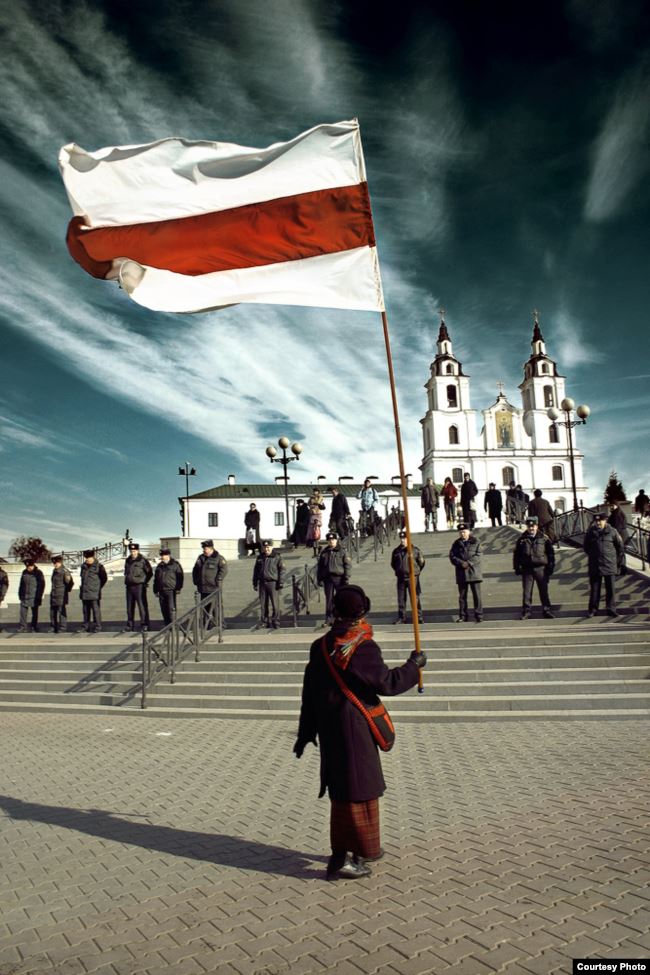
In one famous occasion, she was detained by an OMON riot police officer, literally twice her size. After leaping up to try and pull his mask off, and failing, she resorted to viciously kicking him in the shins until his colleagues had to drag her off. In another occasion, after she had been detained and finally released at dusk, a sheepish security officer came up to her and returned her red and white flag, with which she is never without. “Here, I know how important this is to you,” he said, underscoring the universal respect in which she is held by all Belarusians, including some in the security forces.
The regime's answer to peaceful protest was brutal repression: tens of thousands detained, many beaten, raped and tortured in overcrowded detention centres in the crackdown's first days alone. A few were died of their injuries, and hundreds of thousands of Belarusians ultimately fled the country. Roughly 100 Belarusians have since gone on to fight and die for Ukraine against Russia, according to Visegrad 24 — a measure of how directly the crushed 2020 revolution fed into today's war.
Lukashenko's "Ceausescu moment"
The turning point that came closest to actually unseating Lukashenko, a former collective farm boss, on August 17, 2020, when Lukashenko personally addressed workers at the MZKT truck factory in Minsk — traditionally a bastion of regime support — and was heckled to his face with chants of “get out.” He left looking visibly shaken, in a moment pundits immediately dubbed his “Ceausescu moment” — an echo of the Romanian dictator's fatal on-camera loss of control over a crowd in 1989. A general strike wave followed, spreading through state-owned enterprises that collectively accounted for more than a quarter of Belarusian GDP, and for a few days it looked like the workers who had always underpinned Lukashenko's rule might bring it down.
It never reached critical mass. Strike organisers were arrested, workers were threatened with dismissal and blacklisting, and — decisively — Putin stepped in on August 27, 2020 with a public offer to send a Russian “special military unit” to quell the unrest “if necessary” – the key phrase that turned the tide of the protests.
Backed by that guarantee, Lukashenko regained his nerve, doubled down on repression rather than negotiating a transition, and the strike movement collapsed within weeks. The price of that rescue was Belarus's independence in all but name: from that point on, Lukashenko owed his survival to the Kremlin, a debt he is still paying down in Russian soldiers' staging grounds and drone-guidance relay stations today.
A dictator entrenched, an opposition adrift
Lukashenko was duly inaugurated for a sixth term in 2020 and, despite a Western-led non-recognition campaign, sailed to a seventh in a January 2025 election dismissed by observers as a foregone conclusion, with most credible rivals dead, imprisoned or in exile. Since Russia's full-scale invasion of Ukraine in 2022, Belarus has hosted Russian troops, missiles and — this year — has been accused by Kyiv of allowing its territory to be used to relay signals guiding Russian drone and missile strikes into northern Ukraine.
That last point brought a striking shift in Kyiv's posture this summer: President Volodymyr Zelenskiy publicly warned Belarus on June 19 that it had one week to dismantle the relay equipment “or we will do it ourselves” — an overt threat to strike Belarusian territory, including its two cash cow oil refineries, that marked a break from four years of Kyiv treating Minsk as an unwilling accomplice rather than an active belligerent. Lukashenko switched the relays off, then was summoned to an unscheduled two-day meeting with Putin at Valdai, from which no readout was issued.
Meanwhile the opposition in exile has fractured over strategy. Maria Kolesnikova, freed after five years in jail as part of a prisoner-release deal, has argued Brussels should now engage Lukashenko directly given his openness to “humanitarian steps” in exchange for eased sanctions; Tikhanovskaya has pushed back publicly, insisting sanctions and isolation are still working and that “Lukashenko is ready to release his biggest enemies just to get rid of sanctions.”
Lukashenko's Trump card
What has actually moved the needle on sanctions is not Brussels but Washington. Since mid-2025 Lukashenko has run a charm offensive on Donald Trump, trading political prisoners for sanctions relief in instalments — the same transactional playbook, one Belarusian analyst noted, that he has long used on Putin, “identifying the senior partner's soft spots and then massaging them with flattery.” Trump has called Lukashenko “a highly respected president” and “a great leader” on Truth Social in the process.
The releases have been substantial: 123 prisoners freed in December 2025 in exchange for Washington lifting sanctions on Belaruskali, the state potash producer that is Lukashenko's single biggest source of foreign currency (potash accounted for 20% of the global market and $2.5bn in export revenue, or 4% of GDP, before 2021 sanctions hit); a further 250 freed in March 2026 as the US eased sanctions on two state banks, the finance ministry and the national carrier Belavia; and by early August 2026 more than 450 political prisoners had been released in total, with Belarus publicly confirming it was moving to implement a fresh set of US proposals.
Among those freed was Sergei Tikhanovsky himself — Tikhanovskaya's husband, whose arrest in 2020 was what put her on the ballot in the first place — released last summer after a visit to Minsk by a US envoy. Prominent former presidential candidate Viktor Babariko, protest leader Maria Kolesnikova, Nobel laureate Ales Bialiatski and Tut.by editor Maryna Zolatava were among the others freed in the December 2025 batch, most of them deported directly to Ukraine or Lithuania on release.
Six years after the stolen election that was meant to end his rule, Lukashenko has instead converted Belarus's political prisoners into his most valuable bargaining chip with Washington even as he keeps the country locked into Russia's war machine — a dictator entrenched by the very crisis that should have removed him, running down a clock that a scattered and now divided opposition-in-exile has no obvious way to stop.
The IntelliNews PRO service includes access to reports, exclusive market data, and more news that decision-makers care about. Stay ahead of the market with IntelliNews PRO.
Sign Up Now


