


Guyana's oil boom has lifted it past the US on GDP per capita
3 hours ago
Russian public confidence in the economy has collapsed to its lowest level in at least two decades, according to a new Gallup survey, suggesting the economic resilience that underpinned the Kremlin's wartime strategy may be beginning to fray as the conflict in Ukraine enters its fifth year.
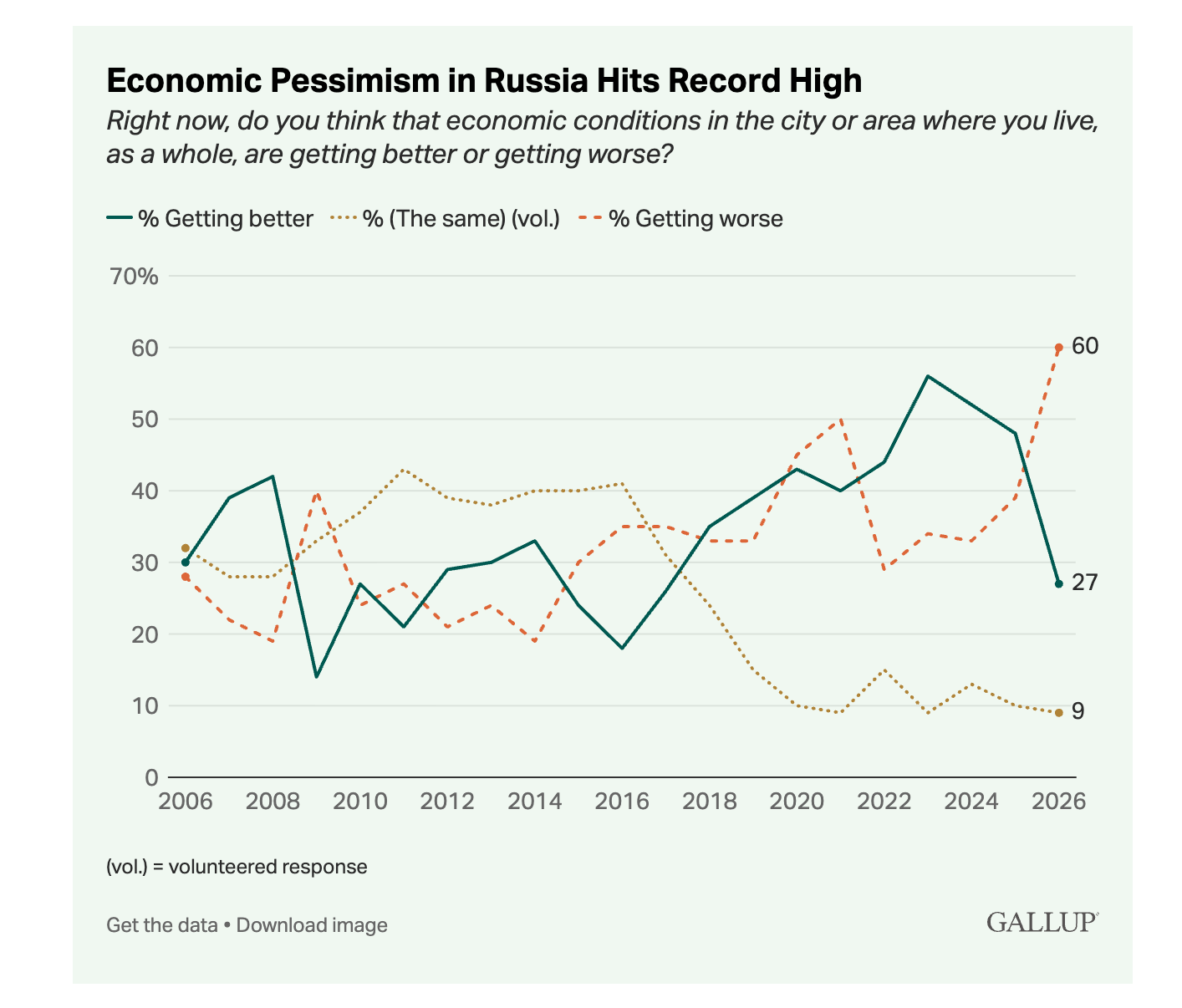
The poll found that 60% of Russians now believe economic conditions in their local area are deteriorating, the highest proportion since Gallup began tracking the measure in 2006. Only 27% believe conditions are improving, marking a dramatic reversal from the early years of the war when buoyant government spending and record labour shortages fuelled optimism despite sweeping Western sanctions.
The findings adds to pressure on Russian President Vladimir Putin, who is facing a muted rebellion in the ranks of the elite between the doves and the hawks, both of which want to end the hostilities, but have very different proposals of how to do that. The collapse of confidence is also a function of the deteriorating state of the economy, which has been split in half: the military industrial complex is flourishing, while the civil sector is stagnating. The official growth outlook for this year has been cut from 1.3% to a mere 0.4% as strong inflation, sky high interest rates and falling oil prices weigh on budget revenues and spending.
While unemployment remains close to record lows and defence factories continue operating at full capacity, civilian sectors are increasingly struggling under the weight of labour shortages and the poor health of the economy. Nevertheless, the economy soldiers: S&P Global reported on July 2 that Russia’s manufacturing PMI moved back above the no-change 50 points benchmark in June and expanded for the first time this year on the back of a mild recovery in demand.
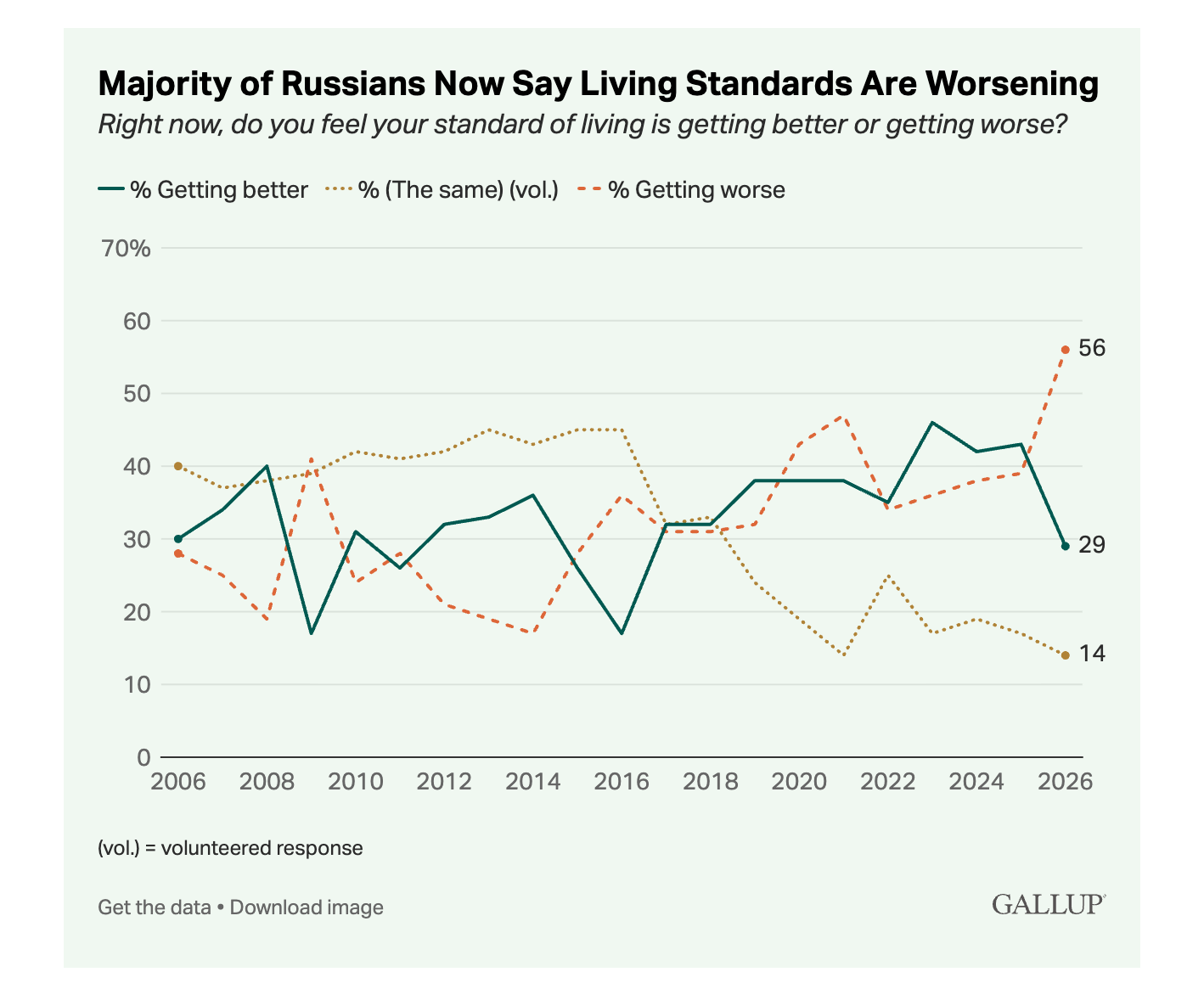
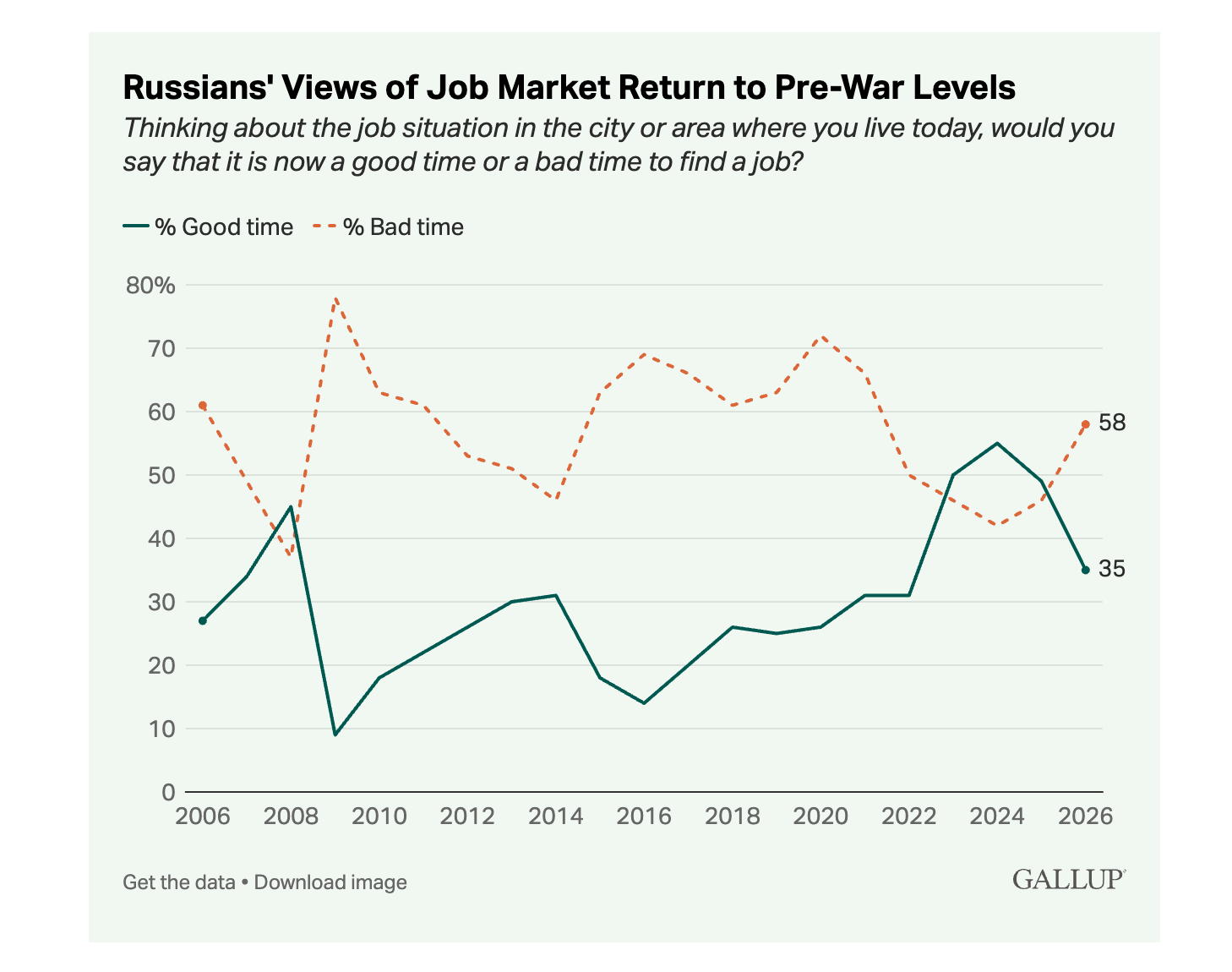
Gallup also found that 56% of Russians believe their own standard of living is worsening, the first time in two decades that a majority has expressed such pessimism. At the same time, perceptions of the labour market have deteriorated sharply. Just 35% now say it is a good time to find a job where they live, down from an average of 51% during the previous two years, while 58% now describe the job market as poor.
The survey suggests that Russians increasingly recognise the difference between an economy sustained by unprecedented military expenditure and one generating genuine improvements in household prosperity.
"The longer the war grinds on, the more it may test people's patience with the conflict and the sacrifices it demands," Gallup concluded.
The deterioration comes as Russia's macroeconomic outlook has become noticeably weaker.
Weak economy
Earlier this year the government cut its 2026 growth forecast from 1.3% to just 0.4%, acknowledging that the rapid expansion fuelled by defence spending is beginning to fade. Russia’s small- and medium-sized enterprises (SMEs) have been particularly exposed and are deteriorating rapidly.
Even the temporary boost from higher oil prices following the conflict between Israel and Iran has done little to change the broader trajectory, while the Central Bank of Russia has repeatedly warned that the economy is overheating after years of exceptionally tight labour markets. The windfall effects of oil prices over $100 caused by the war have already worn off as oil prices fall back to pre-war levels of around $75 per barrel so that the impact on the Russian budget will be small and short lived.
The country's labour shortage has become one of the defining characteristics of the wartime economy, with military recruitment and defence production competing directly with civilian employers for workers. The result has been rapid wage growth in strategic sectors but mounting difficulties for manufacturers, retailers and service industries trying to recruit staff.
Gallup's findings suggest that Russians increasingly view these shortages as a symptom of economic strain rather than strength.
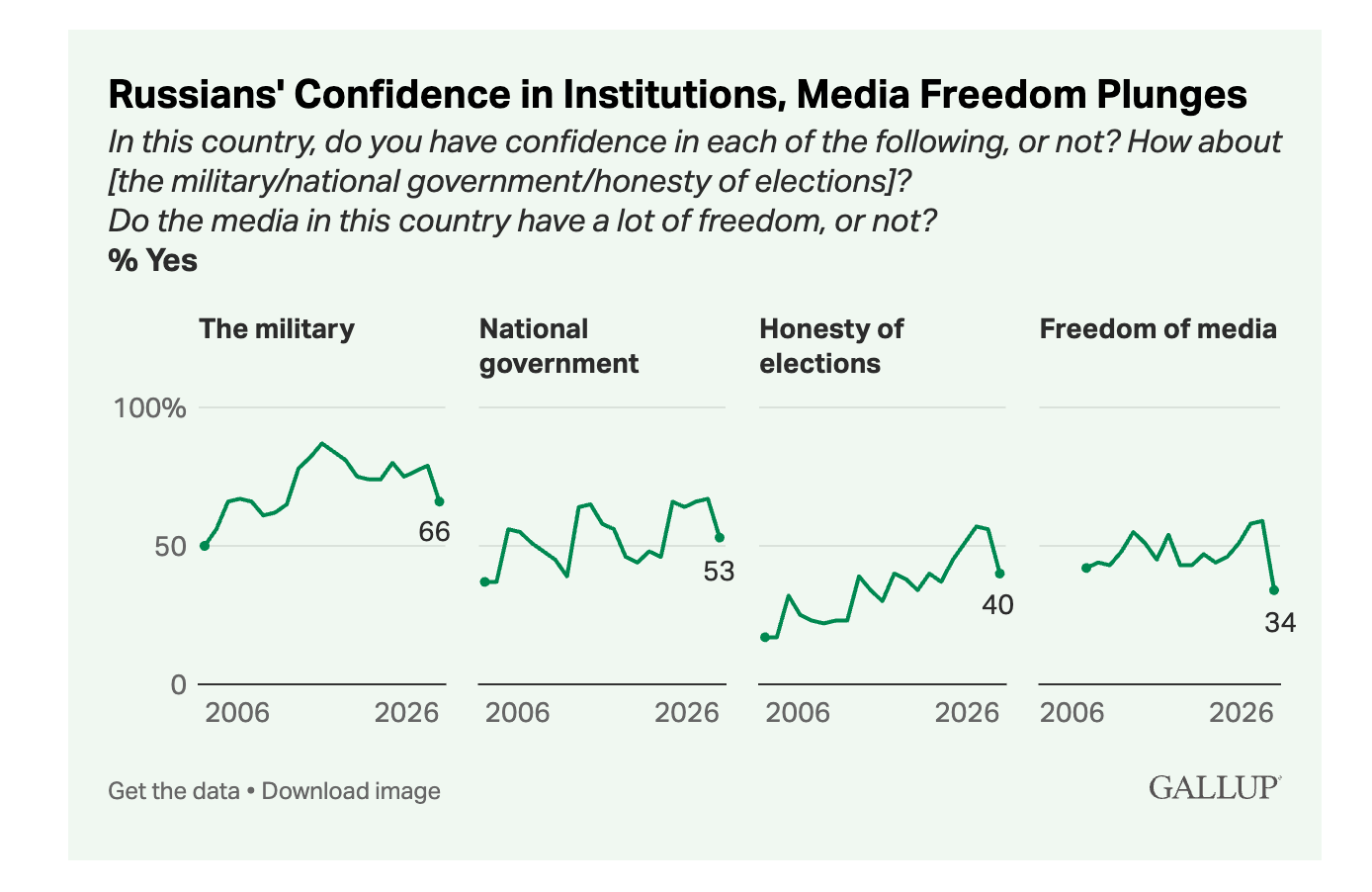
The survey also recorded the sharpest annual decline in confidence in key state institutions since the series began.
Confidence in the military fell 13 percentage points to 66%, confidence in the national government dropped 14 points to 53%, while confidence in the honesty of elections declined 16 points to 40%. Perceptions of media freedom suffered an even steeper fall, dropping 25 percentage points from 59% to a record low of 34%.
The poll was conducted between March and May, before Ukraine intensified its campaign against Russia's domestic fuel infrastructure. Ukrainian long-range drone attacks have increasingly targeted refineries, storage depots and logistics hubs across Russia, contributing to fuel shortages in several regions, particularly in occupied Crimea.
Timothy Ash, the senior sovereign strategist at BlueBay Asset Management in London, argues that the deterioration in public sentiment may therefore only be beginning.
"After 4.5 years of a war, or 'special military operation' which was meant to be over in weeks, the war seems to be finally coming home to Russians," he wrote in a recent commentary.
Ash argues that several factors are likely to reinforce the negative trend.
The temporary rise in oil prices triggered by the conflict in the Gulf has already begun to unwind, while US sanctions relief briefly granted to allow Russian producers to continue exports has expired. As benchmark oil prices retreat towards the $70 per barrel range, he expects Russia's Urals crude to resume trading at discounts of around 30%, potentially pushing realised prices back into the $50 per barrel range or lower.
Longer term, Ash sees even greater pressure building. He argues that higher production from countries such as the United Arab Emirates, combined with weaker global demand following the Iran conflict, could leave Brent crude closer to $60 per barrel over the next year, implying Urals prices could fall below $46, levels already associated with recessionary conditions in Russia earlier this year.
Perhaps more importantly, Ash believes the recent resilience of global oil markets has altered the sanctions calculus.
"The Iran war has shown that the West has much more leverage over Russia than it has perhaps dared to assume," he wrote.
"If the West, and even China, wants to bring this war to an end they should cut off Russian energy exports."
According to Ash, eliminating Russia's remaining oil exports would deprive the Kremlin of around €500mn per day in revenue, potentially triggering a much deeper recession, accelerating capital flight, placing severe pressure on the banking system and forcing a sharp depreciation of the ruble.
"The wheels would literally come off Putin's war machine," he argued.
Ash also points to the growing asymmetry between Russia's economy and that of Europe. With the European Union having approved a €90bn financial package for Ukraine and additional pre-accession funding under discussion, he argues Kyiv now has the financial resources to continue expanding drone production and deep-strike capabilities for years.
"Russia's $2.5 trillion, and declining economy, just cannot compete with Europe's $25 trillion economy," Ash wrote. "Putin started an arms race with Europe that Russia simply cannot win now."
While the asymmetries between the EU economy and Russia’s are large, Russia has repeatedly surprised with the resilience of its economy to the extreme sanctions regime, which has caused as much, or more, damage to the increasingly dysfunctional European economy than to the Russian economy. At the same time the Kremlin continues to fund its war with cash, while Europe is increasingly funding its support for Ukraine with debt.
Nevertheless, Russians are becoming increasingly sceptical about the economic trajectory of the country. The patriotic rallying effect – patriotism was at an all-time high in 2022 – has evaporated, replaced by growing concerns over living standards, employment prospects and the longer-term costs of sustaining a war that the Kremlin initially expected to conclude within weeks.
The IntelliNews PRO service includes access to reports, exclusive market data, and more news that decision-makers care about. Stay ahead of the market with IntelliNews PRO.
Sign Up Now


